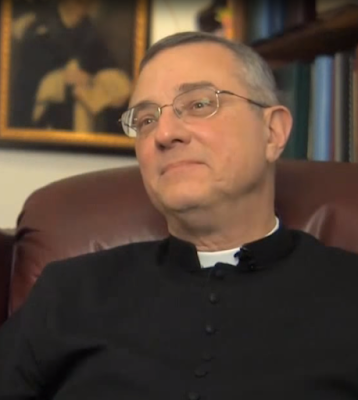
This recording of an interview between Damian Thompson and Dr Gavin Ashenden has struck me profoundly at the same time as my reading the book Alan Watts wrote way back in 1947, Behold the Spirit: A Study in the Necessity of Mystical Religion. I quote a paragraph from his introduction:
The present low ebb of Church religion consists in the fact that rarely, even for Church people, does it give the soul any knowledge of union with the reality that underlies the universe. To put it in another way, modern Church religion is little concerned with giving any consciousness of union with God. It is not mystical religion, and for that reason it is not fully and essentially religion.
The conversation in this light is extremely enlightening, contrasting the collaboration between institutional churches and secular regimes, a new form of Erastianism. One idea that emerges is the “health and safety” culture. How does a Christian community separate itself from the bureaucratic and toxic bishops and diocesan structures? The example given is the present pandemic crisis and how far should we go with prescribed precautions.
The problem is not one caused by events in the western churches over the past fifty years, but go back much further. I was struck by the fact that Watts was writing just after World War II, a period we can imagine to be a high point of recent church history. This is not a place to discuss all the implications of his thought as it colludes to some extent with that of Bonhöffer in the face of Nazi evil. Everything seems to come together from such diverse sources.
The question is the future of the institutional Church, the liturgy, bishops and priests, dedicated church buildings. I dread the idea that there will be a wasteland and Christianity will go into hiding and perhaps end up like the cults of Mithra and Isis & Osiris. My thoughts and feelings about western civilisation are deeply inspired by thinkers like Berdyaev: the night is at its darkest just before the daybreak.
New cultures do not emerge from vacuums ex nihilo. Two candidates seem to be in the breech to replace what we have known in the west: Chinese Communism on the way to re-assimilating Confucianism – and Islam. It is easy to extrapolate with paranoid speculations, but I have read some very articles about China in the light of its way of coping with the present crisis and creating a collectivist culture. If that is the new secular “normal”, then we face the need to go underground.
What would that mean? Worship services in private homes? Perhaps, but the Promised Land is within each of us, where no Thought Police could ever reach. The Lord will provide for a future which is not ours.
Be sober, be vigilant; because your adversary the devil, as a roaring lion, walketh about, seeking whom he may devour: Whom resist stedfast in the faith, knowing that the same afflictions are accomplished in your brethren that are in the world. But the God of all grace, who hath called us unto his eternal glory by Christ Jesus, after that ye have suffered a while, make you perfect, stablish, strengthen, settle you. To him be glory and dominion for ever and ever. Amen.
YouTube has an uncanny ability to monitor the kinds of subjects that are of interest to us and suggest relevant videos to watch. I have developed a prudent interest in Aldous Huxley and Alan Watts, two men of the “greatest generation” who were to an extent at the origin of the 1960’s reaction against western conservatism. The former is much better known in terms of his phenomenal output of written work, and Alan Watts is more known for his lectures and “philosophical entertainment”.
I have listened to a few, and I feel quite overpowered by the volume of words and ideas, combined with an eastern culture of which I am completely ignorant. I have Perennialist leanings myself and have great respect for the world’s spiritual traditions. I am also of the sentiment that every great spiritual inspiration can be found in Christianity too, especially in its mystical dimension. One has only to think of Meister Eckhardt and Jakob Böhme among many other saints and mystics.
Watts lived from 1915 to 1973, his life shortened by heavy smoking and alcoholism. He married three times. These facts make us recoil and seek out information about his life and sincerity in his teachings. Some Asian spiritual teachers asked how he could teach so much about their philosophy without their degree of meditation and asceticism!
Here is his criticism of conservative western Christianity.
I find much of it highly cogent as I myself cannot identify with fundamentalism and literalist Catholicism. Some of his ideas about the Genesis narrative remind me of the Irishman Dave Allen’s jokes on his show in the 1970’s, particularly about the idea of a talking snake.
Underneath, these beings and events are of allegorical and symbolic value. Genesis is a simple myth that illustrates a history of the universe and humanity that is forgotten except in the parallel myths of every religion on this earth.
Watts came from the English public school tradition, as many of did. He exaggerated the role of stoicism and corporal punishment a tad, but he was not wrong in substance. Here, he gives an enormously long lecture on Aldous Huxley:
I have since ordered a copy of Huxley’s Island, and I will see how well I can relate to its ideas. We studied Brave New World in English literature at school, and our anxiety about some aspects of modern life are deeply inspired by Huxley and Orwell. Indeed, we often encounter the slogan “Make Orwell fiction again!” as if we were already in a fully dystopian world. I do believe that as the world population increases, we will inevitably move towards a world where humans will come under the control of technology, a hell on earth – unless something happens to change that prospect.
The 1960’s came from such thought as it laboured to burst the bubble of post-Victorian conservatism. I felt its influence at first-hand, especially around 1971 when I revolted against the idea of social order being determined by convention rather than a truly philosophical notion of a higher good. One difference between my parents was that my mother would tell me to do something. “Why?” I would ask. She would answer “Because I told you so“. It was an argument of authority. My father became aware that I needed answers, so if he told me to stop reading in bed by a certain time at night, it was in order to get enough sleep, stay healthy and be able to work at school. Such an answer was more satisfying than a mere argument of authority.
Similarly, the purpose of religion is to “re-link” the human with the divine. Obedience to authority is only a means to that end, an idea that is emphasised in most monastic rules. This question of the individual person in relation to authority has became a subject of criticism in the context of Nazi and Communist totalitarianism in the twentieth century. It seemed that authoritarianism had lost its intended meaning and became a tool for control by evil people.
These lectures might be a little difficult for those of us who are brought up on “realist” philosophy and materialistic “common sense”. There seem to be hundreds of them on YouTube on all kinds of subjects. After only one or two, I feel quite swamped, but you, my reader, might relate to them differently.
I wondered if he had been some kind of narcissist. Perhaps he was given his married life and other bizarre things about him. He didn’t seem to take himself too seriously. Though he claimed to be no more than an entertainer, he had a very deep knowledge of the world’s philosophical and spiritual traditions expressed in the various religions like Buddhism and Hinduism. Whether or not we remain within our own Christian tradition or try to embrace another, he encouraged his listeners to think freely and as individual persons, hardly the attitude of a sect guru.
Like Oscar Wilde, he loved paradoxes and ideas intended to shock. One was “The biggest ego trip going is getting rid of your ego.” It was something like Wilde’s solution for temptation – giving in to it.
I do think that we can remain Christians but in a different way, and also differently from the “new orthodoxy” of the way most mainstream churches. Certainly, Christians and all others with a philosophy of life above materialism and nihilism have much to learn from this voice of challenge and contradiction. Now that he is no longer of this world, Watts can only be judged on his many constructive ideas. It is for us to read or hear his words and be critical and selective. One thing he did was to cut through the hypocrisy and claptrap of most institutional religions. His language was plain and accessible to ordinary people. We do need to remember that he was an ordained Episcopalian priest and had received classical theological training.
Many conservatives claim that the 1960’s are dead insofar as they represented a reaction against totalitarianism and the flowering of the human spirit – when the basic issues were understood rather than being imitated in their externals. Watt seems to be gaining in popularity in spite of his being dead for nearly fifty years. Rather than rejecting religions, he sought to extract their most profound truths and teach them.
I love this little quote I read on him that just about sums him up:
Alan was a pioneer, sweeping away the grey post-industrial hangover created by lingering Victorian values. He wedged open the door for the 60’s to come rolling in. He was a maverick, a rebel, he was one true voice amongst a sea of dulled mediocrity. He offered a glimpse of freedom from the woes of the Western mindset.
He hit the tobacco, alcohol and LSD quite hard. I have heard that in the right conditions, LSD can do a lot of good in the same way that hallucinogenic drugs were often used in some traditions for the initiation of shamans. To be frank, it would be wonderful to be able to have a trip under medical supervision (to make sure I didn’t jump out of the window thinking I could fly!). Many have found LSD trips to be life-changing experiences. Unfortunately, not only is it forbidden as a “recreational” substance, it is also forbidden to the medical profession. Perhaps it is too effective in helping people with mental illness! Aldous Huxley had LSD administered to him when he was about to die from cancer. None of us will ever know what that did for him in the afterlife.
I wrote in my recent book Romantic Christianity:
“The main hallucinogenic drugs in the 1960’s were LSD and “magic mushrooms” (psilocybin). The dangers of LSD are controversial, with some researchers doubting that this drug would cause permanent personality changes. In research by William H. McGlothin, all the subjects reverted to their normal selves and personalities when they were off the drug. There was no permanent damage. Dr McGlothin found that there was a change of values in those who were given a dose of LSD. Their system of values was changed from the conventions of family, corporate employment and material wealth to the desire for a contemplative style of life, broad-mindedness and creativity. The drug obviously lowered inhibitions to allow some persons to express innate feeling and talents which had been suppressed by ambient culture and conformity. Their philosophy was less dualistic and they came to believe in an essential unity to everything. They came to doubt notions of time and the ontology of evil.
It seems to me that LSD could be very useful in a properly supervised hospital context. The lives of some very unhappy people could be changed for the better. We find here a notion of the alteration of consciousness, which can also be obtained by special techniques of meditation, which are not illegal. This alteration seems to be an essential element of any “conversion” or life-changing experience. The ultimate of such experiences would be the near-death experience (when the brain was so low in activity that unconsciousness should have been total) and those who had mystical experiences.
The idea that LSD was made illegal, perhaps because it made persons who would become unpredictable and rebellious against the materialist and authoritarian order, might be the stuff of a conspiracy theory. You stop being politically correct when you take that stuff! Whether there is any truth in such an idea is anyone’s guess, but it is illegal and dangerous if used “recreationally”.”
I am of the mind that drugs should be decriminalised, removing the source of income from criminal organisations of dealers and mafias and, more particularly, teaching rather than punishing. Most “hard” drugs like heroin and methamphetamine are horrendous, and should not be taken without medical supervision or in some kind of special centre. Alcohol and tobacco are still sold freely, and addiction to both causes serious health problems. The Americans tried prohibition in the 1930’s and all it did was to provide a rich growth medium for the Mafia. It ought to be possible to have a medical prescription on medical or spiritual grounds for an LSD trip in a special clinic to ensure a correct dose and safe conditions.
We can appreciate or reject this man and his works. That is our free choice. Was he a sage or a charlatan? Now he is dead, we can judge only his words. I see the parallel with Oscar Wilde as he committed homosexual acts that were severely punished in the Victorian era. As he languished in prison faced with the prospect of dying painfully and in obscurity in a Parisian hovel, he wrote:
“People point to Reading Gaol and say, ‘That is where the artistic life leads a man.’ Well, it might lead to worse places. The more mechanical people to whom life is a shrewd speculation depending on a careful calculation of ways and means, always know where they are going, and go there. They start with the ideal desire of being the parish beadle, and in whatever sphere they are placed they succeed in being the parish beadle and no more. A man whose desire is to be something separate from himself, to be a member of Parliament, or a successful grocer, or a prominent solicitor, or a judge, or something equally tedious, invariably succeeds in being what he wants to be. That is his punishment. Those who want a mask have to wear it.”
Naturally, his use of the word “mask” was in the meaning of a false personality rather than the precaution we have presently to take against Covid-19. Wilde left England for the country where I am living. Huxley and Watts went to live in California. I don’t think they would like the place if they were alive today! The system breaks a number of us, something that gives us a sense of foreboding about that mortally boring subject of the no-deal Brexit, a country that has drunk and will drink again. Those of us on the outside wait and are ready to observe what changes will come about in the years ahead.
Scoundrels? Charlatans? Fools for Christ? L’enfer, c’est les autres! We live in a tempest of words and ideas, all meaning different things to different people. I think his essential message was – Let us be ourselves and let others think as they believe to be right. There really is nothing else to say.
I received an e-mail telling me about Hélène Nicolas, known as Babouillec, a 34 year old woman diagnosed with a severe autistic deficit and who never attended school. She has, in her own words, “never learned to read, write or speak”. She does not have access to speech, yet after twenty years of silence, she manages to write using cardboard letters on a blank page. Her books Rouge de soi and Algorithme éponyme are published by Payot et Rivages.
I have attempted a very imperfect translation of a brief text on her Facebook page Babouillec Sp.
…..”I am deeply touched to be intimately heard. Thank you for your very encouraging compliments. Through Julie Bertuccelli’s film a portrait of the author is highlighted. One can read my difficulties in resembling you between the lines, and especially my lack of desire to belong to this world of mental order.
To be born with supercharged neurons often means disconnecting from the connection of humans in boxes. It is also possible to be in a different connection phase as is my case. In this system of hyper connection, I write with cardboard letters and I hyper connect with the celestial roof, the antennas of the universe.
We are childish beings. We pretend to be connected to information invented by ourselves and we don’t know how to reproduce a living cell, our identity code.
I am happy to have remained trapped in the egg of conception where the apocalyptic resonance with the big picture is played out. Let us not get lost, because the invisible big bang inhabits our brains and our bodies. Let us remain attentive to the light of the beings clinging to the lantern of the world that swings between earth and sky”.
It might seem a little strange to our rationalist use of language and thought. I am much less deeply affected than this young lady, and I was educated in the traditional way. I had no problem of speech and I was reading and writing fairly fluently at 4, even before going to school. Still, I resonate with this “other intelligence” and experience as an alien to this materialist world of noise and deceit. She certainly has someone to help her with the technical aspects. The above text was taken from this page. Watching a documentary about her, she seems little more like an extremely retarded imbecile. On the contrary, her intelligence is intact, but her problem is communication as well as the usual sensory issues of autistic people.
Even by the slow and laborious method of placing cardboard letters onto a piece of paper, she has somehow learned to write and communicate. This is astounding. Perhaps in time, she could learn to type, since she does not have the ability to write by hand. It would enable her to express herself much more rapidly, but that would require very special teaching methods and her willingness to use a computer keyboard.
More importantly, she has a conception and experience of another world, another intelligence, as the distinguished Dr Laurent Mottron expressed it in his book L’autisme, une autre intelligence. Blind people can make excellent piano tuners because the acuity of their hearing compensates for their lack of sight. In the same way, when we have less ability to communicate with or “fit in” with the “normal” and “neurotypical” world, we have greater insight into other realities.
This person might not be formally religious, but clearly understands the notion of a higher form of life involving consciousness of oneself and what is universal and something like Plato’s World of Ideas to give a crude analogy. Her work of forming words in such a laborious fashion helps us either to understand the existence of another level of life, or even another dimension in our own beings – the γνῶσις of God.
This is just one more step in my own desire to formulate a “philosophy of autism” or philosophical understanding of this condition, not merely a medical or psychiatric analysis in view to finding a cure or special methods of education. Autism is precisely a problem of communication, of putting experience in words and conventional categories so that everyone can understand. This is where the paradox lies.
I refer my readers to the brief obituary in the New Liturgical Movement of Fr Anthony Cekada. I never met him and I have already said elsewhere that sedevacantism is the best refutation of what used to be called the Papal Claims. He has just died at the age of 69 from a stroke.
Fr Cekada’s career is well known in the USA and I have no need to repeat it here. He wrote several books supporting the sedevacantist theory and criticising the modern Roman liturgy of Mass and Holy Orders in particular. See Absolutely Null and Utterly Void. It is the reductio ad absurdam of condemning Anglican orders as invalid. There are references to other articles on the same subject in Unholy Orders.
What caught the attention of Dom Alcuin Reid was his book Work of Human Hands: A Theological Critique of the Mass of Paul VI, Philothea Press, West Chester, Ohio 2010, 445 pp. Dom Alcuin Reid wrote this important article Book Review: Work of Human Hands: A Theological Critique of the Mass of Paul VI, Anthony Cekada. Fr Cekada’s important contribution was to offer criticism not only of the Novus Ordo of Paul VI but also of the reforms of Pius XII in the Holy Week ceremonies and the 1962 revision of John XXIII. The “Naughty Nine” who left the Society of St Pius X in 1983 refused Archbishop Lefebvre’s orders to adopt the 1962 missal, so they returned to their native America and formed the Society of St Pius V. There was a later split between Fr (now Bishop) Daniel Dolan and Fr (now Bishop) Clarence Kelly who obtained episcopal orders from a source other than Archbishop Ngô Đình Thục. Fr Cekada remained with Bishop Dolan. The two main issues separating these priests from Archbishop Lefebvre were the pre-Pius XII liturgical rites and the alleged invalidity of the post-conciliar Church’s sacraments.
I am an Anglican, so have no sympathy with scholastic theology and this paroxysm of counter-Reformation Roman Catholicism. The comments to Dom Alcuin’s article from a conservative American Roman Catholic point of view are just as horrendous. Also, I do not use any form of the 1570 Roman rite of Pius V, so this controversy is not mine. I use Sarum.
Nevertheless, I praise Fr Cekada for his intellectual integrity and reasoned writing, which can only provoke independent enquiry and criticism. May he rest in peace.
I read the posting and sent in a comment. I tried to be constructively critical even though I was surprised to read his negative reactions to the western liturgy now that he has converted to Orthodoxy. I hope he has found his spiritual home rather than a new brand-name, a mask, a πρόσωπον, a term properly used in theological work De Verbo Incarnato, the study of Christology, but which also seems to correspond with the persona or super-ego of Jung. A convert usually arrives at is decision to embrace his church of adoption having expressed disdain, hatred or revulsion in relation to what he is leaving. That can lead to tragic consequences.
This fact of a big change in life involves emotional drama as well as a rational process of seeking truth and fulfilment of one’s sense of vocation. I am living through such a turning point in my own life, not one of going from one church to another, but closer to home. Some of my readers know what I’m talking about. Others can be content with confiding me to God in their prayers. Hatred is that cancer of the soul that will destroy us – unless we can uproot it and replace it with a quest for our own vocation and meaning in this world, coming to terms with our strengths and weaknesses in a journey through the night.
I have noticed my own postings becoming rarer. About the same number of people come each day to read recent posts or search for old articles. Fewer send comments. I have my old faithful friends who have known me in my younger days. What makes the difference for me is working in a spirit of service to others, a ministry of education and pastoral care through expressing some ideas that wouldn’t occur to other priests. This is something that has to pull us out of ἀκηδία (sloth and not caring) and resentment. It is all about bouncing back from the edge.
I too write less about the liturgy. I wrote my book A Twitch on the Sarum Thread in the same spirit that I have been writing blog postings. I become more philosophical in my interests, still in the Romantic and Idealist way of thinking, and see this as the only way to survive the death of institutional Christianity as a spiritual human being. I believe very strongly in the need to preserve and foster what we can in a hope for better days and fairer weather.
My thoughts about the future in the western world are mixed and sceptical. We can be tempted by conspiracy theorists according to whom we are heading towards a dystopia like Communist China or Orwell’s 1984. Covid-19 has brought us close to this as we are assailed by illogical, incoherent and unlikely claims by the press. It is like the Nazis jamming the radio communications of the Allies during the war, as Göbbels pumped out his garbage propaganda. The bullshit-o-meter hits the red! All these insults to our intelligence seem to put everything in the basket of the anti-maskers and anti-vaxxers. We live in an extremely polarised and dialectical world, increasingly violent and fanatical. It is vital to take a step back, find ourselves and our homes, and build a new and peaceful world. Our religious practice and spiritual longing have to be pulled out of politics and rebuilt from within. I have no certain knowledge about the pandemic, with only basic notions of microbiology and disease. All I can do is to wear the damned mask and disinfect my hands when I go into town – as little as possible! Already, we have a decision in France that if we do have contact with an infected person, the quarantine time is no longer two weeks but one week. They say that people will be going to hospital in droves in two weeks’ time – we will soon find out. The pandemic does a lot of harm to our notion of time, so we need to note things, keep a diary or just note essential markers. Think of Robinson Crusoe marking the days and weeks so that he could calculate how long he had been shipwrecked.
As mentioned, liturgical rites and church culture are important, even if only as a subject of study, private prayer and the life of a priest alone at home. We can only do what our forebears in the nineteenth century did: research, writing and publishing. Sometimes, we can get the message through to bishops and synods in our various Churches and show a cultural dimension that can help with that church’s ministry to souls. I had a hard time accepting my marginalisation from the Institute of Christ the King in the 1990’s and the consequences of my decision to leave it. The emotions calmed many years ago and I hardly recognise the “old place” or some of the older priests who are still with them. Every day is one of dying and being reborn elsewhere.
I have established a private list of a number of clergy and laity of different institutional churches. Our project of a meeting in England has been frustrated, this autumn like last spring. Hopefully, the crisis will be over next year and we will be able to travel and organise in advance. I also hope by the same time that other things in my life will be clear and resolved, or at least on the way to resolution. I would hope we would create a sort of “mini-university” and publishing house. Some of this work is already being done, an example being Dr William Renwick in Canada. I believe that we should not be narrowly restricted to a particular rite or local tradition but rather a cultural expression that breaks from the tired old polemics between Roman Catholics and Protestants since the sixteenth century. Men like Fr Louis Bouyer fought for a ressourcement, an appeal to the Patristic era. He was not wrong, but it depended on nobility of spirit that was lacking in the Roman Catholic reforms of the 1960’s and 70’s. This is why I insist on the philosophical context and undertow. Otherwise our work too will become kitsch and shallow.
I have no personal experience of the Orthodox world. I spent many sleepless nights in discussion with Dr Ray Winch in Oxford, and learned much about the pitfalls. The use of the western rite (Roman, Gallican, Anglican or Sarum) in Orthodoxy has often been shallow in cultural terms and clashed with the endemic culture of the Byzantine and Slavonic diaspora. Orthodoxy is not a substitute institution to accommodate the ideologies of counter-reformation Roman Catholicism or Continuing Anglicanism. The best thing for Orthodoxy is to protect it from our own emotional and spiritual diseases! We do best to build from the best of our souls and aspirations for something much higher.
Probably the truest and purest way to find our vocation is to pray our Office, say Mass if we are priests (with or without assistance) and live our lives in peace and nobility. Live each day as if it were our last…
I have found references in several places to an article written by a Franciscan friar in 2007 – The Life and Death of Religious Life by Benedict Groeschel C.F.R. I was particularly impressed by the notion of liminality. There are many explanations in terms of religious anthropology, which are not easy to follow. One meaning of liminality is the sacredness of a place like a church or a temple. It is sometimes called a twilight zone after a popular TV show. It can be a place or the state of a person who experiences the revelation of sacred knowledge or γνῶσις. It also describes the sacred nature of liturgical prayer and actions, and its power to transform and reintegrate the worshipper.
Fr Groeschel describes the notion of a liminal personality as in the saints and mystics of monastic and consecrated life.
Following the example of such saints as Anthony of Egypt, Paul the Hermit, and Pachomius, an ex-soldier of the Roman legions, men and women took up the pursuit of the vowed life. An important but frequently overlooked variable of that life is a quality known as liminality—the state of being an outsider to the establishment of any society, even one with strong religious characteristics and values.
Liminality derives from the Latin limen (which means threshold or edge) and refers in this case to people who live beyond the accepted norms of the establishment. Obviously chastity, poverty, and obedience to a spiritual master or superior take a person out of any establishment where family life and inheritance are the norm. Such people as St. Benedict, St. Francis, and, in our time, Mother Teresa of Calcutta are obvious examples of liminal personalities. In fact, Turner spends much time on the study of liminality in the early days of the Franciscan Order.
Liminal people stand in sharp contrast even to virtuous members of the establishment. This dichotomy is not a bad thing, although there must always be a degree of liminality in any follower of Christ. We see this in the saintly members of royal families: St. Louis IX of France and St. Elizabeth of Hungary, for example, who wore the Franciscan habit beneath their royal finery and served the poor with zeal and joy. Anyone familiar with religious life at the time of its collapse knows that liminality was almost entirely lost—and remains lost, except for the new communities and a few older ones that have remarkably held the line.
If we ask, “What could have gone so wrong and caused such a decline in religious life?” we realize that this is a dull tale extending over a period of more than forty years. Yet it comes as no surprise to anyone who knows church history and understands anthropology. You cannot go against the laws of human nature reflected in psychological anthropology—even laws such as liminality that apply only to a select few—without disastrous results. The current tampering with family life and marriage is another example of foolish intervention into the laws of anthropology. Such endeavors are like trying to grow figs from thistles.
The decline of liminality, the sense of the sacred as a partial explanation, is one reason why institutional Christianity is dying, why monasteries and friaries are dying and leaving their buildings to profane hands. Churches are turned into bureaucracies and administered in terms of corporate management. Originality of personality or so-called “eccentricity” is pushed aside and excluded. All that is left is something that costs a lot of money but has no purpose.
This subject strikes me in particular as I make progress with a new book loosely in the style of a Greek dialogue on utopianism and its expression in this term liminality which I have only just discovered. It is the condition of (some?) autistic people, of losing in social terms what is gained in personal and individual insight into the higher and metaphysical reality. I will include this subject in my work. It all begins with three men and their boats in a little creek up a river in Brittany. I will keep the title and plan secret for the time being.
In the end of the day, I wonder if we are simply talking about the Salt of the Earth…
Voici mon livre que je viens de traduire en français. Christianisme Romantique est un essai sur une autre place du christianisme dans les esprits de notre monde. Ce livre se situe entre trois points essentiels: la tradition liturgique, le christianisme ésotérique et le romantisme sorti du tourment révolutionnaire au XIXe siècle.
Son prix est très modique à 15€ plus les frais du port depuis chez Lulu.
A few years ago, I wrote about a project, the Route du Calvados for a sailing gathering in Normandy to sail along the scene of D-Day of 6th June 1944 when the Allies made a successful invasion of France which proved to be the beginning of the defeat of Nazi Germany. Most of the beaches in question were along the western part of this coast, but there was a battle for Ouistreham where there was a German stronghold and the famous Pegasus Bridge up the Orne towards Caen. There are monuments and museums in many places of this area, and I recommend seeing the epic film The Longest Day.
It is a long coast, and my plan of 2014 came to nothing, simply because I am not an organising kind of person and one can have serious legal liabilities for other people’s accidents. It is better to go to a gathering that more qualified people have organised, often with financial support from businesses and public authorities. The idea was put to sleep, but I kept ideas of having some sails in the area. Finally, I put the idea to a friend by the name of Jean-Baptiste who is a highly experienced sailor, mostly in yachts. So, we did a little bit of this Route du Calvados, two boats and complete simplicity.
We sailed from Dives sur Mer to Ouistreham and the Orne estuary and back. He sailed in my little Tabur 320 with its sprit rig and I on “Sarum”. It was just for Saturday and Sunday, one night on a beach to one side of the Orne estuary. It was pleasant to be otherwise than alone, with a friend who is a highly experienced sailor.
I chose the name Route du Calvados because that is the name of the Département and also of their famous apple brandy which is wonderful after a meal or between courses with ice cream as a trou normand.
This video will give a little taste of this coast, which seems to be the French equivalent of Sussex with its seaside resorts of Brighton and Eastbourne. Deauville and Trouville are the most opulent and wealthy as resorts for Parisians. Cabourg is a little more popular, but still marked by its wealthy past by the hotels and villas from the Impressionist era. Being in August, the beaches were crowded and the sea too was invaded by motor boats and jet skis, making a lot of noise and waves from their wakes. It was a little quieter towards Ouistreham and the entry into the estuary.
We entered the Orne and made some way towards Pegasus Bridge, on the tidal section, not on the canal that takes boats and ships to Caen. We then returned towards a sandy beach rather than the grey ooze that sucks at your feet. There we spent the night, my boat with fore and aft anchors and Jean-Baptist’s high up on the beach on a single anchor. That provided the possibility to get going the next morning at mid (flood) tide. We motored hard against the current and found a place to do a little repair and eat a few bits of old bread and cheese.
The sail back to Dives sur Mer was pleasant, with a moderately agitated sea and a beam wind. The recovery was leisurely and we found a pleasant place to stop off for something to eat, the old lighthouse, the Phare de la Roque overlooking a part of the Seine that was reclaimed for farmland in the nineteenth century. It is now a tourist attraction with a fine view from the cliff. That is where I took the final part of my video.
One thing that motivated me to go to the Institute of Christ the King at the end of my university studies in 1990 was the influence of Opus Sacerdotale, an association of French parish priests. In the 1970’s, they generally remained faithful to the old rite of Mass or a conservative interpretation of the Pauline liturgy. Their primary concern was the older and personal style of pastoral ministry: a priest is both a father and a friend to his faithful, a priest among his people. I soaked in the spirit of this association and view of the priesthood from my early seminary days (when many of the old parish priests were closely associated with the Institute they helped to found and supported in those early days of the 1990’s). I spent time in parishes like Le Chamblac with Fr Montgomery-Wright and Bouloire with Fr Jacques Pecha where I installed an organ in 1992. Most of these old priests are now promoted to glory, and the spirit of French traditionalist Roman Catholicism made a radical change from this pastoral priority to politics, even with the pretext of moral issues.
In 1979, Opus Sacerdotale published a booklet with the title Des Bons Pasteurs pour l’Eglise en France. I have translated the chapter on the Episcopal ministry which contrasts the true priestly and pastoral role of the Bishop with the managerial style that has crept into all churches over the past twenty years and more. It is a beautiful and limpid text.
Without any triumphalism on my part, this notion of the Episcopate is something we have achieved in the Anglican Catholic Church and other continuing Anglican Churches. The most terrible scourge of any Church, beyond gender issues, sexual orientation, ordination of women, flat and boring liturgies and other questions is the sprit of corporate management and bureaucracy, distance from the people in parishes and unaccountability. Ours are small Churches, for which I am grateful for my priestly calling and mission.
Here is the translated text:
* * *
The Bishop, Pastor of a Diocese
Why not apply the same principle of real pastoral responsibility to bishops?
The pastoral charge does not consist in taking care of administration, but of people living with their needs, their sorrows, their hopes.
General services are certainly necessary at the diocesan level, but why deprive those entrusted with them of the effective responsibility of parish priests?
It is traditional for the bishop himself to be the parish priest of his cathedral. Why would he not actually perform this function, with an assistant priest, of course?
Instead of spending his time in meetings, in conferences, in colloquia to say what needs to be done, the Bishop would only himself have to give a pastoral example.
How much time has been saved for him and God’s people!
The pastoral office is not self-glorification but a service. Authority, according to Jesus, belongs to the one who makes himself the slave of his brothers.
It would therefore be necessary for the Bishop to be responsible for a diocese of a size that would be accessible to his human possibilities.
We should no longer have these overly large and cumbersome dioceses whose members are practically deprived of any relationship with the father and spouse given to them.
What is stopping the Church from multiplying the dioceses? The bishops would then be in a position to exercise their service in a healthy and holy manner. The faithful would know and love their bishop.
Perhaps the “trade union” of episcopal commissions, which controls the bishops, would be dismantled in this way! The bishops, currently in office, could, if they wished, free themselves from the hold of the commissions.
True collegiality could be established: it would be a union of persons in Christ and not a collective solidarity in liberalism and resignation.
This solution would put an end to the anomaly of auxiliary bishops who are pastors without families. A man cannot give his life to an administration. You don’t get married with marriage, bu with a real wife. A bishop must be able to love a Church community and give his life to it because it is his in the name of Christ.
Last but not least, a bishop, father and husband of his Church, would no longer leave the care of vocations to incompetent and partisan commissions.
There are countless young men who honestly aspired to the priesthood and were rejected for unbelievable reasons:
– because they are “too pious”,
– because they want to “offer the Holy Sacrifice of the Mass”,
– because they want to “serve the faithful with the Gospel and the Sacraments of Jesus Christ”.
These motives, for which a holy Curé d’Ars was ordained, are deemed to be incompatible with the vocation to a “ministry” the commissions arbitrarily define in the name of temporal points of view of a psychological, sociological or political nature.
I wrote the article Diversity and Inclusion yesterday and it was normal to receive some criticism from a fairly nationalist point of view disillusioned with the double standards of anti-non-white racism and anti-white racism. That is about the only way I can put it because anti-white racism is still respectable in this insane world, depending on where you are.
The reality of human nature is one of brutal competition, which is capable of being moderated by compassion and care for the weak. It is not all social Darwinism as in the ideas of Nietzsche regarding the Ubermensch and the primacy of the will. Christianity does provide a motivation to assist those who are weak on condition that they acknowledge themselves to be weak or different in some way, something we call humility, which is being true to our self-knowledge.
This is a consideration that has made me sceptical about so-called Neuro-diversity, the school of thought that considers autism (wherever on the spectrum) to be a difference rather than a handicap. Those of us who have been diagnosed for autism can be grateful for help, but it invariably has to be on the helper’s terms. Otherwise we have no right to their time or effort. If we are in distress, people will usually help. If we claim equality, then we are on our own and subject to the rules of competition and the stronger will of the other.
It is easy to fall into the trap of thinking that autists are some kind of superior being in intellectual terms or having a special talent, but it is an illusion. Most of us have social difficulties. Perhaps we are particularly sensitive bullshit-o-meters to detect sophistry, deceit and double standards, but the non-autists are in the majority. Is this sensitivity a part of autism or another part of our complex personalities?
A short while ago, I was asked about my opinion on “conversion therapy” on people identifying as homosexuals to “make them normal”, especially if the therapy is enforced by authority or the young person’s parents. My own intuition was that no one should be forced to do anything, but that there are consequences of choices. Someone who self-identifies as “gay” should not expect the majority of society to adapt to his lifestyle or tolerate it when it is publicly known. Autism appears to be the result of a modification of genes in the brain, whilst there appears to be no physical cause of sexual orientations. Imposing one’s identity in either case will not appeal to empathy and compassion but hostility and rejection. Self-identity can be a part of a person’s private life, but imposing it on the majority will provoke only indifference or anger. Being a unique person isn’t something pathological, but we ought to avoid provoking the collective majority as if expecting them to make adjustments to their views. Even more so when we live in a post-rational, post-everything and essentially nihilist society.
Should we fight and campaign with slogans, shouting and mob behaviour? Some think it is the only way to fight for the rights of minority identities. There were such people under the Nazi regime who died martyrs like Sophie Scholl. Perhaps they did more good than those who went to the catacombs and waited out the period of tyranny. Why protest for acceptance as homosexual, someone wanting to identify with the opposite sex, autistic, artistic or anything? What difference does it make to society and the hard-right tendencies who would return to Victorian morals and 1930’s totalitarianism?
I myself obtained the label of “high-functioning autistic”, known as Aspergers Syndrome before the psychiatric establishment absorbed it into the general autism spectrum. My attitude has evolved over the years during which I have written a few articles. It is only very exceptionally that it produces a Mozart or an Einstein – and we are not certain they had this condition. Both are now dead and cannot be diagnosed. It has blighted my life in my family, at school, in seminary, in parishes and now in marriage. If there were a cure, I would go for it. I wouldn’t have to be a part of the conforming collectivity. I could still be odd, an eccentric, an introvert, and be a little less alienated. It is a painful way of life, because we don’t know what we are missing if we haven’t experienced it – something like the fulness of non-verbal human communication enabling us to be social creatures.
My whole point is that these minority identities cause hardships in life. We would be better without them were that possible. At the same time, we have to come to terms with our imperfections, defects and difficulties. We join the long lines of people who humbly went to Christ to pray for a miracle healing. Some had the faith to accept such healing and others went away as they came. Such is the lottery of life. This may be the beginning of humility and the necessary disposition for relying on God more than mankind and the world.
The degree of suffering is extremely variable. I belong to that very “mild” category that I have learned to mask and adapt throughout my life. I have had to adjust insofar as I have needed to have a relationship with my family and colleagues at seminary and in the Church. Some people cause me a great degree of anxiety and it is just a matter of resilience until such a time as I can go my way and continue life. Others “on the spectrum” face serious difficulties and some have to be institutionalised. Should we consider “medieval” cures or euthanasia as the Nazis did? They denied the quality of humanity to the “useless eaters”, and European humanism and justice condemned them after the war. We Christians are called to compassion and to do what we can to help, which is best done by training to be a doctor or a nurse. We are not all called to that vocation.
In my own experience, I have known some who identify as Aspergers or other autists. I have been to organised events to find out whether I would experience a special empathy to them. I found some to be tender and loving souls. Others were constantly complaining about their experience of life and being rejected. I sometimes find autistic people to be extremely intolerant and unable to consider the possibility of other people’s views. Their example hardly makes me want to wear autism as a “badge of honour”! I think it is sufficient to be individual persons with our ways of life, on condition that the freedom of others is respected. Something that has done me a lot of good is the notion of truth as expounded by some of the German Idealists and the notion of reasoned dialogue. Not all truths are absolute but are the result of subjective individual experience.
Perhaps difficulties caused by mental and neurological conditions can help to make us more compassionate and open to others. I don’t wish I could be better at social games and politics. I spend a lot of time on my own and my marriage is loveless. I often reflect on my experience of life, knowing that it is not what most people experience. I think I have intuitive and empathic gifts, but I am not sure they are very different from most other people. How do I describe the colour red in human language? Are we sure that we all see the same thing that we call red even if we are not diagnosed as being colour blind? I try to learn to give and love without expecting anything in return. I think about things critically, rather than go along with prevailing opinion. Seeing films is very instructive in terms of understanding what people’s values are, and those things I personally find unacceptable or merely difficult. I just have to accept the fact that most people would not care less about what I think. Why should they?
We need to be thankful to be able to live independently, and assume the responsibility that goes with it. So-called “mild” cases may carry more stigma than anything else. The whole problem is one of broadening the diagnostic criteria to range from “a bit eccentric” to “severely disabled” and in need of care for life. The debate surrounding the absorption of Aspergers Syndrome into the general autistic spectrum is a double-edged sword. The big problem is that no two persons are the same, let alone two autistic persons. The point of a scientific diagnosis is typical characteristics in common. That would be difficult with those who are diagnosed at the high-functioning or of moderate intensity without the intellect being retarded or whatever expression the psychiatrist chooses to use. It can be called a disability in that it makes it difficult for us to succeed in life according to the most conventional criteria.
The problem is social interacting, which is hardly an “evolutionary advantage”. In my experience I often find Aspergers people so focused on their interest that they become intolerant and sometimes quite intemperate and aggressive. I have had to will myself to learn a more “liberal” and tolerant way of thinking on pain of finding myself in total isolation. Would that be a good thing? One has at least to trade and deal with others. Perhaps the extreme empathy and intuition bit has nothing to do with autism at any position on the spectrum. Psychiatrists and psychologists are surely still researching and working on their knowledge and analysis, since much of their science is little more than speculative analogy and comparison.
I can understand where identity politics and claims come from: discrimination and bullying, cruelty and the Mark of Cain. For me, the true value of a diagnosis is not to give me my identity but a scientific or quasi-scientific marker to help with self knowledge and understanding. This is a basis on which we can educate ourselves in the art of relating to society in the measure that we judge necessary for our own interests and our duty to help the weak according to Christian humanist principles. I often think of the Elusive Scarlet Pimpernel who rescued people who risked being sent to the guillotine during the French Revolution and smuggled them to England. We have to learn to be lambs in the midst of wolves to use an expression from the Gospels.
I have used this example of autism, which is a part of my own life experience, to think about other minority experiences. Who cares about our sexual preferences if we keep quiet and discreet, knowing that they are not “normal” even if they might feel normal for us. Being a woman at one time meant being silenced and subjugated in a man’s world. I would have had a lot of sympathy with early feminism and personalities like Mary Wollstonecraft and her daughter Mary Shelley. Most women are moderate about their relations with men and society at large. Some seek to impose totalitarian tyranny on men and their husbands in particular! I have recently been researching moral and psychological abuse committed by women against men. It is too easy to have dissipated thoughts about the scold’s bridle and the ducking stool! Two wrongs do not make a right. At the same time, men suffer from “inverse sexism” which actually is nothing other than sexist discrimination, this time committed by women. Fortunately, legal authorities and judges are beginning to recognise this fact.
It would be a good idea for us to study history and come to understand something about the roots of revolutions – the replacement of one tyranny by its opposite extreme, a new tyranny that is infinitely worse. It is a prospect that I see happening in our own time with the “Woke” culture and the new anti-white racism. We live in frightening times, in the midst of a pandemic of a virus which potentially has the virulence and lethality of the Spanish Flu of a hundred years ago (if we get a second wave). States have reacted by imposing lockdowns or other “social distancing” restrictions. This has a marked psychological effect on those who are diametrically opposite autism, those who have an excessive reliance on social life and crowds.
Our identities are related to the nobility of spirit to which some of us aspire. This is an ideal to which we aspire. Christians call this nobility holiness, a complete harmony between our desire and what is acquired spiritually in part. The diversity has to be lived in a compromise with the degree to which we desire a social life and healthy relations with other people. Doubtlessly, these reflections will continue and become more refined as the “history of the future” unfolds.
This is my personal blog concerning my philosophy of life as a Christian following the Romantic world view. I am a priest in the Anglican Catholic Church – Original Province and live in France.