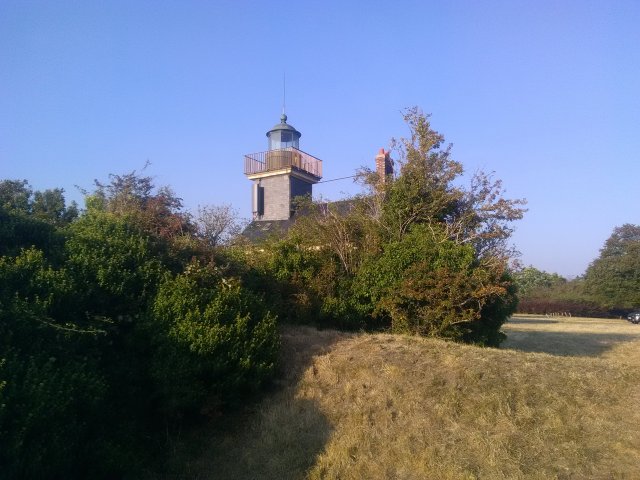
Blogging

About a month ago, a friend put up a posting The future of blogs…

I read the posting and sent in a comment. I tried to be constructively critical even though I was surprised to read his negative reactions to the western liturgy now that he has converted to Orthodoxy. I hope he has found his spiritual home rather than a new brand-name, a mask, a πρόσωπον, a term properly used in theological work De Verbo Incarnato, the study of Christology, but which also seems to correspond with the persona or super-ego of Jung. A convert usually arrives at is decision to embrace his church of adoption having expressed disdain, hatred or revulsion in relation to what he is leaving. That can lead to tragic consequences.

This fact of a big change in life involves emotional drama as well as a rational process of seeking truth and fulfilment of one’s sense of vocation. I am living through such a turning point in my own life, not one of going from one church to another, but closer to home. Some of my readers know what I’m talking about. Others can be content with confiding me to God in their prayers. Hatred is that cancer of the soul that will destroy us – unless we can uproot it and replace it with a quest for our own vocation and meaning in this world, coming to terms with our strengths and weaknesses in a journey through the night.

I have noticed my own postings becoming rarer. About the same number of people come each day to read recent posts or search for old articles. Fewer send comments. I have my old faithful friends who have known me in my younger days. What makes the difference for me is working in a spirit of service to others, a ministry of education and pastoral care through expressing some ideas that wouldn’t occur to other priests. This is something that has to pull us out of ἀκηδία (sloth and not caring) and resentment. It is all about bouncing back from the edge.

I too write less about the liturgy. I wrote my book A Twitch on the Sarum Thread in the same spirit that I have been writing blog postings. I become more philosophical in my interests, still in the Romantic and Idealist way of thinking, and see this as the only way to survive the death of institutional Christianity as a spiritual human being. I believe very strongly in the need to preserve and foster what we can in a hope for better days and fairer weather.

My thoughts about the future in the western world are mixed and sceptical. We can be tempted by conspiracy theorists according to whom we are heading towards a dystopia like Communist China or Orwell’s 1984. Covid-19 has brought us close to this as we are assailed by illogical, incoherent and unlikely claims by the press. It is like the Nazis jamming the radio communications of the Allies during the war, as Göbbels pumped out his garbage propaganda. The bullshit-o-meter hits the red! All these insults to our intelligence seem to put everything in the basket of the anti-maskers and anti-vaxxers. We live in an extremely polarised and dialectical world, increasingly violent and fanatical. It is vital to take a step back, find ourselves and our homes, and build a new and peaceful world. Our religious practice and spiritual longing have to be pulled out of politics and rebuilt from within. I have no certain knowledge about the pandemic, with only basic notions of microbiology and disease. All I can do is to wear the damned mask and disinfect my hands when I go into town – as little as possible! Already, we have a decision in France that if we do have contact with an infected person, the quarantine time is no longer two weeks but one week. They say that people will be going to hospital in droves in two weeks’ time – we will soon find out. The pandemic does a lot of harm to our notion of time, so we need to note things, keep a diary or just note essential markers. Think of Robinson Crusoe marking the days and weeks so that he could calculate how long he had been shipwrecked.

As mentioned, liturgical rites and church culture are important, even if only as a subject of study, private prayer and the life of a priest alone at home. We can only do what our forebears in the nineteenth century did: research, writing and publishing. Sometimes, we can get the message through to bishops and synods in our various Churches and show a cultural dimension that can help with that church’s ministry to souls. I had a hard time accepting my marginalisation from the Institute of Christ the King in the 1990’s and the consequences of my decision to leave it. The emotions calmed many years ago and I hardly recognise the “old place” or some of the older priests who are still with them. Every day is one of dying and being reborn elsewhere.

I have established a private list of a number of clergy and laity of different institutional churches. Our project of a meeting in England has been frustrated, this autumn like last spring. Hopefully, the crisis will be over next year and we will be able to travel and organise in advance. I also hope by the same time that other things in my life will be clear and resolved, or at least on the way to resolution. I would hope we would create a sort of “mini-university” and publishing house. Some of this work is already being done, an example being Dr William Renwick in Canada. I believe that we should not be narrowly restricted to a particular rite or local tradition but rather a cultural expression that breaks from the tired old polemics between Roman Catholics and Protestants since the sixteenth century. Men like Fr Louis Bouyer fought for a ressourcement, an appeal to the Patristic era. He was not wrong, but it depended on nobility of spirit that was lacking in the Roman Catholic reforms of the 1960’s and 70’s. This is why I insist on the philosophical context and undertow. Otherwise our work too will become kitsch and shallow.

I have no personal experience of the Orthodox world. I spent many sleepless nights in discussion with Dr Ray Winch in Oxford, and learned much about the pitfalls. The use of the western rite (Roman, Gallican, Anglican or Sarum) in Orthodoxy has often been shallow in cultural terms and clashed with the endemic culture of the Byzantine and Slavonic diaspora. Orthodoxy is not a substitute institution to accommodate the ideologies of counter-reformation Roman Catholicism or Continuing Anglicanism. The best thing for Orthodoxy is to protect it from our own emotional and spiritual diseases! We do best to build from the best of our souls and aspirations for something much higher.

Probably the truest and purest way to find our vocation is to pray our Office, say Mass if we are priests (with or without assistance) and live our lives in peace and nobility. Live each day as if it were our last…
Posted in Uncategorized | Tagged , , | 3 Comments

Liminality

I have found references in several places to an article written by a Franciscan friar in 2007 – The Life and Death of Religious Life by Benedict Groeschel C.F.R. I was particularly impressed by the notion of liminality. There are many explanations in terms of religious anthropology, which are not easy to follow. One meaning of liminality is the sacredness of a place like a church or a temple. It is sometimes called a twilight zone after a popular TV show. It can be a place or the state of a person who experiences the revelation of sacred knowledge or γνῶσις. It also describes the sacred nature of liturgical prayer and actions, and its power to transform and reintegrate the worshipper.

Fr Groeschel describes the notion of a liminal personality as in the saints and mystics of monastic and consecrated life.

Following the example of such saints as Anthony of Egypt, Paul the Hermit, and Pachomius, an ex-soldier of the Roman legions, men and women took up the pursuit of the vowed life. An important but frequently overlooked variable of that life is a quality known as liminality—the state of being an outsider to the establishment of any society, even one with strong religious characteristics and values.

Liminality derives from the Latin limen (which means threshold or edge) and refers in this case to people who live beyond the accepted norms of the establishment. Obviously chastity, poverty, and obedience to a spiritual master or superior take a person out of any establishment where family life and inheritance are the norm. Such people as St. Benedict, St. Francis, and, in our time, Mother Teresa of Calcutta are obvious examples of liminal personalities. In fact, Turner spends much time on the study of liminality in the early days of the Franciscan Order.

Liminal people stand in sharp contrast even to virtuous members of the establishment. This dichotomy is not a bad thing, although there must always be a degree of liminality in any follower of Christ. We see this in the saintly members of royal families: St. Louis IX of France and St. Elizabeth of Hungary, for example, who wore the Franciscan habit beneath their royal finery and served the poor with zeal and joy. Anyone familiar with religious life at the time of its collapse knows that liminality was almost entirely lost—and remains lost, except for the new communities and a few older ones that have remarkably held the line.

If we ask, “What could have gone so wrong and caused such a decline in religious life?” we realize that this is a dull tale extending over a period of more than forty years. Yet it comes as no surprise to anyone who knows church history and understands anthropology. You cannot go against the laws of human nature reflected in psychological anthropology—even laws such as liminality that apply only to a select few—without disastrous results. The current tampering with family life and marriage is another example of foolish intervention into the laws of anthropology. Such endeavors are like trying to grow figs from thistles.

The decline of liminality, the sense of the sacred as a partial explanation, is one reason why institutional Christianity is dying, why monasteries and friaries are dying and leaving their buildings to profane hands. Churches are turned into bureaucracies and administered in terms of corporate management. Originality of personality or so-called “eccentricity” is pushed aside and excluded. All that is left is something that costs a lot of money but has no purpose.

This subject strikes me in particular as I make progress with a new book loosely in the style of a Greek dialogue on utopianism and its expression in this term liminality which I have only just discovered. It is the condition of (some?) autistic people, of losing in social terms what is gained in personal and individual insight into the higher and metaphysical reality. I will include this subject in my work. It all begins with three men and their boats in a little creek up a river in Brittany. I will keep the title and plan secret for the time being.

In the end of the day, I wonder if we are simply talking about the Salt of the Earth

Posted in Uncategorized | Tagged , , , | 1 Comment

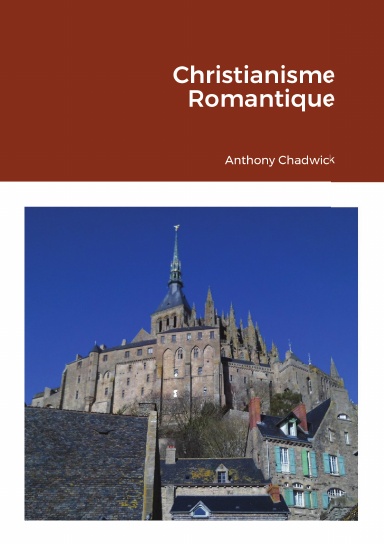
Christianisme Romantique

Voici mon livre que je viens de traduire en français. Christianisme Romantique est un essai sur une autre place du christianisme dans les esprits de notre monde. Ce livre se situe entre trois points essentiels: la tradition liturgique, le christianisme ésotérique et le romantisme sorti du tourment révolutionnaire au XIXe siècle.

Son prix est très modique à 15€ plus les frais du port depuis chez Lulu.

Posted in Uncategorized | Tagged | 2 Comments

Route du Calvados

A few years ago, I wrote about a project, the Route du Calvados for a sailing gathering in Normandy to sail along the scene of D-Day of 6th June 1944 when the Allies made a successful invasion of France which proved to be the beginning of the defeat of Nazi Germany. Most of the beaches in question were along the western part of this coast, but there was a battle for Ouistreham where there was a German stronghold and the famous Pegasus Bridge up the Orne towards Caen. There are monuments and museums in many places of this area, and I recommend seeing the epic film The Longest Day.

It is a long coast, and my plan of 2014 came to nothing, simply because I am not an organising kind of person and one can have serious legal liabilities for other people’s accidents. It is better to go to a gathering that more qualified people have organised, often with financial support from businesses and public authorities. The idea was put to sleep, but I kept ideas of having some sails in the area. Finally, I put the idea to a friend by the name of Jean-Baptiste who is a highly experienced sailor, mostly in yachts. So, we did a little bit of this Route du Calvados, two boats and complete simplicity.

We sailed from Dives sur Mer to Ouistreham and the Orne estuary and back. He sailed in my little Tabur 320 with its sprit rig and I on “Sarum”. It was just for Saturday and Sunday, one night on a beach to one side of the Orne estuary. It was pleasant to be otherwise than alone, with a friend who is a highly experienced sailor.

I chose the name Route du Calvados because that is the name of the Département and also of their famous apple brandy which is wonderful after a meal or between courses with ice cream as a trou normand.

This video will give a little taste of this coast, which seems to be the French equivalent of Sussex with its seaside resorts of Brighton and Eastbourne. Deauville and Trouville are the most opulent and wealthy as resorts for Parisians. Cabourg is a little more popular, but still marked by its wealthy past by the hotels and villas from the Impressionist era. Being in August, the beaches were crowded and the sea too was invaded by motor boats and jet skis, making a lot of noise and waves from their wakes. It was a little quieter towards Ouistreham and the entry into the estuary.

We entered the Orne and made some way towards Pegasus Bridge, on the tidal section, not on the canal that takes boats and ships to Caen. We then returned towards a sandy beach rather than the grey ooze that sucks at your feet. There we spent the night, my boat with fore and aft anchors and Jean-Baptist’s high up on the beach on a single anchor. That provided the possibility to get going the next morning at mid (flood) tide. We motored hard against the current and found a place to do a little repair and eat a few bits of old bread and cheese.

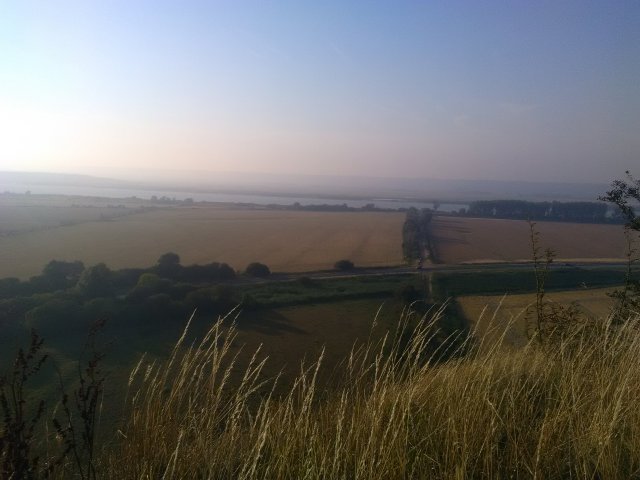
The sail back to Dives sur Mer was pleasant, with a moderately agitated sea and a beam wind. The recovery was leisurely and we found a pleasant place to stop off for something to eat, the old lighthouse, the Phare de la Roque overlooking a part of the Seine that was reclaimed for farmland in the nineteenth century. It is now a tourist attraction with a fine view from the cliff. That is where I took the final part of my video.

Posted in Uncategorized | Tagged , , | 3 Comments

La Douceur Pastorale

One thing that motivated me to go to the Institute of Christ the King at the end of my university studies in 1990 was the influence of Opus Sacerdotale, an association of French parish priests. In the 1970’s, they generally remained faithful to the old rite of Mass or a conservative interpretation of the Pauline liturgy. Their primary concern was the older and personal style of pastoral ministry: a priest is both a father and a friend to his faithful, a priest among his people. I soaked in the spirit of this association and view of the priesthood from my early seminary days (when many of the old parish priests were closely associated with the Institute they helped to found and supported in those early days of the 1990’s). I spent time in parishes like Le Chamblac with Fr Montgomery-Wright and Bouloire with Fr Jacques Pecha where I installed an organ in 1992. Most of these old priests are now promoted to glory, and the spirit of French traditionalist Roman Catholicism made a radical change from this pastoral priority to politics, even with the pretext of moral issues.

In 1979, Opus Sacerdotale published a booklet with the title Des Bons Pasteurs pour l’Eglise en France. I have translated the chapter on the Episcopal ministry which contrasts the true priestly and pastoral role of the Bishop with the managerial style that has crept into all churches over the past twenty years and more. It is a beautiful and limpid text.

Without any triumphalism on my part, this notion of the Episcopate is something we have achieved in the Anglican Catholic Church and other continuing Anglican Churches. The most terrible scourge of any Church, beyond gender issues, sexual orientation, ordination of women, flat and boring liturgies and other questions is the sprit of corporate management and bureaucracy, distance from the people in parishes and unaccountability. Ours are small Churches, for which I am grateful for my priestly calling and mission.

Here is the translated text:

* * *

The Bishop, Pastor of a Diocese

Why not apply the same principle of real pastoral responsibility to bishops?

The pastoral charge does not consist in taking care of administration, but of people living with their needs, their sorrows, their hopes.

General services are certainly necessary at the diocesan level, but why deprive those entrusted with them of the effective responsibility of parish priests?

It is traditional for the bishop himself to be the parish priest of his cathedral. Why would he not actually perform this function, with an assistant priest, of course?

Instead of spending his time in meetings, in conferences, in colloquia to say what needs to be done, the Bishop would only himself have to give a pastoral example.

How much time has been saved for him and God’s people!

The pastoral office is not self-glorification but a service. Authority, according to Jesus, belongs to the one who makes himself the slave of his brothers.

It would therefore be necessary for the Bishop to be responsible for a diocese of a size that would be accessible to his human possibilities.

We should no longer have these overly large and cumbersome dioceses whose members are practically deprived of any relationship with the father and spouse given to them.

What is stopping the Church from multiplying the dioceses? The bishops would then be in a position to exercise their service in a healthy and holy manner. The faithful would know and love their bishop.

Perhaps the “trade union” of episcopal commissions, which controls the bishops, would be dismantled in this way! The bishops, currently in office, could, if they wished, free themselves from the hold of the commissions.

True collegiality could be established: it would be a union of persons in Christ and not a collective solidarity in liberalism and resignation.

This solution would put an end to the anomaly of auxiliary bishops who are pastors without families. A man cannot give his life to an administration. You don’t get married with marriage, bu with a real wife. A bishop must be able to love a Church community and give his life to it because it is his in the name of Christ.

Last but not least, a bishop, father and husband of his Church, would no longer leave the care of vocations to incompetent and partisan commissions.

There are countless young men who honestly aspired to the priesthood and were rejected for unbelievable reasons:

– because they are “too pious”,

– because they want to “offer the Holy Sacrifice of the Mass”,

– because they want to “serve the faithful with the Gospel and the Sacraments of Jesus Christ”.

These motives, for which a holy Curé d’Ars was ordained, are deemed to be incompatible with the vocation to a “ministry” the commissions arbitrarily define in the name of temporal points of view of a psychological, sociological or political nature.

Posted in Uncategorized | Tagged , , | 6 Comments

Identity and Diversity

I wrote the article Diversity and Inclusion yesterday and it was normal to receive some criticism from a fairly nationalist point of view disillusioned with the double standards of anti-non-white racism and anti-white racism. That is about the only way I can put it because anti-white racism is still respectable in this insane world, depending on where you are.

The reality of human nature is one of brutal competition, which is capable of being moderated by compassion and care for the weak. It is not all social Darwinism as in the ideas of Nietzsche regarding the Ubermensch and the primacy of the will. Christianity does provide a motivation to assist those who are weak on condition that they acknowledge themselves to be weak or different in some way, something we call humility, which is being true to our self-knowledge.

This is a consideration that has made me sceptical about so-called Neuro-diversity, the school of thought that considers autism (wherever on the spectrum) to be a difference rather than a handicap. Those of us who have been diagnosed for autism can be grateful for help, but it invariably has to be on the helper’s terms. Otherwise we have no right to their time or effort. If we are in distress, people will usually help. If we claim equality, then we are on our own and subject to the rules of competition and the stronger will of the other.

It is easy to fall into the trap of thinking that autists are some kind of superior being in intellectual terms or having a special talent, but it is an illusion. Most of us have social difficulties. Perhaps we are particularly sensitive bullshit-o-meters to detect sophistry, deceit and double standards, but the non-autists are in the majority. Is this sensitivity a part of autism or another part of our complex personalities?

A short while ago, I was asked about my opinion on “conversion therapy” on people identifying as homosexuals to “make them normal”, especially if the therapy is enforced by authority or the young person’s parents. My own intuition was that no one should be forced to do anything, but that there are consequences of choices. Someone who self-identifies as “gay” should not expect the majority of society to adapt to his lifestyle or tolerate it when it is publicly known. Autism appears to be the result of a modification of genes in the brain, whilst there appears to be no physical cause of sexual orientations. Imposing one’s identity in either case will not appeal to empathy and compassion but hostility and rejection. Self-identity can be a part of a person’s private life, but imposing it on the majority will provoke only indifference or anger. Being a unique person isn’t something pathological, but we ought to avoid provoking the collective majority as if expecting them to make adjustments to their views. Even more so when we live in a post-rational, post-everything and essentially nihilist society.

Should we fight and campaign with slogans, shouting and mob behaviour? Some think it is the only way to fight for the rights of minority identities. There were such people under the Nazi regime who died martyrs like Sophie Scholl. Perhaps they did more good than those who went to the catacombs and waited out the period of tyranny. Why protest for acceptance as homosexual, someone wanting to identify with the opposite sex, autistic, artistic or anything? What difference does it make to society and the hard-right tendencies who would return to Victorian morals and 1930’s totalitarianism?

I myself obtained the label of “high-functioning autistic”, known as Aspergers Syndrome before the psychiatric establishment absorbed it into the general autism spectrum. My attitude has evolved over the years during which I have written a few articles. It is only very exceptionally that it produces a Mozart or an Einstein – and we are not certain they had this condition. Both are now dead and cannot be diagnosed. It has blighted my life in my family, at school, in seminary, in parishes and now in marriage. If there were a cure, I would go for it. I wouldn’t have to be a part of the conforming collectivity. I could still be odd, an eccentric, an introvert, and be a little less alienated. It is a painful way of life, because we don’t know what we are missing if we haven’t experienced it – something like the fulness of non-verbal human communication enabling us to be social creatures.

My whole point is that these minority identities cause hardships in life. We would be better without them were that possible. At the same time, we have to come to terms with our imperfections, defects and difficulties. We join the long lines of people who humbly went to Christ to pray for a miracle healing. Some had the faith to accept such healing and others went away as they came. Such is the lottery of life. This may be the beginning of humility and the necessary disposition for relying on God more than mankind and the world.

The degree of suffering is extremely variable. I belong to that very “mild” category that I have learned to mask and adapt throughout my life. I have had to adjust insofar as I have needed to have a relationship with my family and colleagues at seminary and in the Church. Some people cause me a great degree of anxiety and it is just a matter of resilience until such a time as I can go my way and continue life. Others “on the spectrum” face serious difficulties and some have to be institutionalised. Should we consider “medieval” cures or euthanasia as the Nazis did? They denied the quality of humanity to the “useless eaters”, and European humanism and justice condemned them after the war. We Christians are called to compassion and to do what we can to help, which is best done by training to be a doctor or a nurse. We are not all called to that vocation.

In my own experience, I have known some who identify as Aspergers or other autists. I have been to organised events to find out whether I would experience a special empathy to them. I found some to be tender and loving souls. Others were constantly complaining about their experience of life and being rejected. I sometimes find autistic people to be extremely intolerant and unable to consider the possibility of other people’s views. Their example hardly makes me want to wear autism as a “badge of honour”! I think it is sufficient to be individual persons with our ways of life, on condition that the freedom of others is respected. Something that has done me a lot of good is the notion of truth as expounded by some of the German Idealists and the notion of reasoned dialogue. Not all truths are absolute but are the result of subjective individual experience.

Perhaps difficulties caused by mental and neurological conditions can help to make us more compassionate and open to others. I don’t wish I could be better at social games and politics. I spend a lot of time on my own and my marriage is loveless. I often reflect on my experience of life, knowing that it is not what most people experience. I think I have intuitive and empathic gifts, but I am not sure they are very different from most other people. How do I describe the colour red in human language? Are we sure that we all see the same thing that we call red even if we are not diagnosed as being colour blind? I try to learn to give and love without expecting anything in return. I think about things critically, rather than go along with prevailing opinion. Seeing films is very instructive in terms of understanding what people’s values are, and those things I personally find unacceptable or merely difficult. I just have to accept the fact that most people would not care less about what I think. Why should they?

We need to be thankful to be able to live independently, and assume the responsibility that goes with it. So-called “mild” cases may carry more stigma than anything else. The whole problem is one of broadening the diagnostic criteria to range from “a bit eccentric” to “severely disabled” and in need of care for life. The debate surrounding the absorption of Aspergers Syndrome into the general autistic spectrum is a double-edged sword. The big problem is that no two persons are the same, let alone two autistic persons. The point of a scientific diagnosis is typical characteristics in common. That would be difficult with those who are diagnosed at the high-functioning or of moderate intensity without the intellect being retarded or whatever expression the psychiatrist chooses to use. It can be called a disability in that it makes it difficult for us to succeed in life according to the most conventional criteria.

The problem is social interacting, which is hardly an “evolutionary advantage”. In my experience I often find Aspergers people so focused on their interest that they become intolerant and sometimes quite intemperate and aggressive. I have had to will myself to learn a more “liberal” and tolerant way of thinking on pain of finding myself in total isolation. Would that be a good thing? One has at least to trade and deal with others. Perhaps the extreme empathy and intuition bit has nothing to do with autism at any position on the spectrum. Psychiatrists and psychologists are surely still researching and working on their knowledge and analysis, since much of their science is little more than speculative analogy and comparison.

I can understand where identity politics and claims come from: discrimination and bullying, cruelty and the Mark of Cain. For me, the true value of a diagnosis is not to give me my identity but a scientific or quasi-scientific marker to help with self knowledge and understanding. This is a basis on which we can educate ourselves in the art of relating to society in the measure that we judge necessary for our own interests and our duty to help the weak according to Christian humanist principles. I often think of the Elusive Scarlet Pimpernel who rescued people who risked being sent to the guillotine during the French Revolution and smuggled them to England. We have to learn to be lambs in the midst of wolves to use an expression from the Gospels.

I have used this example of autism, which is a part of my own life experience, to think about other minority experiences. Who cares about our sexual preferences if we keep quiet and discreet, knowing that they are not “normal” even if they might feel normal for us. Being a woman at one time meant being silenced and subjugated in a man’s world. I would have had a lot of sympathy with early feminism and personalities like Mary Wollstonecraft and her daughter Mary Shelley. Most women are moderate about their relations with men and society at large. Some seek to impose totalitarian tyranny on men and their husbands in particular! I have recently been researching moral and psychological abuse committed by women against men. It is too easy to have dissipated thoughts about the scold’s bridle and the ducking stool! Two wrongs do not make a right. At the same time, men suffer from “inverse sexism” which actually is nothing other than sexist discrimination, this time committed by women. Fortunately, legal authorities and judges are beginning to recognise this fact.

It would be a good idea for us to study history and come to understand something about the roots of revolutions – the replacement of one tyranny by its opposite extreme, a new tyranny that is infinitely worse. It is a prospect that I see happening in our own time with the “Woke” culture and the new anti-white racism. We live in frightening times, in the midst of a pandemic of a virus which potentially has the virulence and lethality of the Spanish Flu of a hundred years ago (if we get a second wave). States have reacted by imposing lockdowns or other “social distancing” restrictions. This has a marked psychological effect on those who are diametrically opposite autism, those who have an excessive reliance on social life and crowds.

Our identities are related to the nobility of spirit to which some of us aspire. This is an ideal to which we aspire. Christians call this nobility holiness, a complete harmony between our desire and what is acquired spiritually in part. The diversity has to be lived in a compromise with the degree to which we desire a social life and healthy relations with other people. Doubtlessly, these reflections will continue and become more refined as the “history of the future” unfolds.

Posted in Uncategorized | Tagged , , , , , , | 1 Comment

Diversity and Inclusion

“Diversity and inclusion” have become buzz words and they mean different things to different people. The most obvious meaning of diversity seems to be acceptance that different persons, cultures, races, personalities, etc. have equal right to favourable consideration in society. Inclusion would in its turn mean the acceptance by the majority of the minority. The problem comes when the differences and minorities have become politically radicalised and want to become the majority and make the old overthrown majority into a new minority position. That is how I see it.

The current disputes about historical slavery, statues and racial prejudice have muddied these subjects in the same way as politically radical gay and transsexual agendas have done at different times. Another problem is the de-personalising of words and their use to describe collectivist and corporate ideologies. The idea of “embracing difference” seems wholesome and Christian, but it is often a point of manipulation by western ‘liberal’ culture and shallow slogans.

Personally, I am inclined to be quite cosmopolitan in taking interest in the way others live and their cultures. As a child, I never had the slightest problem with people of other races living in England. I even went through a childhood phase of looking for a way to become black! Shoe polish? Humour apart, I never considered them as being in any way “inferior”. I was profoundly shocked when I first discovered that the Nazis killed millions of people simply because they were Jewish, Slavonic or any number of minority cultures living in Europe. I always had a different and more tolerant attitude because I thought of life in terms of the world and not only my own country and race. I think this is the key to understanding these words.

What is most important is to form our own understanding and thought, and avoid following the latest groupthink or bandwagon. Those who use these words in slogans often use violence to promote what seem to be or what should be altruistic ideas for the good of others in this world. However, the radicals cause division and violence. The slogans currently used are Black Lives Matter, cancel culture, taking the knee and others. To me, none of these slogans make any sense, because all lives matter regardless of race. What does cancel culture mean? Perhaps it means abolishing the culture of some of favour that of the victors. Whose language is taking the knee? I would talk of kneeling or genuflecting, of kneeling down – which is a gesture both of adoration and penance, and done in regard to God, not man – except for greeting bishops and kissing their rings as a mark of respect.

Diversity and inclusion are words that describe our respect for others, having empathy and awareness of ourselves in relation to them. What is most essential is our ability to think critically and justly. Our age is increasingly post-rational. Romanticism is built on the reason of the Enlightenment as a foundation for the whole person including the imagination and the emotions. Unfortunately, such a paradigm is outside the thought of most people in our society.

It is self-evident to me that people in other parts of the world or who have found it necessary to immigrate into a country of Europe or America should have the right to life, freedom and the search for happiness. It is simply a question of humanity and humanism, reflected in the teachings of Christ. Do to others as you would have them do to you.

I am realistic enough to know that whatever I write will have no educational effect on tbe general public, for the simple reason that my blog would be of no interest to them even if they were aware of its existence. That is of no importance to me.

Perhaps it is because these words are used that their meaning is so shallow. It is like the ridiculous term social distancing used to brainwash us into taking precautions against catching contagious viruses. We should search for inner meanings, accept those who are different, unless of course they are criminal or violent. I do believe we should seek to resist nationalism and become cosmopolitan, identifying ourselves with a global view of humanity, we in Europe and the UK, the Americas, Russia, Asia, Africa, Australia and the entire southern hemisphere.

I do think it is important for us to learn from Christians who have had profound contact with other religions like Hinduism. I would like to learn more about Dom Bede Griffiths and his experience with the Ashrams of India and his non-dualist philosophy. I do think this could be a key to undoing many of our less Christian instincts. Finally, we will develop respect for others even if we do not entirely embrace their spiritual traditions.

If equality, inclusion and diversity are just empty words and slogans, we will not make any progress in their meanings. Our big problem is mass humanity as named by Ortega y Gasset in 1930, with all the characteristics that Nietzsche and Tocqueville predicted. It is a paradox with our democratic age in that mankind had an opportunity to overcome tyranny and the feudal system only to be rejected by a new type of humanity, the man of the crowd. Not listening to reason, the man of the crowd knows only one language – violence against what does not conform to humanity at its basest. We become influenced by identity politics, so-called woke culture and consumerism. Covid-19 and the lockdowns are truly a sign of a world where wearing a mask (or not) in specified situations is a political gesture.

We seem to need to work towards a new Age of Reason and do away – not with “religious superstition” – but with the irrationality of the mass man and the mob. One big principle of St Thomas Aquinas was the primacy of reason over the will and all the emotions. This is also a principle found in many of the Romantic thinkers who extended the rational intellect with the creative imagination and the quest for the transcendent.

If this does not happen in the next few years, I fear a world war or a revolution that will dwarf 1789 in France and 1917 in Russia. That will not be a pleasant time to live in, nor will it be one of either diversity or inclusion.

Posted in Uncategorized | Tagged , , , , , , | 5 Comments

Facebook and Com-boxes

My brother priest Fr Jonathan Munn shows sympathy for whom he calls “the administrators of a certain Sarum-based Facebook group“. I thank him for his discretion. I am the founder of Use of Sarum on Facebook, and my other brother priest, Fr Andrew Scurr, is a co-administrator, something which is useful now that we are 1,720 members. Fr Jonathan has expressed himself in Being right in the com-box.

Just after the little rififi of someone asking a genuine question about the Use of Sarum on behalf of a female member of the clergy of some institutional Church, and someone expressing surprise by this seeming act of collaboration or treason, I wrote a posting. I later followed it by a comment in the light of some of the things written by other people’s comments.

Just a little housekeeping reminder: There has been a posting which seems to have disappeared, about finding texts in English of the Sarum Missal. I added a comment linking to some Word documents that can be formatted and printed as anyone wants. There was something of a dispute about the original post referring to a clergy woman and someone expressing surprise. I belong to a Church that doesn’t ordain women. However, the subject is not germane to this group and we need to avoid polemics and potential nastiness. Please respect the mind of this group that I have tried to convey: polite conversation about the Sarum and other medieval western liturgical traditions and something of the spirit of a university seminar. We can also discuss practical matters, but please keep the polemics away.

I have to say that I have accepted members onto this list via the criterion of not accepting those who are extremely unlikely to be interested in the subject matter, or who join hundreds of groups for the purpose of promoting their particular agenda, marketing, spamming or scamming. There are borderline requests by people in other parts of the world, at least interested in Christianity, and I just have to assume they want to learn about something new for them. Also, there are requests from clergy and laity of the Church of England or the American Episcopal Church, some of whom are female clergy. I resolved from the beginning to accept requests on the basis of at least a potential interest in the Use of Sarum (and other medieval liturgical traditions). I have implicitly trusted such female clergy not to promote their convictions in this domain. I myself have a sister going for ordination in the Church of England, and I belong to a Church that doesn’t ordain women. What do I do? Live in perpetual conflict, or come to understandings on another basis? In the end of the day, we are not here to worry about other people (unless they come to us for help and advice) but the health of our own souls. Such “another basis” can be the subject of this group – the Use of Sarum. We are now 1,698 members, and we are not all from the same institutional Church with the same orthodoxies. I went from that basis because I believe that the study and use of the Sarum liturgy cannot be restricted to any one institutional Church or system of orthodoxy. I took a risk that it would all implode or explode, but so far, some very good work has been done and made known. Let us continue on that basis…

These unpleasant episodes happen. I have long experience with blogging & flogging, people with fanatical emotional reactions and the Nozzle of Weirdness as a Canadian journalist I know put it. Maybe for many of us, being put into lockdown and then brought out of it and told there is still a risk of infection is getting to our subconsciousness and affecting our rational faculties. I am not joking or making fun.

Fr Andrew and I keep a watch on this kind of thing, not because it brings personal suffering, but because it can cause a group dedicated to its subject to collapse into a polemical and off-topic mess. It has happened on groups dedicated to vestments and clerical dress and even some of my sailing groups where religion is generally not discussed. Things have to be nipped in the bud.

Supposing the group had to be restricted to traditionist Roman Catholics, I doubt there would have been ten members. The subject would be demolished by the idea that Sarum isn’t explicitly allowed in the Roman Catholic Church, then by speculations about the Pope, Our Lady of Fatima and other apocalyptic messages, which priests are valid, etc. usque ad nauseam… We could be all Continuing Anglicans or Methodists or the Church of England. There would be no point. The question cannot be entrusted to any institutional Church or members only of that institution. I have said it all in my two quotes above. We come from everywhere and we have the Use of Sarum as a common interest. Otherwise there is no relationship between all those 1,720 people who don’t know each other for the most part.

Personally, I have become utterly exhausted by polemics over the subjects that have been debated for decades. There is no end of it. From all points of view, it erodes the very point of Christian faith and spirituality, bringing out a sense of boredom and ἀκηδίαsee more adventures of Micky Drivel next week

It is easy to become upset with Facebook, but without it there would only be silence. It has replaced the old Yahoo e-mail lists with a user-friendly and graphic interface that makes it possible to include photos and links to websites. Facebook can have constructive uses if the limits are firmly set. Otherwise, without any self-moderation, it becomes an addiction for empty and frustrated souls, d’où the phenomenon of trolling and other uncivil behaviours.

We can simply moderate threads with just the right amount of force made possible by excluding offenders who are unwilling to explain themselves rationally and respectfully. That prevents us from having to close the group and deprive many genuine liturgical students and enquirers from the intended benefit of what I created, motivated by my own interest in the subject.

Sometimes, people ask to join the group. At first, I put questions to try to find out whether they were actually interested in the subject. Then some were not answering the questions, but were manifestly interested in Christianity and liturgy by the other groups to which they belonged. Now I go by this second criterion. I set the bar low so as to give the benefit of the doubt. I can always get rid of someone who is looking for money or wanting to spread ideas that are nothing to do with the subject, for example politics or a new hair shampoo. Such things have rarely happened. We are probably twenty or thirty members to be posting on the Sarum liturgy and contributing to something very positive in terms of dispelling ignorance, teaching and working for practical revivals as church worship. For this reason, the group continues.

Facebook is used for all kinds of things. This seems to be a part of the genius of its design and what made its owners very rich people. In its basic configuration, you set up an account and you make “friends” by accepting their requests or their accepting yours. You can then join groups or set them up. I set this one up. I have set up others that were less “successful”. It can become addictive if you don’t have clear and rational ideas. There are irritating things like “tagging” so that someone can start posting their stuff on my Timeline. It took a while to find out how to turn that option off. It is a complex piece of “machinery”, morally neutral in itself, just like a sharp knife which most of us use for cutting food in the kitchen, and which can also be used morally or immorally.

Conversations are public, according to the group settings. Use of Sarum is very open and we need to take that into account. Outside the subject matter, people’s beliefs and conviction of what is true are as diverse as in any social context in real life. A large group like this one is mostly self-regulating in regard to cantankerous people or troubled souls.

Finally, it is not the com-box that is at fault, any more than the carving knife in the kitchen drawer, but us as human beings. It is the Enemy Within in ourselves, in our own inner conflicts threading their way through our whole lives. This is where we have to care for our spiritual souls and live as incarnate spirits of God – and be human beings.

Posted in Uncategorized | Tagged , , , | 1 Comment

Online and recorded Mass

I have decided to discontinue my liturgical recordings and I encourage those who would like to attend online or recorded Sarum masses to go to Fr Andrew Scurr’s page on Facebook (ask for his “friendship” if necessary). I will continue to post other outdoor and office-based (computer and webcam) videos.

A part of the reason for this decision is the poor quality of my videos due to using a mobile phone (“bumping” image and mediocre sound quality). Experiments with my computer and webcam were even less conclusive. The only other option is an expensive camcorder, which might be possible in the future.

I also need to learn more about video editing using the appropriate software and various techniques like dubbing and fading. It is a new world for me.

Fr Scurr is doing a sterling service with his daily online and recorded Sarum Masses in Latin (or the English Missal). I recommend him for those still under strict lockdown or those who are vulnerable for reasons of health and age.

Posted in Uncategorized | Tagged , | 11 Comments

La Fête-Dieu 2020

Corpus Christi according to the Use of Sarum. The proper is identical to that in the Roman missal. I give a few reflections on the joy of La Fête-Dieu in French or Fronleichnam in German as still celebrated in towns in Switzerland and southern Germany to this day, where this procession unites with the civic life of the community. It reflects our joy to be Christians. Also, the Blessed Sacrament and the Church are one and cannot be divided, even if the Host is broken into an infinite number of pieces. So with the Church, our communion in Christ before being a political or bureaucratic institution.

I was wearing my oldest vestments, French and probably from the late eighteenth century, but in poor condition. This is regrettable because the cloth has a fine design on it.

Posted in Uncategorized | Tagged , , , | Leave a comment