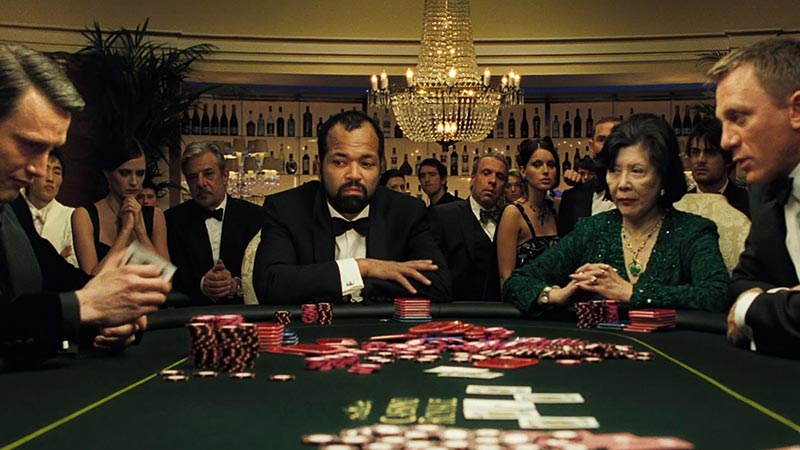
Casino Brexit

There are speculations about next week’s votes in Parliament. Here is a text I found on a Facebook group.

Reported Developments

The Financial Times and other outlets are reporting:

(1) The vote on the Withdrawal Bill next Tuesday will almost certainly fail. Peston is writing that he has not met a single minister or MP who thinks it will succeed. Cox will probably bring nothing back from his negotiations in Brussels and even if he does, it will not be nearly enough to satisfy the DUP/ERG.

(2) The bill to be voted on next Wednesday to rule out a no deal Brexit will almost certainly pass. The government will allow a free vote. (It will be particularly interesting to see how May herself votes, as she has been preaching all along that no deal is better than a bad deal. As she has tried to change the WA, presumably because she thinks it is a bad deal, she has to lose credibility or propose no deal chaos. And yet she negotiated and agree with Europe the Withdrawal Agreement…

(3) The vote on Thursday to ask Europe for an extension, will almost certainly pass, or a vote for no deal, makes no sense. There will be amendments, proposing that the extension be from a couple of months to two years. Again May dare not whip her MP’s on this vote or she would be faced with at least 20 Cabinet ministers and others from her government.

(4) Losing the Withdrawal Bill will effectively mean May has lost control of the process, and Parliament will take over. With the breakdown in party discipline, we move into an area of uncertainty. The Spectator in an editorial today is warning MP’s to vote for May’s deal or risk a soft or no Brexit. The consensus is that anything that follows will either be a soft Brexit or less likely, no Brexit. There is absolutely no parliamentary majority for a hard Brexit.

(5) There is no present majority in Parliament for a second Referendum, or at least not enough of those who privately would like R2 have yet come out.

(6) Thee is growing support for Norway plus, especially in the Labour Party, and interestingly, among the leadership. Corbyn and others met Tory proponents of Norway plus yesterday in the Commons.

(7) (5) and (6) have to be seen in the context of a) the vast majority of MP’s voted Remain; b) the breakdown of party discipline leading to free votes (de facto, as if not free, the whip would be ignored); the probability that with the breakdown in Government policy, pro Remain Cabinet ministers and other Remain Tory MP’s would break cover and support Norway plus or possibly R2.

(8) My own view, as a passionate Remainer, is that we should be wary of falling into the trap which it looks like the ERG has fallen into: rejecting something which is good, in the hope of gaining something perfect, and in the process losing both.

I also believe that if we stayed in the Single Market and Customs Union, it would be far easier for a pro European government to negotiate our eventual re-joining.

I don’t know what to make of all this. Just a few ideas:

The MP’s will vote against no-deal, but not for blocking no-deal. So no-deal is still on the table and Theresa May can still try to use it to force through her deal – but May’s deal will be defeated. All that will be left will be no-deal or no Brexit. May can only go so far, because she would have the Cabinet against her.

A lot will depend on how long the EU will allow the Article 50 extension to go. May wants it short. The EU would make it long, and everyone would die of boredom over the next couple of years – during which anything could happen (General Election, implosion of the political system, etc.). So much harm has been done to the economy that all the squandered millions and billions would have to be paid from the taxpayer’s pocket. So taxes will go up, the pound down, pensions will be hit, the NHS as well. The Tories are really going to be hated! Labour is discredited and the Tories can’t last for long in these conditions. The new party formed of ex-Labour and Tory MP’s, or a swing to the hard-Right? Could May call a General Election the day Brexit is delayed? To what end? That seems doubtful.

We have to have a delay, otherwise it’s off the cliff-edge we go and without a parachute. Between the fear mongering and “It will all be OK”, there is something ominous and very nasty waiting for us all, even for those of us living in other countries. Perhaps she is really mad enough to want no-deal and make sure there is no alternative – Nero Decree and commit suicide? That would seem to be melodramatic and Mrs May is not Hitler!

There is no Parliamentary majority for a second referendum, and in any case, the result might be the same, either through propaganda or informed conviction based on certain reports of the Lisbon Treaty of 2009.

If May loses control, Parliament will take over, but that leaves uncertainty. There is the point that you can’t vote for no-deal, but rather for something to make no-deal unnecessary. That is precisely May’s position – my deal or no deal. But, there is no majority for May’s deal. We have agonised with that for months – years. It isn’t that the EU is being intransigent. The only way to get rid of the backstop is to colonise Ireland or let Ireland have Northern Ireland. Either way, Paddy from the IRA will be making bombs in his bicycle shed! Fun for the whole family…

The UK asks for an extension. The EU will truly get control and make Brexit quite impossible. There has to be an acceptable purpose for the extended time. No extension. No deal. No taste for Nero’s fires and bombs. Then all that’s left is revoking Article 50 – goodbye Brexit… Could May do that without Parliment agreeing to it? Perhaps, given the “extreme emergency” character of this situation, would a Prime Minister call Parliament when responding to a declaration of nuclear war? I doubt that it would be a physical red emergency stop button like on a machine. Would she just sign a piece of paper? If it does require Parliamentary approval, then the UK just has to face the inevitable and some demagogue with a moustache and jackboots to “sort everything out”… Bo-jo and Lord Snooty are still clean-shaven – for the time being. If it is no-deal and the things we fear come true, then the future is a coup d’état or a revolution, but, mind you, Brexit could be that revolution or coup d’état. No-Brexit could go on the table but only at the very last minute.

For everything to come to no-deal or no-Brexit, it would be an incredible gamble for the highest stakes, hence my title for this article and the photo out of a James Bond film. Winner take all. Survival of the fittest. Indeed the UK would be quite godless! The time is nearly up, and we should already have an idea next week, and certainly by the end of this month. The winner will be laughing his way to the bank and the country will be up for grabs by the highest bidder. Or not.

I would love to be wrong and be rebuked for my lack of faith in sunlit uplands and blue unicorns, or some glorious future that would materialise after we’re all dead. I have long been horrified by the shambles of this process, the wanton irresponsibility and inability to make decisions and stand by them. As I say, the Lent may be long and not merely forty days from Ash Wednesday to Holy Saturday. It is sometimes suggested that a little suffering is good for the soul – but I would take back such a thought immediately, because those who would pay the most would be the weakest and most vulnerable.

The European Union isn’t everything. Macron here in France is of the opinion that it does need reform and a better idea of its identity. There are many threats in the form of populism and a swing to the hard-Right in some countries, with a possibility of a Fascist resurgence. The identity the EU has tried to forge isn’t just money and oligarchy but also the fruits of suffering through the years from 1914 to 1945. That fruit must be a new Christian and spiritual humanism and a new world so ardently desired by the Romantics throughout the years of the Jacobins and the Napoleonic Wars. The UK risks becoming like France in the nineteenth century, unstable and unworthy of her vocation.

I fear that when Holy Week arrives, the Lamentations of Jeremiah will take on a whole new meaning.
Posted in Uncategorized | Tagged , | 8 Comments

Christian publishing during the Occupation

After my last posting, one of my faithful commenters (David Llewellyn Dodds) jogged my mind, and I mentioned in my comment replying to his I am presently reading Alan Jacobs, The Year of Our Lord 1943. Christian Humanism in an Age of Crisis, OUP 2018. Through this book, I am coming to have another understanding of the minds of writers and intellectuals during the worst years of the war. 1943 was the turning point when the Nazis began to be on the defensive and the war was turning against them. Some days ago, I mentioned the film Nuremberg. At first, the Allies wanted to take the Nazi war criminals out and shoot them, but the idea came into the minds of the judges and the chief prosecutor Justice Jackson that if they were to do that, they would find it difficult to claim moral superiority and a greater degree of humanity than the enemy? Going to war against Hitler wasn’t everything, though it seems that there was no alternative historically. We had also to take the moral high road. I believe we did that through Nuremberg, bringing justice to the guilty and setting a new standard for international law and the cause of peace.

My generation has not had the experience of war, occupation or siege, but it is not difficult to imagine through reading and watching films. I remember the tortured face of my grandfather if I asked him too many questions about his experience as a prisoner of war in Germany. There is the old saying of Samuel Johnson: Depend upon it, sir, when a man knows he is to be hanged in a fortnight, it concentrates his mind wonderfully”. I read that and instinctively put my hand up to my throat as if to protect it! The proximity of horror and death brought many to profound thought and especially to faith and prayer. For others, it had the opposite effect like for Elgar and Vaughan Williams who lost their faith during the 1914-18 war. The effect of war cannot be neutral or banal for the normally constituted person.

I have only begun to read the book mentioned above, but it looks very promising. In this vein, David wrote to me and asked for the following guest posting to appear on this blog.

* * *

Christian publishing during the Occupation

David Llewellyn Dodds

Remembering the end of the Second World War and  the Dutch war dead in May, my thoughts turn more than usual to what it was like here under the Nazi Occupation. Such a sharpening of attention came even earlier this year, as part of my Lenten reading was in Wierookgraan: Gebedenboek in Verzen [ something like ‘A Grain of Incense: A Prayer Book in Verse’] selected by Henk Kuitenbrouwer and Gabriël Smit, which received its Imprimatur on 17 May 1944 (the day before the Ascension Feast that year) in Joppe. And we often read the appropriate Lessons and Propers at home in a handsome little pocket Missaal which received its Imprimatur a bit earlier on 2 April 1944 (Palm Sunday that year) in Laag-Keppel. It was not till almost exactly a year later that Laag-Keppel – and Joppe – were liberated. Both volumes were published by Het Spectrum, Utrecht. So was our copy of Frits van der Meer’s excellent Catechismus – with the foreword by Archbishop de Jong dated the Feast of St. Lucy, 1941. Would I guess these fine books were printed under Occupation  if I did not see the dates? I am amazed how far it was possible to get on with normal, good work. By contrast, our copy of Paus Adriaan VI, which W.S. Jurgens calls his “vrije Nederlandsche bewerking” [‘free Dutch adaptation’] of Else Hocks’ 1939 German biography, lists publishers – Strengholt in Amsterdam, and Standaard in four Belgian cities – and an Imprimatur, but has no date anywhere.  I can’t remember if I first looked up the publication date elsewhere – 1942 – or was surprised by what seemed a word of encouragement between the lines, about a quarter of the way through, in the chapter, ‘Het Vaderland’, such as: “zulk een volk staat stevig op zijn grond, houdt oog en oor voor gevaar gespannen open en waantrouwt alles wat ongewoon is. De aldus met zoveel strijd verwonnen karaktereigenschappen van de Nederlanders zouden zoowel op geestelijk, zedelijk en religieus gebied proefhoudend blijken te zijn.” [‘such a people stand firmly on their ground, keep eye and ear open for danger, and distrust all that is unusual. The character traits of the Dutch so won with so much struggle should show themselves to survive being put to the test in the spiritual, moral, and religious realm.’] Here was a good book in its own right which also had what seemed to me a clear wartime subtext. But the other three I mentioned surely consciously intended to aid the reader to live thoughtfully, prayerfully every day of the year (Van der Meer has a special index related to the cycle of the Church’s year) despite the Occupation.

If we can compare Wierookgraan to Herbert’s Temple, Stalpart van der Wiele’s collections, Keble’s Christian Year, and Guido Gezelle’s Tijdkrans  [‘tijd’ is ‘time’ and ‘krans’ includes senses of garland, wreath, and crown – a rosary is a ‘roszenkrans’] as a collection of poems, we can also compare it to another wartime work (in prose), Charles Williams’s New Christian Year (1941), as an anthology drawing on many different writers. If Stalpart and Gezelle can be found in the dbnl.org and Herbert and Keble in various places (see their Wikipedia articles), sadly I have had no luck finding Wierookgraan online. Happily Williams’s always-rewarding daily readings are very conveniently available:

http://tomwills.typepad.com/thenewchristianyear/

David Llewellyn Dodds (originally published in The Grapevine, the monthly news letter of the Arnhem-Nijmegen Chaplaincy of the Diocese of Gibraltar in Europe, in May 2018)

Posted in Uncategorized | Tagged , , , | 1 Comment

Parce Populo Tuo

Once again, we arrive at the gates of Lent after the short period of preparation called the Gesimas, after the Sundays of Septuagesima, Sexagesima and Quinguagesima. This is the time in many places when Carnival is celebrated – the word meaning “good bye to meat” and the embracing of a vegan diet except the Sundays. The full rigour of a diet without meat or other animal products is now only to be found in some monasteries and the stricter Eastern Orthodox Churches. For us in our times and living an active life, a good compromise is to abstain from meat on Mondays, Wednesdays, Fridays and Saturdays and to simplify our diet. The point is doing something that is healthy both for our souls and bodies to prepare us for the Paschal Mystery by revisiting the journey of the ancient catechumens in the early Church as they prepared for Baptism.

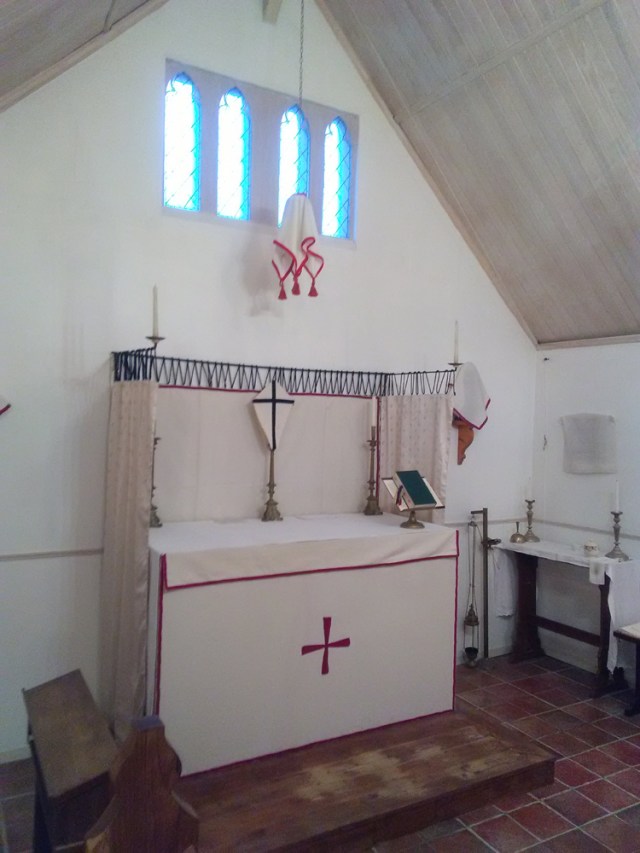
I have just returned from my chapel, having put up the Lenten Array according to our English tradition and burning old palms to make the ashes using a blowtorch and the metal lid of a jam jar. Once the burned bits have finished smouldering, I use a teaspoon to powder the ashes and put them into a little pot in which they will be blessed tomorrow. Being a cleric, I will be imposing ashes on the crown of my head where traditionally the Tonsure is shaved. The dirty crosses on the forehead are a later custom adopted for the laity.

What will Lent mean to me this year. For us all, it is a journey towards the renewal of our Transitus Domini, an expression full of meanings in the archetypes of the Old Testament and the Passion and Resurrection of Christ. Some of us will be wanting to work on something particular in our spiritual lives. I certainly intend to read more, especially the Humanist dimension of Christianity, which I believe is the only thing that will save the Church, not as an elite institution, but the communion of all in Christ. We will certainly reflect on the crisis of seeing what we have held dear for much of our lives being taken away, first our Churches, and then our countries and fatherlands.

Coming back to the old tired subject, I read How Brexit will save Britain today. It confirms my reflections on the new middle ages, the hymn to the night as we expiate our pride and embrace a new chapter of our history. My other thought was the story of Charles Dickens The Tale of Two Cities, and it being the turn of England and the UK to suffer a revolution it has not seen since the seventeenth century. What form that would take, I have no idea, and I can only pray there will be no violence or loss of life.

I do remember something from school history – that we escaped revolutions in critical times like the 1790’s, 1830, 1848, 1870 when there was so much instability in Europe, because our political establishment was able to enact the right reforms at the right time to lower the pent-up pressure slowly and safely. The status quo was maintained. In the twentieth century, the UK alone escaped occupation by the Nazis because of the natural barrier of the sea and the courage of the Royal Air Force. This certainly made many of us English feel apart and special in some way compared with France and most of Europe at one time or another occupied and oppressed by the Axis. We also have a highly archaic system of constitutional law and jurisprudence, which may be an advantage or a handicap (depending on which way you look at it) in comparison with the Napoleonic Code or France’s five Republics and the new Germany after 1945 and the reunification of that country in 1990. We have laboured with an archaic system for centuries, and the rest of Europe has a modern constitution and code of law for each country.

As for us all, Christians during Lent or our countries facing the future, we have to stare into our souls and take stock of our existential crisis. The UK, if no-deal goes ahead (or any kind of Brexit for that matter), is about to declare war on itself and become a defeated nation like Germany in 1945. No enemy was needed, and at no time has the European Union uttered the slightest threat in England’s regard.

I don’t know what is going to happen. There are plenty of rumours and sensational news articles, stories of chlorinated chicken and junk food, of shortages of medicines and toilet paper. These seem to be scare strategies for people used to thinking only about their daily lives (as I too have to). The main religion of England is no longer Christianity, but has for a long time been that of Mammon, the worship of money and power. Our country has more or less returned to the Victorian era when medicine and a home were luxuries and the poor cannot even appeal to the charity of religious communities. In the Victorian era, philanthropy was something that Oscar Wilde found wanting in sincerity or true compassion:

Most people are other people. Their thoughts are some one else’s opinions, their lives a mimicry, their passions a quotation. Christ was not merely the supreme individualist, but he was the first individualist in history. People have tried to make him out an ordinary philanthropist, or ranked him as an altruist with the scientific and sentimental. But he was really neither one nor the other. Pity he has, of course, for the poor, for those who are shut up in prisons, for the lowly, for the wretched; but he has far more pity for the rich, for the hard hedonists, for those who waste their freedom in becoming slaves to things, for those who wear soft raiment and live in kings’ houses. Riches and pleasure seemed to him to be really greater tragedies than poverty or sorrow. And as for altruism, who knew better than he that it is vocation not volition that determines us, and that one cannot gather grapes of thorns or figs from thistles?

O tempora, o mores! We are not very different now. Perhaps we are about to be taught a lesson. Our political system, both conservative and socialist, is rotten and unfit for purpose. It all needs to be swept away. The humiliation will be complete, and I can only hope that redemption and God’s forgiveness will come out of it. Read the article and ask yourself the question – Could it be true? Are we not a roaring mouse?

… perhaps we will get the revolution we actually need.

I don’t hope for a revolution, for violence or for death, but rather in the words of our Prayer Book:

Almighty God, the Father of our Lord Jesus Christ, who desireth not the death of a sinner, but rather that he may turn from his wickedness, and live; and hath given power, and commandment, to his Ministers, to declare and pronounce to his people, being penitent, the Absolution and Remission of their sins : He pardoneth and absolveth all them that truly repent, and unfeignedly believe his holy Gospel. Wherefore let us beseech him to grant us true repentance, and his Holy Spirit, that those things may please him, which we do at this present; and that the rest of our life hereafter may be pure, and holy; so that at the last we may come to his eternal joy; through Jesus Christ our Lord.

Posted in Uncategorized | Tagged | 3 Comments

The Moral High Road

A few days ago, I watched Nuremberg (2000) on YouTube. The whole film is available for you to watch online or download.

From 1 hour 32 minutes to 1 hour 50 minutes, there is a dramatic cross examination of Hermann Göring who takes advantage of procedure to manipulate, monopolise and forward his arguments. Justice Jackson is brought to want to offer his resignation after the blows of Göring’s bloated arrogance, the judges following procedure and his own tactical errors. His aide Mrs Elsie Douglas handles Jackson in very simple terms, inviting him to bring out his own interior thoughts and values.

… if their values are stronger than yours, if they believe in their ideals more than you believe in yours…

Jackson then talks with the British judge who reminds him of his thoughts of moral superiority in prosecuting this trial.

– Do you see Göring as a statesman?

– No, I do not. I see him as reprehensible – and inhuman.

– Then treat him as such – the vile, conniving, fascist bastard that he is.

I once found this frightening recording of Göring, and you don’t need to understand German to discern his ability to crush and manipulate at will. Just his tone of voice conveys this psychopath’s personality.

These ideas came into my mind as I read Remainers should get ready for what this political chaos may bring.

This game can’t go on for very much longer and it won’t. Very soon, something will give and, depending what that is, it could create some real opportunities for remainers. So whilst it would be entirely premature for them to expect victory, remainers should learn lessons from the Brexiters when they didn’t expect their victory: they didn’t plan for it and so when to their and everyone else’s surprise they had their prize in their grasp, they didn’t know what to do with it. The consequence may now be that it slips through their fingers.

What is the essential point of fighting against Brexit? As I have mentioned before, two essential paradigms are opposed, both in the minds of politicians and ordinary voters: the revival of nationalism and a fear of the outside world (unless that outside world can be controlled), and on the other side, a healthy cosmopolitanism concerned for human rights and the welfare of the weak. If we are shaped by the latter world view, how do we conceive the idea of shaping the UK as a viable, credible and positive member of the EU?

Surely, there are practical benefits from membership of the European Union. One is freedom of movement: my right to live and work in France, Germany or Spain or any of the other European countries – and the right of people from any of those countries to live and work in the UK. Obviously, the concern is people from third countries getting into Europe via a country with slack immigration requirements, and then their being able to claim the same status anywhere of European citizens. To begin with, most of those immigrants are undocumented and illegal, not legitimately claiming refugee status. Obviously that issue has to be clarified – but without abolishing all freedom of movement.

The other main issue is discerning what really is “the will of the people”, an ideological euphemism or something real about whether a person’s vote is like the conditions of a mortal sin or any positive moral act: serious matter, full knowledge and full consent. In a context like this, we need to be clear and credible about our motivations for leaving or remaining. What is best for the country, above all for human beings and only then for the economy and business?

Whether we are Leavers or Remainers, we need to consider the purity of our own motives and their perceived motives. Are their values stronger than ours? Do we believe in our ideals more than they believe in theirs? If no-deal Brexit is something like our country declaring war on itself or shooting itself in the foot, then we have the moral duty to resist by all moral (and legal if we don’t want to get into trouble with the police) means at our disposal. Another thought is whether our adversaries in the ERG are true statesmen with the good of the country at heart – or whether they are vile, conniving, fascist bastards. Are the accusations of dark money and corruption true? If so, this is very serious, and it is our patriotic duty to fight and push our MP’s to such a position of resolve and determination to do what is right.

A very important thing for us to do is make judgement from facts, and not try to extract truth from opinion. We have to develop a critical mind, which partly comes from education, but also from a spiritual life that seeks the good, the true and the beautiful. Sometimes, events and facts bring us to change our minds and come to terms with a new truth. Most things we believe in turn out only to be possible or probable, not absolute. I have had written dialogues with those close to me who see things in a different way from the way I see them. My question is why they believe in what they do hold as true. Did they believe a lie – or did I? Are we all confused by the present shambles of British politics, the lies and corruption? What can be verified? We may never know for certain.

As for other matters in my life, like autism, we need a philosophical approach, an ideal to look towards. The European Union isn’t perfect. Nothing is. But, the founding ideas were born from the Nuremberg Trial and the lessons learned from defeating the Nazis and the fascists. There are two essential paradigms: one of competition and the absolute rights of brute strength, the other of compassion and the rights of all human beings and the natural environment in which we live. The latter must prevail as an ideal and be ever perfected and strengthened like our life of virtue and prayer as Christians.

What are those ideals at the foundation of the European Union? They are resumed briefly in this EU in brief. The project is eminently humanist and cosmopolitan, which appeals to anyone who has emerged from his cocoon to discover the world.

The first ideal is to put an end to war and genocide, to make sure that Nazism and fascism can never again happen or find fertile ground in our countries and continent. The second is to ensure our rights to freedom, life and the pursuit of happiness. Others concern our right and possibility to live by our work in decent conditions, our education and encouragement to use our rational faculties. If peace is to be maintained, we need to have our cultural identity as English, Germans, Greeks or whatever, and for our countries to live in harmony on common agreed principles.

Would it really be such a loss if the UK went over to the Euro? We already changed our money system in 1971, and the half-crown coin or the tanner are now a distant memory for me. Trade and banking would be so much easier, and we ordinary people wouldn’t be changing money as we crossed the Channel.

If the Church is semper reformanda, to be constantly reformed, then so has any country or union of countries. I don’t know about everything going on in Brussels. People I am inclined to believe tell me that there is less corruption and dark money than in the British Government. There are lots of lies and fables about square or straight bananas, or about some Orwellian scheme to bring about the 1984 dystopia. The UK already has one in its new “ministry of truth”! As I recommended above, we need to be ready to come to terms with changing our minds if new evidence convinces us.

I feel called in my life to pursue the goal of Christian Humanism, as reigned from the time of the Renaissance and has influenced our nobility of spirit ever since. Democracy is a difficult question, since it is authentic and possible only in small entities in which people are educated and have a moral and spiritual basis to their lives. Otherwise it is little more than mob rule. Churchill said in a speech to the House of Commons in 1947:

Many forms of Government have been tried, and will be tried in this world of sin and woe. No one pretends that democracy is perfect or all-wise. Indeed it has been said that democracy is the worst form of Government except for all those other forms that have been tried from time to time.…

Conservative Christians may find fault in what I have to say about equality and inclusiveness. These ideas will mean something when we are ourselves members of a minority (an Englishman living in France, someone with autism, etc.). I said to my wife some days ago that I am the most feminist man she is likely to meet, because I do believe in the ideals Mary Wollstonecraft, Elizabeth Pankhurst and others stood for. She seemed to give me credit for that. To go further, we need to build a whole new philosophical reflection on the complementarity between men and women as being equal in their diversity and difference. I will not go into the other “hot button” issues here, but they all need reflection from a humanist point of view.

Since my days with the traditionalist Roman Catholics, I have had to reflect on these questions. I found that many such Roman Catholics entertain ideologies close to fascism. It is the old question of relinquishing freedom to be constrained into salvation. People who think that way are likely to find some nasty surprises at the end of their earthly life. My own thought has been influenced by philosophers like Berdyaev and Tolstoy, and by the Romantics in the wake of the French Revolution, and by the entire humanist movement from Renaissance times. I am as unsatisfied by Socialism as by the various Capitalist systems on offer. There is the old joke about Boris and Ivan in Moscow, one asking the other what was the difference between Capitalism and Communism. The other answers: In one, man exploits man, and in the other, it’s the other way round. Tweedledum and Tweedledee, the old conundrum of conservativism and liberalism. This is why I try to look higher and deeper, over the slogans of the man of the crowd. I find it is what Rob Riemen says when he finds the essential difference that makes us noble, that of man’s soul.

Do I believe in these principles of human dignity, peace and freedom more than those with the ideal of power, competition and strength (physical and financial)? I have no simple answers, given the diversity of motivations that give each one of us our beliefs and convictions. The question is open:

What do you believe in?

Posted in Uncategorized | Tagged , , , , , | 6 Comments

York Minster organ specification revealed

I mentioned some time ago that the organ of York Minster was being restored to more or less its 1931 specification. The project is due to be completed in 2020. This is an exciting development.

Specification from Harrison & Harrison.

Posted in Uncategorized | Tagged , | 4 Comments

How do we deal with evil?

This is a theme that confronts us each year during Passiontide as the Church brings us to meditate on the rising wickedness of Scribes, Pharisees, Temple clergy and others against Christ, culminating in his death by crucifixion inflicted by the Roman occupying forces.

Some time ago I read Frederick Forsyth’s Odessa File, in which the diary of a former Auschwitz prisoner who had committed suicide is unfolded. It lays the entire foundation of the quest of a German journalist in the 1960’s to find the evil SS officer who was responsible for millions of deaths at the concentration camp and of his own father. The old Jew had written in his diary about when the Nazis killed his wife:

After her death, my soul died inside me. But my body and mind remained alive. I was determined to survive…

This is certainly the most poignant quote in the whole novel. It is the testimony of absolute destructiveness of evil. There is nothing positive in it. It does not build the personality, but destroys it. We will only find redemption by seeking a higher power, the good and true – which we call God.

Where did evil come from? There are any number of myths (not something that isn’t true but expressed via a narrative not intended to be literally understood) that try to answer this question from the Book of Genesis to the Gnostic scriptures and others in other world spiritual traditions and religions. Whichever narrative most describes the origin of mankind and evil, whatever happened in that parallel universe we will never understand fully in this life, man was driven from paradise into a world of evil. Thus we would encounter people who care about nothing, who lie, kill, swindle, are cruel bullies and everything we read about in the news. There are also the catastrophes that happen independently from human causality. It is a mystery that goes all the way back to origins.

In each of us remains the imago Dei, the spark of divinity that no amount of evil can extinguish. This enables us to choose to seek the truth, beauty and goodness. We can find our place among many philosophers and prophets, lessons of wisdom and the highest aspirations. This has to be our cause for optimism however dark the world becomes. Notwithstanding, as it comes and goes in waves, evil seems to win out until some miracle comes from where it is least expected. As a theological student, I often asked myself what was the point of the Redemption, since it seemed to have failed to change the evil in the world, or that its effect was limited in time. What I failed to understand – as we all fail to understand – was that we expected something that was never to be. The Redemption is situated at another level that abolishing evil in this world.

The power of the Archons continues in its full force. Everything is in our understanding of goodness and truth. Wars and persecutions continue in their fury against us, but we have not to fear those who kill the body, but who can annihilate the soul before sending both body and soul to hell.

It is a spiritual battle, but not only. We are endowed not only with the eternal and transcendent spirit of God, but also with reason and optimism about our lot in life. In the Renaissance, something new emerged, optimistic and filled with light. Human reason can choose to seek truth and goodness. It brought us to another understanding of sin and our dependence on God’s grace. The Enlightenment brought us awareness of our capacity to make ethical judgements, that our humanity may shine forth. Thus we reacted against the notion of the Church being the only ark of salvation, something which was necessary to cast off the evil that had entered its institutions. However, the Enlightenment also had its dark side in pride and arrogance. The foundation of the United States of America was a wonderful opportunity for a New World, but slavery and racism were accepted. When God, spirit and humanity are rejected, there are no moral constraints and only the motivation of pleasure and bestiality remains.

Nietzsche, is his own tormented way, showed us the consequences of nihilism and the loss of any meaning to life. Power and money have no knowledge of good and evil. We live in that nihilism from when our world died in the trenches of World War I, the gas chambers and battlefields of the second, and in the mounting evil of politicians and businessmen. We become no more than brute animals, like in the depiction of an English public school in the 1830’s. Nietzsche was right in that as religion and faith died, they would be replaced by the political ideologies of Soviet communism, Nazism and fascism. What is being concocted in the present British chaos can only lead the same way. When evil grows, it stifles everything, enters our homes and makes our clothes smell like old cigarette smoke. Humanity ceases to have the strength to resist the disease, and life ceases to have any value. It becomes normal for the weak to be killed without compunction by the strong, wealthy and powerful. At the end of World War II, Hitler committed suicide, Mussolini was shot and hung upside down by his feet in Milan, Franco died of old age – but the disease remained like bubonic plague in hibernation.

Is there any hope now? It is for us to find it, to be philosophers and prophets and create new values of truth and goodness, to shine like lights in the darkness. We can do something. I am trying to do so by studying and writing, since the pen (or computer keyboard) is mightier than the sword. My vocation is one of education, of taking my humble part in this great movement of spiritual renaissance and humanism.

Whilst we can say that humanity died in the twentieth century, not everything was annihilated. As our world is increasingly absurd, something remains of the old humanity. If I am thinking and writing like this, there is me – and others must be thinking and writing along similar lines. Indeed I know they are, because I read them. What constitutes the difference?

W.H. Auden asked himself in 1947:

If, as I’m convinced, the Nazis are wrong and we are right, what is it that validates our values and invalidates theirs?

It is a good question, when I read Theresa May’s record on human rights when she worked for the Home Office. There are many threats, and the anxiety is mounting as I write. If the end justifies the means, then anything is allowed like the killing of “undesirables”, the banishment and exploitation of the poor, racism, slavery and everything we keep reading about. What is the source of morality? What happens when self-interest is the only “good”, at the cost of freedom and justice? We don’t seem to want to know. As Dostoyevsky’s Grand Inquisitor levels at Christ:

People do not want freedom, they want to be happy; the burden of the choice between good and evil is too heavy. People want to relieve their conscience by submitting to the miraculous, the mysterious, to authority! That is what we, the Church, offer them.

In other words, Huxley’s Brave New World. We go beyond good and evil to modern corporate values: money, efficiency, market, being competitive, etc. This has become the modern “paradise”. Not only is there no morality. There is no truth. We live in a “post-truth” era and language has no value. The next stage is the amalgam of man and machine, the final death of the soul. Reason, technology and science have brought many benefits, but evil is still lurking, and always hidden or disguised. It is easy to understand the populist reaction as nationalism and xenophobia are resurrected. This revolt is utterly unpredictable, until the demagogue goose-steps onto the stage and has them all mesmerised like the guru of a sect. Like in the 1930’s mainstream political parties are discredited and they no longer have any usefulness. They are dinosaurs. Liberalism and social democracy seem to have outlived the usefulness and have to be replaced. By what? This is my concern when people tell me that Macron must go! Mme Le Pen doesn’t convince me! She too is in it for the money.

We live in anxiety and fear. Fr Jonathan Munn has just written Custard Pies, Spacetime, Joy and Brexit in which he expresses the same concerns as most of us at this time. Like Germans in the 1930’s, we are paralysed by fear and helplessness, and we are faced with the temptation to give in, to accept evil becoming banal. Even the “Remainer” Facebook groups contain many comments advocating the execution by guillotine or hanging or whatever of the chief powers behind Brexit: Boris Johnson, Rees-Mogg, etc. A women who watched an execution in France in the early twentieth century expressed her disappointment: “It’s already over?” I find myself having to look away from these groups, because they saturate me with anxiety.

Our historical period seems to be one of the Night, a new middle age of purgation and conversion, a long and hard Lent. I have resolved to read more, good philosophy from past eras and our own times. I get piles of grouped e-mails about the problems in the Roman Catholic Church and its Pope – and see parallels with the government of my country. That said, Pope Francis seems to have a higher moral calibre even though he is not a conservative or a traditionalist. I have to filter the saturation of information and concentrate on what is essential and fundamental to truth, beauty and goodness. Bad news, whether true or false, builds anxiety and bad judgement. Things are not easy to understand, and that is why there are conspiracy theories – some of them as ridiculous as they are absurd. We have to filter and be aware of our own limits. Otherwise we burn out!

Both reactionary politics and technocracy will promise us paradise and a solution against evil. Paradise is not attainable in this world. The battle between good and evil is eternal and never ending. However, we can look within ourselves and make a difference there… It may seem to us that Christianity has been mortally wounded, something I often think about. There may be any amount of evil in churches as in secular politics, but Christ remains as does his message to us all.

Every time my faith seems to be flickering away and dimming, it always bounces back with every spark of goodness and light. The sunny weather of our mid-February is already a sign and an encouragement. A full order book assures me of being able to earn a living. Blessings abound where we look for them and have the gratitude to receive them from the God who is pure love.

The night is far spent, the day is at hand: let us therefore cast off the works of darkness, and let us put on the armour of light. Romans xiii, 12.

Posted in Uncategorized | Tagged , , , | 10 Comments

Tom Brown’s Schooldays

Last night, I watched the 2005 film of Tom Brown’s Schooldays with Stephen Fry as Dr Arnold. We are very lucky to have the full film available on YouTube. It is worth getting one of those special software packages to download the mp4 file onto your hard disk – either that or buy the DVD.

It is a film with which I can relate, quite different in nature from Lindsay Anderson’s If… The latter is a parody of the English public school intended to convey a different message, one very much in vogue in the late 1960’s.

I was myself formed in the English public school system (St Peter’s York), but I was thankful that I had an enlightened and progressive headmaster by the name of Peter Gardiner (he has just died in his 90’s) who was replacing the old spirit of competition and rule of strength by humanist principles. I went there in 1972 at the age of 13 years after a troubled time and several attempts by my parents to find the right thing for me. Already, the year before, I had experienced the progressive vision of Kenneth Barnes and Brian Hill at Wennington School. In September 1972, off I went with my trunk and tuck box to my place at The Rise, where I had my bed in the dormitory and a desk in the Junior Common Room. I still have the tuck box, which I use as a portable chapel. Peter Gardiner had been appointed headmaster in 1967, so he was still relatively new and youthful. His predecessor J. Dronfield had maintained the old tradition of fagging and flogging, success in competitive sports and masculinity. Gardiner dragged the school kicking and screaming into the 20th century by transforming fagging into a rota system of junior boys performing set tasks in the senior boys’ common rooms. They were simple and light chores like washing pots and cleaning shoes. It was a tremendous improvement on the old system. Fagging was really a relic of the old medieval knights and squires. As for flogging, I was never whacked at St Peter’s but received punishments consisting of copying pompous texts about “discipline” or various restrictions, for infringements of school or house rules. We still had rugby and cricket, but these team sports were only compulsory for my first two years, after which I was allowed more freedom to choose non-competitive outdoor activities. I was teased a little in House for joining the Chapel choir and having organ lessons. Boys were still quite brutal and cruel in the 1970’s but were a universe away from Rugby in the early nineteenth century. Gardiner encouraged the arts, music and drama. We had House singing competitions, musical productions, Gilbert & Sullivan operettas and many more. A boy could be as “sissy” as he wanted, and the old brutality was definitely melting. My memories were a world away, but the experience prepared me for independent life away from home and seminary (which was quite “cushy” in the midst of gilded mirrors and silk drapes).

Rugby School in the 1830’s was another world. Dr Thomas Arnold was a visionary for his time. He set the standards from which my headmaster reacted in his modern and progressive way. Boys’ schools in those days were brutal and cruel as pupils were left to their own devices, and tyranny by bullies was the result. Dr Arnold introduced new subjects on the curriculum like history, mathematics and modern languages like French. He did not favour the natural sciences on account of their materialism and his Romantic idealism, but rather favoured philosophy. He introduced the prefect system which gave sixth-form pupils powers over the younger boys. In my school, they were called monitors and had the privilege of wearing blue college gowns. It can work as a system if it is carefully watched, lest bullying and cruelty enter the system. Our tradition of sports entered the picture through being an alternative to fighting and delinquency.

Arnold’s priorities were the cure of souls (he was a clergyman of the Church of England), moral education and only then intellectual development. It was a philosophy of education akin to German Bildung. In my time at St Peter’s, learning German was encouraged (I did very badly as I also did in French) and some pupils went on exchange programmes to a school in Münster. Already, there was a European dimension that sunk deeply into many of us. Anyway, back to Rugby and Dr Arnold.

In the film, I closely watched the depiction of Flashman the bully and the psychological study of the toxic pathocracy in a society dominated by force and cruelty. The film is a tear-jerker with the death of a young boy who had been tortured by Flashman by being lowered into a well. The extent of Flashman’s evil cruelty is astounding for us in our time. Flashman was a fictional character, but they exist in the real world – and in England’s political establishment. There is an element you might miss if I don’t mention it, that Arnold found Tom Brown being morally poisoned by a school he could not reform quickly enough, and sent him home. Tom Brown returns to school with a strengthened and more noble character, able to face Flashman’s tyranny as a man.

Posted in Uncategorized | Tagged , | 4 Comments

If only….

I’m sure most of you know the classic film by Charlie Chaplin made in 1940. It is a caricature of the Hitler regime and there is the mistaken identity between the World War I veteran and Jewish barber and Adenoid Hynkel, the dictator of Tomania. The Leader is arrested by mistake and put in a concentration camp and the Jewish barber is taken to speak to the people. Here is his plea for humanity and peace, which I find intensely moving.

Posted in Uncategorized | Tagged , , , , | 1 Comment

Fascism and Nobility of Spirit

The following is a short article by Rob Riemen. After having nearly finished his second book To Fight Against This Age, I looked him up using Google, found his e-mail address and wrote to him asking him if he would be interested in writing something for my blog. I doubted I would receive a reply or anything substantial. I was wrong. He has been following my blog for some time and sent me this piece as an attached document. I was very moved to have received his warm reply which I found in my e-mail just after I had finished reading the book I mentioned above.

He was also open to my suggestion of studying Aspergers / autism from a philosophical point of view, and this is certainly going to be a great challenge for me to be asked to participate in a symposium at the Nexus Institute in Amsterdam (I don’t speak any Dutch, but I have never met a Dutchman who didn’t speak fluent English). I find the prospect quite thrilling.

Anyway, here is his précis of the book I have just read. There is a way to fight, not with weapons of war or aggression, but bringing back Princess Europa is a matter of caring for our soul. This is the real meaning of Europe.

* * *

What if the world of tomorrow turns out to be the world of yesterday? No, not that world of yesterday of Stefan Zweig’s evocative memoir of the splendor of the world before the first world war, but the era that came after that war, the fascist era?

‘No, not possible’, is what an academic and political class wants us to believe. Populism, yes, but fascism – are you kidding? Yet this kind of denial, as the memoir of Zweig reminds us, is so not much different from the mindset in Europe in the first decade of the 20th century. A World War? Impossible!

And yet it happened.

That was the first chapter of the 20th century.

The second chapter was the rise of fascism, Nazism, Stalinism, the love of millions of a nationalistic, xenophobic, resentful mindset and their hatred against the values of a liberal democracy.

The third chapter was a second world war.

The fourth chapter was based on the premise: ‘Never again!’. And we build a new society, this time a commercial society with economic growth, science and technology as the guardian angels for an enduring peace, progress and prosperity. But with almost blind faith in this new Holy Trinity of Money, Science, Technology, we no longer even wanted to remember what caused a First and Second World War. A political amnesia could get hold of our society.

The fifth chapter of our more recent history, our time, presents already one obvious fact: just one look in the better newspapers will tell us that the idea, the wish of  ‘never again’, is simply no longer true. Those who still believe this, are delusional – and ignorant.

Ignorant that with his novel La Peste Albert Camus already warned in 1947: fascism is a political phenomenon that will never disappear, as it is the dark side of every democracy! When democracy degenerates into mass-democracy whereby demagogues, stupidity, propaganda, claptrap, vulgarity, and the lowest of human instincts increase their dominance, that will inevitably give birth to that bastard child of democracy: fascism.

Ignorant about the fact that fascism will never return in black uniforms, and of course it will deny being fascist. But the characteristics of its mindset will be the same: the politics of resentment, the incitement of anger, fear and violence, the vulgar materialism and xenophobia and need of scapegoats, its hatred of the life of the mind; it’s hatred against the democratic spirit.

Ignorant about the fact that fascism is effective as a secular religion because it offers exactly what Dostoevsky’s Grand Inquisitor knew that a people who live in fear of freedom and devote their life to the pursuit of happiness and likes really want: myths, wonders and authoritarianism.

Ignorant about the fact that a true democracy, a pluralistic society of free people where everybody can life in dignity, is an elitist idea! Elitist in its original meaning: an expression of the best; of what a good society is. But like every expression of “the best” it comes with conditions and demands.

A democratic society demands the cultivation of moral and spiritual values which will set us free and create a culture in which we can try to make life meaningful and find understanding of our world and ourselves.

A true democracy will cultivate the tradition of European humanism, which teaches us that the quest for freedom and a living together of all kinds of people, demands of everybody that they practice: to live in truth, to do justice, to create beauty, to have compassion.

It was Cicero who captures this humanism in just four words: cultura animi philosophia est – the cultivation of the human soul is the quest for wisdom.

This humanism defines European culture and it is the key to a true democratic society. However when this mindset of nobility of spirit is replaced by the kitsch of nowadays money-culture with its idolatry of quantity, and the blind faith in science and technology, just one economic crisis will trigger all those dark instincts with which fascism will return.

Can we stop it? Of course we can. But that demands a fight, a fight against this age – for a human world tomorrow.

Rob Riemen

Author of Nobility of Spirit. A Forgotten Ideal (Yale UP)

and To Fight Against This Age. On Fascism and Humanism (W.W.Norton, 2018 )

Posted in Uncategorized | Tagged , , , , | 1 Comment

Dead Rats

I have just received a new book I ordered, Rob Riemen, To Fight Against This Age, and began to read it in bed with the accompaniment of some music playing quietly on a little portable speaker under my pillow. The vision of this author is amazing, as he analyses an état d’esprit that predisposes some people to a violent and indifferent “don’t care” attitude towards their world. I have had the advantage of reading about this problem of humanity from a psychological point of view – the various personality disorders and psychopathy. Not only do such people have no empathy, they couldn’t care a (you name it) about anything.

In this book, we read about a doctor in Northern Africa during World War II who found a dead rat on his landing. He took no notice. The next day he found three of them, and the caretaker of his block of flats dismissed the problem as a prank. More rats were dying, and then an increasing number of patients came to see the doctor with nasty symptoms leading to death within two days. The epidemic turned out to be bubonic plague. Denial become a situation of absolute emergency. Human nature brushes many things under the carpet until it is too late. In 1947, the French existentialist Albert Camus wrote the novel La Peste (The Plague) as an allegory of Fascism. The Nazis had been ostensibly kicked out of France in 1944, but the germs remained. You can never get rid of plague bacteria. They will go dormant for years and decades, and then they find a new vector to wreak devastation and death.

Riemen dissects and analyses the disease, and there are so many times as I read his words that I exclaim – I knew it! The nefarious potential is within each one of us. Even in the immediate aftermath of World War II, the bacillus would remain virulent in humanity.

I won’t reproduce Riemen’s book here. He deserves his royalties and I advise my readers to buy this slender hard-bound volume that says everything in so few words. I give you above a scene of two rival gangs of Yellow Vests in Lyon this weekend. One side is nationalist and the other is left-wing. Both sides share the same bestiality and violence. As I continued to read, I discovered the notion of the mass-man, the man of the crowd, the rot already detected by Göthe in 1812 and Alexis de Tocqueville who had been to America in the 1830’s to research its attempts at constructing true democracy. Nietzsche was the prophet of the consequences of nihilism. The man who has nothing and who lives for nothing becomes aggressive and violent. The “mass-man”, the man of the masses, has no mind of his own, no critical sense. He follows fashion and refuses any challenge to his certitudes. Man’s social instinct brings him to the lowest common denominator.

I have commented considerably about the British situation and the looming threat of no-deal Brexit. I live in France, but sheltered from the troubles by living in the country. I sympathised with the early Gilet Jaune movement, because the elected authority of a country has a duty to listen to its citizens and institute reforms for the sake of social justice, welfare and humanity. Many of us find it hard to make ends meet and increasing financial pressure makes people very bitter. Even though President Macron showed good will and willingness to dialogue with those expressing these grievances, the breakers and fanatics continued to break, burn and terrorise. Now they are fighting each other. Here in France, the alternatives to Macron are the extreme right Marine Le Pen or the extreme left Jean-Luc Mélenchon who is a kind of “French Corbyn” and as anti-European as his English opposite number. The Plague is no solution to our woes!

Look at this video. Is this what we want in our world in the name of populism or opposition to oligarchy and extreme capitalism? A man using “Byzantine” as a part of his handle has sent toxic comments to this blog with personal insults. They were trashed and that e-mail address has never been admitted to freely commenting here. I suppose this man is one of those fanatics who converted to Orthodoxy and in no uncertain manner carries the bacillus of the dead rats. He can’t kill me from where he is (USA) nor can he haul me off to a concentration camp, but I feel pity for him in his blindness, bitterness and anger. Only prayer can do anything good there.

I have no pretensions about my own “holiness” or resistance to the disease, but there are certain things in my life that I consider essential. There are the Transcendentals of Truth, Beauty and Goodness – but also a willingness to be critical about my own certitudes, to be constantly thinking, feeling and caring about others. Another important thing is that I have empathy, even an excessive degree of it thanks to autism which in my case is not “self-diagnosed”. It isn’t a label to absolve me of any responsibility for moral failings, merely a “tool” that helped me come to terms with myself and begin to find knowledge and balance. Three things are especially vital: faith, reason and humanity. Over the past five hundred years, humanity in the Christian west has seen the sublimity of the medieval cathedral, the Renaissance and art, the Enlightenment and science, and then the re-humanisation of both faith and reason by the Romantic movement. Religion without humanity can be truly evil like the atheistic and nihilistic ideologies of Soviet Communism and Nazism. Only humanism will save faith and spiritual life.

Populism and voluntarily contracting the Plague is not the way. Those who catch the germs will die from them. Perhaps this warning comes too late. At Mass this morning, I read the Gospel of St Matthew about the the storm at sea and Jesus sleeping.  Lord, save us: we perish. And he saith unto them, Why are ye fearful, O ye of little faith? In one way or another, we will return to the night of the middle ages: darkness and bestiality or light and sublime beauty. The choice is ours.

Then he arose, and rebuked the winds and the sea; and there was a great calm. But the men marvelled, saying, What manner of man is this, that even the winds and the sea obey him!

Posted in Uncategorized | Tagged , , , | 1 Comment