Darkest Hour

Sophie and I went to the cinema today to watch Darkest Hour, the film made last year about Winston Churchill in the spring of 1940 when all the odds were against England. Here is a trailer from YouTube:

What this film has done for me is to restore my devotion to and veneration for the greatest Briton of modern history. Early in the film, Churchill was portrayed as cantankerous, rude and unfeeling, perhaps as vulgar and mad as old King George III back in the eighteenth century. He drank whisky with his full English breakfast! He has been denigrated quite a lot over the last few years in the name of historical realism. I thought the film would follow the trend.

However, there are several things I noticed in this film, his deep humanity and emotional suffering under the weight of the decision of whether to try to negotiate with Hitler or defend the honour and freedom of his country. King George VI also comes through as a man of humility and a profound sense of duty to his people. Mrs Churchill is the women with an uncompromising character but yet the ability to support and strengthen her husband in these terrible times – true feminism in my reckoning. Following the King’s advice, Churchill takes the London Underground to Westminster, and asks ordinary people to advise him. Never would England surrender, and every man, woman and child was for fighting for our freedom. On the basis of Vox populi vox Dei, the principle of the Jury of a Crown Court trial, Churchill won the support of England’s entire political establishment and the people. Here is his famous speech which brings tears to my eyes:

That is the stuff of which my grandfather was made. He was taken prisoner in Dunkerque as he (Captain in the Green Howards Regiment) and his men fought to the last. Those men made the true nobility of my country. We can look back at World War II and take our victory and Hitler’s defeat for granted. Would we have liked to have lived in May 1940 when all seemed to be lost, darkness would conquer the earth with all its bestiality and love of death?

I have expressed opinions on the question of the just war. I tend towards pacifism, but if there was ever a just war, it was against Hitler, Mussolini and Hirohito. There is no compromise against evil, only the bitterness and determination to win the victory like the Knights of old.

Those days were not mine, but I might live long enough to see worse. Propaganda and fake news make the world that much more difficult to understand, knowing who are the “goodies” and who are the “baddies”. Some try to get us to believe that we would end up at war with Russia. Others try to pass off Donald Trump as a “new Hitler”. I don’t buy any of it. There would be no just war against either. I read alternative news as well as mainstream sources, and try to form a balanced judgement – and it isn’t easy. I see more evil in our own midst, in globalism, in our corrupt western political establishments. I would not like to live in Putin’s Russia, but I believe he is more a force for good than for evil. The Muslim Caliphate is an evil enemy, and I hope and pray our rulers and leaders will take decisive action to make sure they do not end up dominating us and imposing their ideology of death in the name of their totalitarian god.

If it is of any consolation, May 1940 was just as confusing then as many current events of our own time. History could have turned out so differently, and the idea is horrifying. The film Fatherland is much more tame than what might have happened. We have seventy-eight years hindsight. The men who fought and died then were not supermen, but ordinary people like you and I.

War is that one terrifying mystery of sinful humanity that deeply depresses me, but even more so the possibility of totalitarianism, evil ideology and the darkness of madness.

Κύριε, ἐλέησον…

Posted in Uncategorized | Tagged , , , | 2 Comments

Playing Classical Music on your PC or Smartphone

I have been through the wars trying to find the best way to play my favourite music on my computer (with an output to my stereo amplifier and speakers) – or on my smartphone through a portable speaker or earphones. The problem is that most music (mp3) applications assume that everyone listens to pop music – therefore everything is organised into albums, artists and songs. The application does this through data contained in the mp3 files, whether you copied them from your CD collection or downloaded them from YouTube or similar sources. In extreme cases, the application will delete files from your computer and decide what you should be listening to from streaming sites.

Windows Media Player used to leave files in the folders you put them in, and simply followed that system. Now, you are likely to find everything under “Unknown Artist”, Unknown Album” and “Unknown Songs”. Now, that’s really practical <sarcasm>, and in the best cases I find that half my Elgar or Mozart collections have disappeared under the names of the orchestra conductors or something even more esoteric. One solution is to edit the “metadata” in the files – which is really tiresome – which in any case will still be assumed to be the latest hits from Heavy Metal Shithead or whatever.

How do we escape the tyranny of the artists, albums and songs? I found some of the very rare applications for smartphones and computers that simply play your files from the folders where you put them on your hard disk.

For the smartphone (Android) – Folder Player which costs almost nothing for the full version. Music Folder Player was made for people who don’t like to see music displayed based on artist, album, track or playlists. If you prefer organizing your audio tracks in folder this may be the right player for you. There is a free version that you can try on your phone before buying the full version. It works fine for me.

Finding something for a computer is not easy. Google searches will point you to the applications designed for pop music. I came up lucky by finding Micro Music Player. Read through everything carefully to make sure it is compatible with your computer and operating system. There are versions for Windows and Linux. I don’t know about Apple-Macintosh. You organise your files yourself in folders under names of composers or whatever you want, and you select those folders manually, and the application will play everything in that folder – no frills and no “unknown …”. It isn’t perfect for everything, but I haven’t found anything better.

Of course, you can go on playing CD’s as in times past, or even tapes and vinyl records. The nice thing about having music on a computer is not having to look through rows of disks to find what you want. The point of any of these applications is organising things so that you can find things easily. That’s what computers do!

Please note that I’m not advocating illegal copyright violations, and that I assume you have paid for and bought the CD’s or downloads from the Internet that can then be copied for your own private use in this way.

Happy listening.

Posted in Uncategorized | Tagged , | 1 Comment

Dr Winch’s Gregorian Club

I am dwelling somewhat on Dr Raymond Winch (1921-2000), because I think I have some understanding of his thought underneath the enthusiastic rhetoric of his desire to get western rites accepted by existing Eastern Orthodox Churches. This understanding was brought home to me by several nights of discussion with him, until I was so exhausted I had to repair to some grubby bed in a spare room. My need for sleep was one of my great regrets as the daylight began to appear through the windows. I remember the shelves of books and the lectern from which he said daily Office from the Monastic Breviary. He was truly a hermit, a medievalist Romantic, and almost a Starets in his own way.

From the first time I met him during Holy Week (western) 1988 until his death in 2000, I counted him among my personal friends. I usually dropped in to see him when I was travelling between the south of England and my parents’ home up north. I also enjoyed days in Oxford and especially in the churches, college chapels and the bookshops. Ray’s conviction in Orthodoxy was already fading in the 1990’s, and he did not encourage me to seek out any “solution” with Orthodoxy. It was frustrating to me that the idea would remain academic. Since then, there have been successful initiatives in the Antiochian Church in the USA, and the Russian Church outside Russia has something, of which there are some small congregations in England – quite comparable to ours in the Anglican Catholic Church. I abandoned any serious idea about Western Orthodoxy from about 1999. I try to be courteous with those who believe they have found the “true church”, but to me it is little more than hyperbole and ideology. I was sad for Ray towards the end of his life when he was attending Roman Catholic masses, but the “punch” had gone from him. He requested a secular funeral, at which I was not present, living as I was at the time in western France.

What seems most salient in his approach was that he was an academic and believed that learning as well as piety was an essential part of Christian culture. He was not interested in “evangelising”, founding a parish, getting ordained in this or that Church. He prayed, read and passed on his wisdom through discussion and dialogue, through friendship and concern for men younger than himself. There was never anything improper or lewd about Ray, at least in my experience.

He often referred to the work and experience of Joseph Overbeck in the late nineteenth century and, in the twentieth, by Alexis van Mendesbrugghe and Eugraphe Kovalevsky. He contended that the Roman Canon had no need of a descending Epiclesis, and that the Supplices te rogamus was perfectly sufficient for this purpose and theological meaning. The Roman Canon had no need of any reordering and that it was perfectly acceptable to Orthodox liturgical and sacramental theology.

He became Orthodox long before women’s ordinations in the Church of England, but in any case, he had been a Roman Catholic like Overbeck. The prospect of Anglicans wanting to become Orthodox was passed up as an opportunity. Ray attended the Byzantine Liturgy for many years, but with an increasing awareness that he was not in his own liturgical culture. He knew that post-Tridentine Roman Catholicism had little to do with the medieval Church even though the 1570 Pian missal was almost identical to the old use of the Roman Curia. He was often seen in the Oxford Union and Bodleian libraries until his death, researching mainly English church antiquities and ordinary parish life in the 14th and 15th centuries. He was no longer quickened by what he had found in Orthodoxy.

I have cheekily suggested that he was one of the last of the Oxford Movement, like Pusey and Keble, but the latter two were clerks in holy orders of the Church of England. In itself, it is a serious anachronism, but might be considered by analogy. It has confirmed me in my own educational approach, not having a regular pastoral ministry here in France as a priest. Far away from those wonderful libraries, where a new member swears an oath never to kindle therein any fire or flame, I have the advantage of the Internet and have access to an immense quantity of published texts and websites. My work as a translator leaves me with leisure time to read and study, and I believe my life is finding a certain regularity and order so that I can begin again to work as I did at University. This is a true ministry, and I largely owe it to Ray Winch.

There is little about Ray or the erstwhile Gregorian Club on the Internet other than what I have put up myself. However, we read in a recently published book, Orthodox Identities in Western Europe: Migration, Settlement and Innovation, edited by Ms Maria Hämmerli, Dr Jean-François Mayer, Farnham 2014, pp 281-282.

While this overview covers most of the developments pertaining to the Western rite in (canonical) Orthodox Churches in Western Europe, it should also take into account efforts by various individual Orthodox faithful, although they have not resulted in the creation of parishes. One example was Raymond Winch (1921-2000), who converted to the Orthodox Church from Roman Catholicism, but kept a strong interest for the Western liturgical heritage. ‘His interest in the idea of a Western Orthodox rite originated in his previous dissatisfaction with the reform of the Roman Catholic liturgy following the Second Vatican Council. He founded in Oxford a Gregorian Club ‘for the restoration of Orthodoxy’s Western heritage’, for missionary reasons, but not only, according to the Statement of Principles: ‘Hitherto the great heritage of Latin Christendom has in some measure been preserved by those who are not Orthodox. Now it is being rapidly abandoned. We believe our heritage to be of great intrinsic worth. If it is not to be lost altogether, we Western Orthodox must make it our own once again. We wish to worship and live according to our own traditions – those of our saints’. The Gregorian Club did not envision separate Western Orthodox dioceses, but hoped for the unity of the Church, with one bishop in each place, over communities of different rites. The Gregorian Club did not last, but it had a few issues of a bulletin as well as some booklets printed, including what its founder envisioned as the ‘Canonical Mass of the English Orthodox’. [Footnote: ‘Rev. Anthony Chadwick, a priest of the Anglican Catholic church, has made this out-of-print text available online (Winch 2007).] A supporter of the Club published a study suggesting that the ‘historical point of departure [for a restoration of a Western Orthodox rite] must be the period before the schism, about 800-1000 – obvious, one would have said, yet none of the previous Western Orthodox restorers has taken this line’ (Coombs 1987: 60).

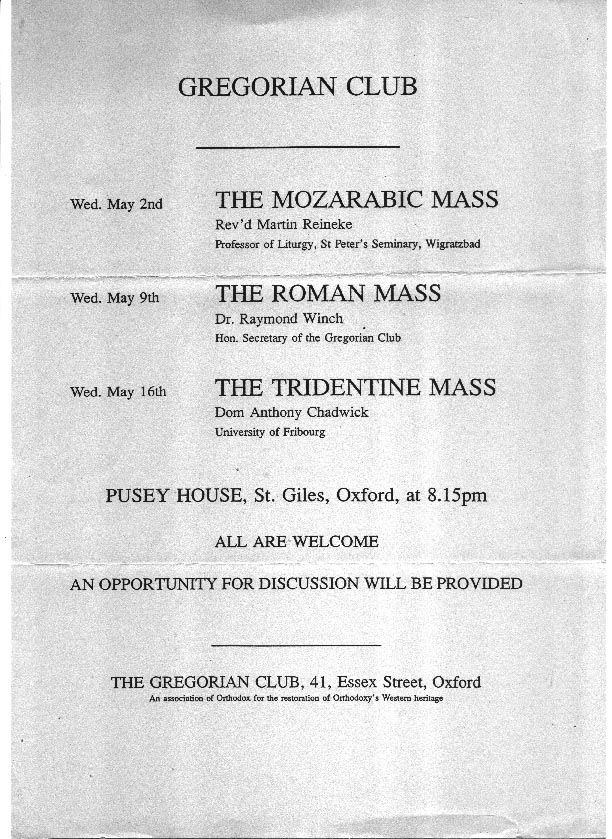
Ray, in 1989, organised some talks in Pusey House, and this leaflet found itself taped to windows of bookshops and libraries. Fr Martin Reinecke, a German priest, was at Fribourg at the same time as I was, also studying with Dr Jakob Baumgartner. I introduced him to Ray, and the idea came up about these talks. I prepared mine from my licentiate mémoire, which in abridged and revised form found its way into The Clark Companion to Liturgy edited by Dom Alcuin Reid (London 2016), pp 107-131. I was intrigued to be called Dom, but I was already a cleric in minor orders.

It was all a long time ago, but there were about 20-30 present at each talk, mostly people from the University, but a few friends from London too. The emphasis on Western Orthodoxy was practically gone, and it was now a question of working on our liturgical heritage regardless of which institutional Church we belonged to. This became a lasting principle for me, which formed the basis of this blog and my Sarum group on Facebook. Courtesy, absence of polemics, serenity for study and the use of our rational faculties. Briefly, it is the spirit of the university, of that fanciful community of canons that survived the Reformation, the Counter-Reformation and Vatican II!

His musings about this community were sometimes not very clear. I remember little about it, but he did imagine a college of canons as something like the Counter-Reformation Oratory and the university college – but for clerics. The foundational charter was so strong that it stood amidst the vicissitudes of the centuries. It rang close to a dream I had of finding a European diocese that hadn’t changed, perhaps in the French Massif Central or southern Italy. I found parishes like Le Chamblac (Fr Montgomery-Wright) and Bouloire, priests in Opus Sacerdotale, but nothing I could join in view to ordination and ministry. Anything that was “traditionalist” was reconstructed in the movement of Archbishop Lefebvre or a few conservative diocesan ordinaries like Cardinal Siri in Genoa. Msgr Wach’s Institute of Christ the King, with some Oratorian aspects but heavily baroque trappings came close, as did the Canons Regular of the Mother of God who have a magnificent monastery in Lagrasse, southern France. They too are reconstructions, though much less “military” than the SSPX.

I explored Western Orthodoxy from about 1988 until the following year. There were lovely ideas, but nothing accessible to me. To join a Church in the USA, I would have had to go to one of their parishes. Self-financing and with no guarantee, and with no basis for getting a Green Card. Yeah, I have heard that one before. It’s better to eat cake here in Europe, but I can’t blame a priest for imposing conditions. We do in the ACC.

I certainly wouldn’t attempt to run a club. I don’t have the “people skills”, any more than Ray did. A great idea fizzled out, because he wasn’t the right man for it. Someone else would have had other ideas… At the basis of all this is the reality of academic study and education as a form of Christian ministry, promoting our culture and basis of spiritual life and stability. The Gregorian Club was a pre-internet forum, and its purpose can be amply served by blogs and discussion groups. There is no need for anyone to be a member of anything – simply to learn, study and discuss.

There is something of Ray’s legacy in my work, and I’m proud of it. May he rest in peace and attend that Liturgy of which our own is but a dim shadow!

Posted in Uncategorized | Tagged , , , | 7 Comments

Our New Pro-Cathedral in the UK

Click on the photo for an enlargement.

I have been following the developments of my Bishop’s new church near Faversham in Kent, and this photo has appeared just after the carpeting was laid and the windows covered with a special plastic film to make them look like Victorian stained glass. This is a “fish-eye” view, so the altar rails and roof beam are straight, not curved.

Our Diocesan website announces:

The Anglican Catholic Church of St Augustine of Canterbury, Eastling Road, Painters Forstal, Nr Faversham, Kent ME13 0DU will celebrate its first public worship in its new Church on Ash Wednesday (14th February 2018) at 12 noon with Low Mass and Imposition of Ashes.

This is a wonderful achievement, and the Methodists who once worshipped in this church are commemorated on a brass plate on the wall to the right of the altar. The architecture is plain and lends itself well to the new furnishing as a church of Catholic tradition. The round-topped lancet windows are a real asset. The furnishing is reminiscent of the old church in Canterbury (many items transported and fitted), and the altar is sober and in the Anglo-Catholic style that is found in many churches in England.

Again, I am proud to be one of Bishop Damien Mead’s priests, and look forward to worshipping in this church, and perhaps saying Mass. A visible place of worship is always an asset to the Church’s mission both in England and in the USA.

Posted in Uncategorized | Tagged , | 1 Comment

Notes by Dr. Ray Winch

I have quite a few handwritten notes by Ray Winch which illustrate his view on the contrast between the Catholicism of his youth (1940’s and 50’s) and the medieval status quo. I remember the nights of discussion when I had to concentrate and be very patient of the slowness by which he exposed his ideas. He did tend to ramble – but always did return to the subject. He rarely looked me in the eye, and I would suspect he had Aspergers / high-functioning autism at the origin of his eccentric lifestyle and passionate knowledge and learning of philosophy and history. I seem to attract them!

He must have spent hours painstakingly writing things to send me, whether I was with the parish priest of Bouloire or at Triors Abbey with the monks. I do believe his memory can be honoured and served by publishing his essential message, that Catholicism without any other adjective is almost dead and only replaced with various ersatz expressions in Roman Catholicism and Anglo-Catholicism. Ray sought a “medium” for this aspiration in Orthodoxy, but alas it was an illusion.

In many ways, I try to continue his work in my own way of thinking about things via this blog and my Use of Sarum group on Facebook. We cannot go back in time, but we can seek to do better in recovering the older sense of Christian civilisation and culture. I don’t think we will succeed, but we can die trying! Ray did… He had a big influence on me, encouraging me to read Russian philosophy – which changed my entire outlook as a convert to Roman Catholicism, changed my views about George Tyrrell and Catholic Modernism (as opposed to Liberalism à la Bultmann, Harnack, etc.). He was a pure intellectual with little practical sense! But, in many ways, he was like a father to me during the short time I knew him.

I still have some letters to transcribe…

* * *

Catholic Worship in the 20th Century

I am old enough to remember Catholic worship as it was in England before the more significant liturgical changes. Living in the suburbs of London, during school holidays I visited many Catholic parish churches. Often I attended liturgical services in Westminster Cathedral when I was usually the only layman attempting to follow their choir offices. I was a relatively well informed observer. Having access to a few useful books in the splendid public library at Croydon, I knew a little of liturgical history. I was about 15 when I obtained and began to make some use of the Off. Parvum. A little later I acquired an Horae Diurnae and then some odd volumes of the Brev. Rom. Thus it was with a relatively informed mind that I observed what I did. I knew that what happened in a Catholic church c. 1950’s was vastly different from what happened c. 1450’s: yet, strangely, the contents of the official service books had changed but little.

I have witnessed the Rosary officially recited aloud during Mass – and much of the like.

Three points, often overlooked:-

i) Services held in the open church were intended only for the public (called the faithful). Even when there were 2 or more assistant clergy, only the priest who was taking the service came into the church. The priests, it seemed, had no need of Benediction or to venerate the Cross on Good Friday, etc. etc.

ii) A good part of Sunday evening Devotions and Benediction was celebrated in Latin. On these occasions the faithful sung lustily and, I supposed, not without comprehension. (I have recently checked this matter with a few old men).

iii) Low Mass was not usually intelligible even to those who knew Latin. Most priests celebrated the entire service in a whisper even before a crowded congregation on a Sunday morning. The almost universal assumption was that the liturgy was not for the faithful.

Worship in an English Medieval Parish Church

I have accumulated abundant documentary evidence to prove that, in every parish church, Office was recited in choir every day. Additionally, on ordinary weekdays then was Placebo and Dirige. The services were arranged in two clusters, called in the vernacular, “Matins” and “Evensong”. The latter began “an hour before the setting of the sun”. During much of the year Matins would have begun before dawn. Then was a daily parish Mass while, at least in larger churches, was a High Mass. Contemporary illustrations of a solemn service, without servers but with one of the ministers holding a torch for illumination, are more accurate depictions than I had suffered. Apart from some town churches when special times were prescribed, chantry celebrations were chronologically geared to the parish Mass. (Here I disagree with Duffy about the purpose of squints.)

The laity attended Mass and Evensong on Sunday, as other great days. Those who had some leisure – particularly old men and young boys – were often in church for at least some of the choir offices.

Every parish had some clergy additional to the vicar. All vicars were to appoint, and pay, a clerk.

Clergy were trained by a kind of informal apprenticeship. A boy would receive the Tonsure, but he might not receive major orders until he was fully adult. Clerics in minor orders could marry and continue to serve as clerks, though they could not then proceed to the subdiaconate. (This system persists in present-day Cyprus: hence, besides, a priest, all churches have a psalmista and often a deacon.) Very many churches had chantrists who had “to help with service in the high choir”. Then were also, often, capellani (hired assistant priests).

Clearly, strict rubricism was impossible, eg. At Twyford an Ambrosian missal was in use. Clearly the psalter and much else would have been known by heart.

Some large parish churches had, additionally to the services proper to the day, a daily Mass B.V.M. “cum nota”. For this, boys were sometimes hired, or rewarded with teaching. I would guess that harmonized singing was often used on these occasions.

What follows does not, in the nature of things, permit of direct documentary proof: however, there insufficient evidence of diverse kinds to have convinced me.

1) Latin was far less of an obstacle than is popularly supposed. I believe that even the illiterate were able to follow the greater part of the services relatively intelligently. Certainly it was not only the men of Wales and Cornwall who would have found the familiar Latin far more intelligible than Cranmer’s London English. (I suggest that the imposition of the “vernacular” was motivated more by political than religious motives. There is a close parallel with what a faceless establishment is even more engaged upon.)

2) A measure of Latin literacy was widespread in the late middle ages. Having seen young boys teach themselves how to use complex computers, I have little doubt that an intelligent boy with access to the choir books would have required little assistance to learn to read. Our Cicero and Virgil, etc. would have usually required grammar schools and universities. It was the humanists who condemned Latin to death. Accidentally, I have stumbled upon incipient public libraries of non-liturgical books at St Paul’s, St James Garlickhythe and in Hereford. I guess that more might be found for the searching.

Fragments

I. Many men who write about medieval life may be excellent at dealing with the documents, etc., but make absurd mistakes because they are not at home with that about which they are writing. I could provide many examples. Here is one from Life in a Medieval College [cathedral vicars] by F. Harrison (1952) with a foreword by the Most Rev’d Cyril Garbett.

p. 56 “Immediately after the hour offices have been sung in the choir … the meal shall begin … The meal shall be taken at 3 pm. Supper shall follow at 5 pm at cinque de le clok”.

p. 57 “After Prime, the vicars may drink Benedictine once only”. The author notes numerous occasions when the vicars drank Benedictine (sic).

You will understand immediately how he has come to suppose that the vicars had their only two meals separated by two hours. But, so far I have not seen why he should make the mistake of supposing that the vicars drank little but Benedictine.

II. Another writer supposes that, where the liturgy at Saturday required three High Masses on the same day, the last Mass was celebrated in the chapter house. One can guess how he comes to make that mistake. [Chapter houses did not have altars as a rule.]

Yet another writer explaining that, though the people would have not understood the Mass because it was in Latin, they would have had some idea about the feast or season “from the colour of the vestments”. This, of course, is a gross anachronism.

I think I told you about the author Hamilton-Thompson, who had obviously used a Missale Romanum to describe the ceremonies of Holy Week in a medieval parish church. Unfortunately, he had taken a book published in the 1960’s! Hamilton-Thompson is now a Reader in Medieval History somewhere!

Can it be that I sometimes make mistakes like those above? I hope that friends would tell me at once. I know that I am a poor proof reader. Thus, let pass frumentum for fermentum and Romae for Romanae.

You ask “Can you also show evidence of common people going to Matins … and Evensong…?” Yes, I can. Matins, Mass and Evensong was standard observance of Sundays and other solemnities. I sent you my transcript of the Synodal Statutes of Quinel of Exeter [quoted below]. “…presentes essent ad horas canonicas faceant campanus pulsari quarum sonitu populus excitatus, dum ad ecclesiam divinum officium audiendi et orandi causa accedit…” Quinel was not the only bishop to leave record of this matter. Also, there are references to attendances at Matins and Evensong in vernacular literature. It would seem that on ordinary days, Evensong consisted of Vespers, Placebo and Dirige if one Nocturn with Miserere (ie. Lauds) several other psalms for the dead called Commendatio. This latter was ps. 138, ps. 118 [twice a day!] with a responsory. So far I have not found a specific mention of Compline.

You write “… England’s religion is money, comfort…”. I totally agree with you. I would add that cowardice has become the national vice. No man will risk anything for any cause whatsoever. I am deeply ashamed to be English.

Vale,

Ray

* * *

De Divino Officio Nocturno Pariter et Diurno

Ministri ecclesiarum, qui ecclesiasticis sustenantur stipendis, prompte debent esse et solicite circa divinum officium paragendum, ut in vina domni virilita laborantes preter stipendia temporalia que hic percipiunt eterne retributiones denarium meriantur percipere post laborem. Quos circa ipsum officium propheticus sermo instruit et informat dum per profitum dicitur: “In matutinis meditabor in te, etc” et alibi: “Septies in die laudem dixi tibi etc.”

Hinc est quod singulis ecclesiarium ministris invertute sancte trinitatis iniungimus, ut secundum formam concilii generalis divinum officium nocturnum pariter et diurnum corde et voce simul studiose celebrent et devote, plane et plene absque sincopa psalmendo seu cantando singula que incumbunt. Caveant igitur psalmentes ut in medio versiculi pausant pusillium, nec unus sequentem versiculum prius incipiat donec alta plene dixerit precedentem, et sic psalmendo sese intelligant ut dom voce unus psalmit animi affectu alta simul psallere vidietur. Et quia canonice hore secundum temporum interstitia in eccleses parochialibus sicut in cathedralibus et collegiatis nequiant decantare, et precipimus ut presbeterii parochialis ab ecclesiis suis recedere non presumat donec festibus diebus ante missam vel post canonicas horas decantaverint, vel saltem legerint absque canto cum dies non fuerit feriandus: proviso quod missam sacerdos prius non celebret quo usque matutinas et primam suo exsolverit creatori. Precipimus etiam quod parochiales presbeteri omni die preteream in pascale tempore et festis sanctorum novum lectionum et in vigiliis eorum dicant Placebo et Dirige et Commendationem: Hec tamen tempora non excipimus dum tamen id velint facere ex devotione.
Preterea audivimus quandoque quod presbeteri, quamquam fuerint absentes forte ex illicita causa, tanquam presentes essent ad horas canonicas faceant campanus pulsari quarum sonitu populus excitatus, dum ad ecclesiam divinum officium audiendi et orandi causa accedit, presbeterium non inveniens, a clerico presente querit ubi sit et responsum accipient: Non est hic, iam recassit: et sic parochiani elusi recedunt, et ecclesia debit is defrandatur obsequis.

……

Alii vera capellani conductitu diebus dominicis et aliis solemnitatibus non prius celebret donec missa parochialis fuerit celebrata.

Posted in Uncategorized | Tagged , , , | 29 Comments

Dr Ray Winch reinvented

It was quite a while ago when I wrote about Dr Raymond Winch in Oxford. Simply, I was browsing through Blackwell’s Bookshop in the early days of Holy Week 1988 and came across The Canonical Mass of the English Orthodox. The booklet had his address on the back, at which he based his Gregorian Club, 41 Essex Street. I simply went and knocked on his door, and discussion began immediately.

As mentioned a few days ago, I have been clearing out my stuff and arranging for myself an “Oratorian nest” in our house. My wife can, of course, come into the room if she wants, but I have clearly done it as I wanted. Going through so many old papers, I came across this grubby little photo, perhaps from some official ID card, and have enlarged it on Photoshop. He was obviously not photogenic, but this is all I have. I share it with my readers, a few of whom might at least have heard of this name. David Llewellyn Dodds is my one reader who actually knew him and was interested in his work.

I have also found some handwritten correspondence in a folder from my time with the monks at Triors in 1996, and I will go through it and offer some transcriptions. It will take time, since handwriting can only be typed out by hand. I am informed by one of the commenters on my earlier posting that Dr Winch left his books and papers to Magdalen College School. I hope someone will have the diligence to publish something of lasting value.

Reinvented? I mean of course the Latin meaning of the word invenire – “to find”, as in the Invention of the Holy Cross.

Posted in Uncategorized | Tagged , , , | 17 Comments

A Different View of Diversity

On my daily rounds of the Internet, I try to keep to things that are inspiring and positive, unlike news (whether fake or “official”), but I could not resist a comparison between someone giving a personal answer to the question of whether Aspergers can be “fixed” and an article on the ideology of “identity politics”.

To quote the view of someone with Aspergers, with which I can perfectly identify:

I simply happen to think differently from many people on this planet. Some might say I have problems on a social level; I simply think I don’t need some of the ‘trappings’ that seem important to folks not on the spectrum. I am not impressed by status, not interested in most material things, can’t be bothered by gossip and more interested in looking at people without all these ‘add ons’. My inner life is ‘rich’ and I treasure that.

The longer I study this question and see these little points of view, the more I see what Christ seems to have been all about: that famous paradox of the humble being given the highest places and the haughty being told to leave the places they had usurped. Maybe my own life would have been more “successful” with a better social sense – definitely at seminary where I spent as much time alone as possible. This disassociation from the “world” coincides so perfectly with the Gospel idea “and the world knew him not” and so many more expressions especially in St John. To me, I seem to have received a gift that is humbling and filled with light.

I also seem to have received the ability to detect human sophistry (worldly wisdom) in such a way that I simply don’t understand many people around me. One example is this article Identity Politics vs white people that appeared in an alternative news site I occasionally consult. On one hand, I understand the animosity felt in regard to aggressive and insensitive men who historically have exploited those they have defeated by brute strength and competition. I have no sympathy with right-wing politics and the subordination of the human person to the totalitarian collective, but I also eschew this desire for revenge, for an equal and opposite reaction.

Whatever happens in the future, we are best off by taking our distance, both physically and ideologically. Someone is trying to stir up a war between right and left, black and white, homosexual and heterosexual, men and women and so forth. Perhaps one advantage with Aspergers is that we don’t have issues with women, people of other races, those who live their lives as they are and getting by as best as possible in an imperfect world. Perhaps the best way to work for inclusion of diversity is oneself to accept one’s own difference and personality, and then we understand that no two persons are the same except for any superficial external characteristics.

I am concerned that this “identity politics” ideology may lead to something dreadful like Stalinism or Orwell’s Big Brother, perhaps an all-out war between races, religions and any differences. Then, to survive, we would all have to be the same like new cars coming off the assembly line of a factory. My impression is that the ideology is so absurd and stupid that it cannot survive and would do little more than cause blowback against those who are protesting that white males are different from what they think they are.

Such is the world:

If the world hate you, ye know that it hated me before it hated you. If ye were of the world, the world would love his own: but because ye are not of the world, but I have chosen you out of the world, therefore the world hateth you. Remember the word that I said unto you, The servant is not greater than his lord. If they have persecuted me, they will also persecute you; if they have kept my saying, they will keep yours also. But all these things will they do unto you for my name’s sake, because they know not him that sent me. – John xv. 18-27

Posted in Uncategorized | Tagged , , , | 2 Comments

Novalis

To romanticize the world is to make us aware of the magic, mystery and wonder of the world; it is to educate the senses to see the ordinary as extraordinary, the familiar as strange, the mundane as sacred, the finite as infinite. – Novalis

Doing my rounds on Facebook, I came across this sublime quote. I looked up this character and found two articles:

His real name was Georg Philipp Friedrich Freiherr von Hardenberg (2nd May 1772 – 25th March 1801). I am getting very intrigued by this young German philosopher in the early Romantic tradition. Like many philosophers and poets of that era, he died very young of tuberculosis. He also had long natural hair, which was more in fashion in the eighteenth century than now. I recognise many of the themes and constructs from German idealism and Romanticism.

Like Nicholas Berdyaev, he was very influenced by his extensive reading of Jakob Böhme, and we find many themes of mystical Lutheranism.

Time to get reading….

Posted in Uncategorized | Tagged , | 5 Comments

Where it all happens

I have been doing a massive job of reorganising my scriptorium, or in less pretentious terms, my office. It’s still not finished, but it is operational for my translating jobs and other uses I make of my computer including this blog. I have selected the most consulted of my books to be near me, and all the others are left in a library in another room of the house – still to be reorganised and adapted for Sophie to be able to use it as an office.

It was quite a mammoth task, as both she and I tend to be hoarders – and the useless stuff is going. I won’t sleep and work in a furniture store. The house is becoming something of a Kubric’s Cube! What comes out of one place has to go into another. Sophie is convinced of the need to do much more sorting-out, and get rid of, give away or sell what we don’t need. It’s a start.

In order to do the main heaving and moving, I have not attended to the details of archiving loose papers, but came across a few photos that dropped out of an envelope. One of them was this one of my priestly ordination in 1998.

Of the six of us in the photo, only I and one other are still alive! It is a sobering thought. I am glad to have found my way back to Anglicanism and the possibility to minister somewhat more legitimately as a priest in a diocese under a Bishop. I thank God for that grace, because we are not priests for ourselves but for the Church. This coming June, it will be my twentieth anniversary… In March (19th) it will be the Silver Anniversary of my diaconate (at Gricigliano by Cardinal Pietro Palazzini).

Posted in Uncategorized | Tagged | 1 Comment

The Potomac two-step

On receiving an e-mail from a correspondent in Belgium this morning, I was reminded of a film I once saw of Harrison Ford with a fictitious American President. The President reminds Ford about the realities of Washington politics and the need for Machiavellianism, expressed as the Potomac two-step. Ford replies to the President: “Sorry Mr President, I don’t dance” and then goes “up the hill” to the Senate to expose the President’s unconstitutional acts.

I am brought to think about this expression when considering the present-day clash between the conservative Right and the various minorities seeking to flaunt their ways of life and expect to be deferred to because they shout the loudest. I believe that I have always made the effort to understand the alternative lifestyles of everyone and to respect their choices, just as I have my way of life and thought. I have, for example, expressed my reserves about the “neurodiversity” movement if the statistical one in fifty of men sought to rule the world by their experience of life. The result is invariably provoking the growing groundswell of bigotry and conservative simplism. The more we complain about discrimination, the more people will feel inclined to discriminate and be bloody-minded.

Just a few decades ago, black people in some parts of the United States were segregated, weren’t allow to drink in the same bars or even use the same bathroom facilities. Now, some of them are calling for genocide against white males. Don’t you find that a little excessive? Doesn’t that make us tempted to make racist comments in circumstances where we wouldn’t get in trouble with the law? I saw a black school pupil for the first time when I was about 7 – and I had no problem with that. We had to endure a lecture from the schoolteacher about black people being humans like us. The question didn’t even come into my mind – Stella, as she was called, was simply a human being with a different appearance. Why should I have a problem with that? I felt that the teacher was putting ideas into our minds. Of course I was not the other pupils in the class who might have had racist ideas. Is it Aspergers that makes me feel alienated?

A few days ago, I wrote a posting about a point of view representing reasons to be optimistic about our times, and found the same old message of feminism, “anti-homophobia” and environmentalism. I tried to see the good in these positions. The e-mail I received this morning caused me to remove that posting, along with comments mitigating this optimism. I felt on shaky ground, so decided to remove the posting. Also in the posting, I expressed my reserves about gay marriage. That for the person who wrote to me was an expression of homophobia. My intention was not one of hatefulness and condemnation, but a call for discretion and respect for those who cannot be expected to understand or accept their way of life.

My attitude was compared with the way “true church” apologists seek to disturb the certitudes of Anglicans and get them into the Roman Catholic or Eastern Orthodox Churches. According to this young man, apparently a priest of some Church that promotes Orthodox doctrine and the gay lifestyle, I was treating people “like shit” in the same way as I would be treated “like shit” by Roman Catholic or Orthodox apologists. It would be inappropriate to quote the e-mail or say who wrote it. The person isn’t in question, but the ideas are. I don’t mind that the person lives in a gay marriage and loves his friend. In itself, it is a good thing if that person has found happiness, where many in heterosexual marriages only find unhappiness and discord.

We find ourselves faced with the old tolerance paradox yet again. It seems to be a watershed moment, between Scylla and Charybdis, between the people who are truly motivated by hatred, bigotry and prejudice on one hand, and, on the other, those people who want to impose their minority choices on the majority. The world has never been entirely Christian, and we are increasingly forced into the private sphere, a life of silence and contemplation, because seeking a public profile would put us on the Right or the Left.

The thing that bothers me most is being in that position of promoting tolerance and peace in regard to minorities (I belong to several myself) and asking for prudence and discretion. Perhaps this is a cowardly attitude, the person who tried to stay neutral during Robespierre’s Terror and ended up by getting his head lopped off anyway. Many Germans and people in the occupied countries tried to carry on living in spite of the Nazi tyranny and were punished for collaboration or non-resistance. The only real resistance to Nazism in France under the Occupation came from the Communists. Do we have to be Communists to resist the evils of Fascism? This is the dilemma being presented to us every day. Protest against LGBT (and any number of additional letters), certain excesses of feminism, trans-genderism and so forth – and you are necessarily one of those American Klu Klux Klan rednecks from the South! My optimism for human nature has taken a blow.

My immediate instinct is to get off the internet and just get on with life: say Mass and Office, otherwise mess about with my boats and do the garden. Make efforts with the art of small-talk at various times when I have to be with groups of people. Make sure that the outside world has no idea that I am a priest or anything. There is of course the notion that we didn’t help so-and-so when the men in the jackboots carried him away to a concentration camp, the same thing with any group of humans, and finally no one said anything when they came for me. That gives me the obligation to become some kind of activist. But activism provokes blowback, the equal and opposite reaction. Catch 22, damned if you do, damned if you don’t.

A part of the purpose of this blog is to discover a way forward, and help others, and transcend this diabolical binary dilemma and paradigm of manipulation. I get one or two ideas from Nietzsche, though he was wrong in rejecting Christianity as just another manifestation of nihilism and human weakness. We have to go deeper.

Mankind is behaving very irrationally, but I think that has always been the case. There has always been hatred, persecution and warfare. It seems to be a part of our nature and “total perversity” as Calvin put it. The so-called “majority” has rights too, and people don’t like to be told what to do or think.

A watershed moment, indeed. I have been conversing with my brother priest along these same lines, and am dismayed by this question of the Church’s attitude to the world. If we have the right to preach our doctrine and morals, do not the other minorities also have the right to impose their ways and require them to be normal in society? Perhaps we should all be silent and live in our private spheres.

It hasn’t been a very good start to my day, and I would appreciate ideas…

* * *

I have just received another e-mail from the person who apologises if he has hurt my feelings. I sent this in response (I wrote in French and here is my translation):

I understand your message and I’m used to not being understood. We live in a world of advertising and propaganda, right as well as left. Göbbels said that if you repeat a lie often enough, the people end up believing it. I am talking about identity politics, which has nothing to do with respect for our people and our way of life. The button is pressed and the acronym LGBT still takes on more letters. In some countries ideologues encourage children to undergo an operation to “change sex”. At the end of all this, the Right will mix everything up as in the 1930s in Germany. Very exceptional life dramas are becoming banal and trendy. Nietzsche was right when he grumbled against the herd mentality!

Yes, I belong to a Church that has the same moral position as Rome and the Russian Orthodox. I have always distinguished between the pulpit and the confessional. I appreciate the notion of friendship, true friendship, probably more than you think, and I’m not interested in sexual issues unless someone asks me the question. In myself, I am rather liberal, but I cannot stand the ideologies in this world that seek to impose George Orwell’s dystopia – a ban on thinking, writing and expressing oneself even when there is no hatred. Live your life discreetly, and life is beautiful in your neighbourhood, the world of work and even at church. Impose oneself, and we will be faced with reaction, the feeling of being fed up and the instinct to think like the totalitarian right-wing.

My target is not diversity, true diversity, but the ideology that gives rise to opposing ideologies. That’s why I don’t have time for Gay Pride, Affirming Anglicanism and all the organizations that promote cultural Marxism, nihilism and counter-culture. A distinction must be made.

Otherwise, in Orwell’s words: “There will be no curiosity, no enjoyment of the process of life. All competing pleasures will be destroyed. But always — do not forget this, Winston — always there will be the intoxication of power, constantly increasing and constantly growing subtler. Always, at every moment, there will be the thrill of victory, the sensation of trampling on an enemy who is helpless. If you want a picture of the future, imagine a boot stamping on a human face— forever.”

We want freedom to be human. The “monster” appropriates all the movements of claiming tolerance and freedom for minorities, and things no longer have the same meaning. I’m not right-wing, because I see too much of the philosophical aspect. There are choices to make if you want to live your life for a long time, if I don’t want to be put in a psychiatric hospital or the gas chamber. I exaggerate… Maybe. Do you want to take that risk?

Posted in Uncategorized | Tagged , , , , | 6 Comments