Swimming Rivers

There has been a long thread on the Facebook Discussion Group for Anglicans Considering the Anglican Continuum (closed group). It concerns the relative merits of those Anglicans who become Roman Catholics through the Ordinariate or normal diocesan channels, or yet via the traditionalists, and some who become Orthodox via some western-rite channel or the various eastern Churches present in the western world.
I observe these discussions from afar, but my own experience of the Roman Catholic Church does not leave me indifferent. Perhaps with the self-knowledge I now have (Aspergers / autism), I would have stayed away from churches in my early 20’s or continued a loose relationship with the Church of England as a cynical organist, like so many others. However, I am glad I discovered Continuing Anglicanism and ended up with a good and trustworthy bishop in +Damien Mead. A part of my swimming the Tiber, or rather the Rhône, was due to the sales pitch and pressure of a young man still under instruction with the Jesuits at Farm Street, who has since then lapsed.

Of course, if someone wants to change churches, or even religion, I would be the last to stop him or exert pressure. Everyone is different, and especially someone like myself with a degree of autism just cannot imagine what it is like to be another person. Their thoughts and motivations are so different – and alien. I laboured for many years under the illusion that I had to be in the one true Church, outside of which there was said to be no salvation. One chance, miss it and you go to hell! I have read the extreme positions of Feeneyites (the most rigorist interpretation of extra ecclesiam nullus salus) to the absurd theories of sedevacantists – the most effective anti-apologia to the Papalist ideology I have come across.

Another thing I have discovered is that Orthodox Churches and the Roman Catholic Church are not designed for “converts” or “spiritual refugees”. The receiving institutional church is under no obligation to make any concessions for converts other than, perhaps, taking their money. Beyond a given critical mass, converts would do to a Church what a few million fanatical Muslims would do on entering a small country like England as refugees. The entire culture would be forced to change, and not necessarily for the good.

Some apologists in America are interested in proselytizing among Anglicans, profiting from the low morale and sense of identity. Those who are not deeply rooted in the Anglican tradition can easily be caught up in the movement. I have to remember that Archbishop Hepworth, formerly Primate of the TAC, is a former (cradle) Roman Catholic and presumably became an Anglican for personal reasons rather than on the basis of properly religious issues. That is something I can only surmise.

Anglican identity is not something that is easy to define, still less to agree upon between Anglicans. That is a frustrating fact that drives some to seek their happiness in Eastern Orthodoxy or Roman Catholicism. Coupled with that is the advanced state of decomposition in most of the Anglican Communion because of identity politics and theological liberalism.

Next to that, there are individuals who have studied theology, church history and culture, and others who are less cultured and more vulnerable to pressure from the “salesmen”.

Even after my painful experience of Roman Catholicism, I was a part of the movement of Archbishop Hepworth and elements of the TAC towards petitioning Rome to set up some kind of uniate solution on the basis of agreeing with the Catechism of John Paul II. Anglicanorum coetibus was interpreted by Archbishop Hepworth to be an answer to that petition, but in reality, it answered groups still within the Church of England and ECUSA like Forward in Faith. TAC clergy were later welcome to join as individuals on condition that they had never been Roman Catholics. A few discreet exceptions were made, but not for Archbishop Hepworth. I waited and bode my time, but never made any application to Rome or anyone else. I waited for the endgame to play out, for the lies and deceit to be refuted by fact, and made my decision to apply to the Anglican Catholic Church in spite of my squabbles with Fr Robert Hart shortly before that final year.

I don’t envy those who are still in the Anglican establishment, though I appreciate the point of view of some of the Forward in Faith clergy, who, like a few French parish priests in the 1980’s and 90’s, soldier on in the parishes and expose the weaker of the laity to as few painful decisions as possible. There is a risk to having a Church entirely made up of “enthusiasts”. Religion is also part of a popular culture – or used to be. I am impressed by the parish of St Luke in Kingston on Thames. It may not last, but good is being done while it is still under the same Vicar and assisting priests.

The main problem with the alternatives is that they are not substitutes for an “ideal” Anglicanism or an Anglicanism of a bygone era. We may seek a kind of “mere Catholicism” that is neither Reformation nor Counter-Reformation, but it is an illusion. Converting is really that: you forsake your familiar religious culture to assimilate another. That should not be an imperative to ordinary churchgoers, but only as the result of a long and mature reflection and spiritual growth. Where is home? The answer to that question is in ourselves. I mentioned that all Christians are in this world but not of it. We have no abiding home. The problem is that we have had familiar things and been at home where we once were.

I saw a comment asking whether the Continuing Churches could have more liturgical diversity outside the 1928 American Prayer Book. It is a two-edged sword. It can mean the Use of Sarum, but also the Novus Ordo! In practice, under the authority of our Bishops, we do have a certain scope of liturgical diversity, especially in England. Some Americans try to recreate an Anglicanism of, say the seventeenth century. My own religious references are not all from the 1520’s, since I am very fond of the cultural developments of the late nineteenth century and early twentieth, such as the Arts & Crafts movement and the by-products of neo-Romanticism. Rather than referring to a polemical standpoint, a cultural reference seems much healthier – and more peaceful.

I would not be opposed to some people needing a “time out” from the religious hothouse, to melt into secular life and study philosophy, culture and art. Why have people in lockstep across some imaginary bridge over a river, and then see them unhappy and regretful about precipitated choices because “their salvation depended on it”?

The American situation is completely different from other parts of the world, including the UK. People discuss religion and have strong opinions. Elsewhere, people care much less because they have been hurt by religious intolerance and bigotry. They often like “fire-breathing” preachers. We Europeans don’t, preferring our own reading and meditation for devotional inspiration and validation. We see such preachers as those who dominate and moralise, often with a measure of hypocrisy.

I was very interested in the idea of Western Rite Orthodoxy in the 1980’s when I was at Fribourg University. I read the usual authors like Vladimir Lossky, Bulgakov and the more acceptable names like Bobrinskoy of the Institut Saint Serge in Paris. I met Dr Ray Winch in Oxford who had founded the Gregorian Club and dreamed of reviving a highly archaic version of the Roman Rite for Orthodox use. Within ten years, he was worn out and disillusioned, half-returned to Roman Catholicism and was evidently a broken man, going by some of the letters he wrote me shortly before his death. The bait was to be there in ideal and theoretical terms, but nothing practical would ever materialise in England. What little that has appeared seems quite elitist and beyond the reach of the less informed and formed of ordinary churchgoers. I gave up the idea by 1990, the year when I went to seminary (Gricigliano) after my university days.

I can’t judge the Ordinariate. I read odd bits and pieces about it. I live in France and have no contact. I only slightly knew those priests who had been in the TAC, and whom I haven’t seen since about 2008, nearly ten years ago. Some of their churches seem to be good places to go, but I’m not keen on their liturgy, whether it is “English Missal” inspired or more or less compromised with the Novus Ordo lectionary. There is nothing wrong with that in terms of faith or morals, but it does destroy the inner coherence of the liturgy and the liturgical year. The Ordinariate has never appealed to me, perhaps partly because of my Aspergers-based social difficulties in relating to people I don’t know, and who would make little effort for me. Also, I just can’t see where it is all going.

Many of us Anglicans, even Continuing Church, try to be less obsessed with self-definition, especially through negation of the “others”. Religion must not be an unhealthy addiction.

As I mentioned a short while ago, division between Christians is tragic and it takes away our credibility. It should be seen that we reap what we sow. It is for us to convey a new and authentic meaning of Judeo-Christian monotheism and the mission of Christ. If most people refuse it now, there is a reason for it – however frustrating it is for us. Either we have to accept that it is all bunk – and act in consequence – or seek a new way. Proselytism is a part of the division and the movement of destruction. This tendency will not be reversed by movements of conversion to perceived “true churches”. The Roman Catholics and Orthodox have their own problems! The unity of the Church is not institutional but mysterious, sacramental, something that “works” in spite of human sin. That Church subsists in more institutional bodies than most would be prepared to admit because of vested interests and human bigotry. All that being said, I am more impressed by the quiet work of our Continuing Anglican bishops in getting us all to recognise each other as belonging to the same sacramental Church even if we have different human institutions and jurisdictions. That is a step in the right direction, and perhaps a tiny part of a reversal to the karma Christianity generally faces.

We also need to think of the Church not as international “mainstream” institutions, but as authentic little communities like I have seen in the ACC in England: a priest and a deacon with only six to ten lay people. We have next to no bureaucracy and the only church buildings we have are those we build with our bare hands or fit into an old building. We are free to do what the Church does. That seems to me to be the future, not the workings of distant and bureaucratic systems far away from where I live that produce talk and papers, not very much else. I really am more convinced by our little communities in Kent, Lancashire and elsewhere – they are what the “label on the jar” says.

Some of us have been burned by the temptations and the guffaws of the Tempter when we have fallen for the bait. We are faced with a choice of leaving Christianity to its fate on the scrap-heap of the weak and feeble, or to take our responsibilities in the areas where we can do something and are called by God and our consciences to do so. We can’t do anything about Rome, or the C of E or ECUSA – but we can do things like look after those who are near to us, work using modern media like the Internet, and above all pray and lead a Christian life.

There will always be predators and people with perverse personalities. They have their way, and we ours.

Posted in Uncategorized | Tagged , , , , , , , , , , , , , , | 2 Comments

Railways and Theology

The latest from John Bruce is quite a jaw-drop. I’m sure quite a few keep a watch on his blog without making any ado – as is usually the case for me. In A New Angle On The Oxford Movement, we read about the coincidence between railways in England and the Oxford Movement. After all, it all happened in the 1830’s!

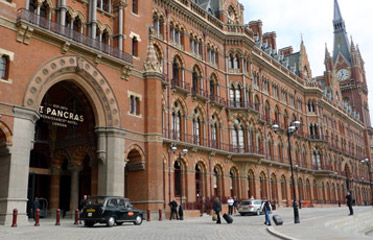
We read that some of the most fantastic buildings of the time were railway stations like St Pancras in London. Most of the other stations like Victoria, Paddington, Kings Cross and Waterloo are grandiose but more mundane. There had to be plenty of space and ventilation so that people wouldn’t be suffocated by the coal smoke and the steam from the mighty locomotives. I don’t know many gothic stations in England, to be truthful.

The Oxford Movement is a parallel tendency, a response to the industrial revolution, social upheaval, and the commercialization of society“. An aggiornamento? Really? I always thought that Romanticism was a reaction away from the Industrial Revolution rather than an adaptation to modern times!

I would mention that French Liberalism, also based on Romanticism and situated in the same time frame, had little to do with railways or The Machine. From that movement came Dom Guéranger, the monastic revival – and Ultramontanism. The Vatican has a private railway station, though I don’t think there are many trains running from it these days, even if Mussolini enforced the observance of Ferrovia dello Stato train times. However, a small railway still runs inside the Vatican to carry tourists. Most of the Parisian stations reflect the same Haussmann grandiosity as the church of Saint-Augustin next to the Gare Saint-Lazare. Perhaps John Bruce might consider visiting France and admiring the SNCF and the same institutional Church he spends his life defending.

This rather lovely building is from the end of the nineteenth century. It is (or was) a liquor factory making the famous Bénédictine of Fécamp. What a delicious drink to finish a meal! The grand hall of this place looks a bit like a church, and indeed my wife and I went to a concert there a few months ago. I wouldn’t be surprised to find out that the Direction of this distinguished firm gave generously to the Church.

There is also the High Court in London, which I always wished had been a church.

Would Anglo-Catholicism be a tad on the legalist side? Not just oof, oof, off, choo, choo!
Coming to the point, I see no connection between the Oxford Movement in England or Liberalism and Ultramontanism in France and the Industrial Revolution. Plenty with Romanticism and a new wave of philosophy and culture away from both the Ancien Régime and the Revolution.

I think that John Bruce is trying to convince us that our trashy Catholic Anglicanism is just a mix-and-match of the famous “private judgement” and therefore something to be shunned by “proper” Catholics. I won’t call the dear fellow names as I have done in the past, but will leave the reader to judge for himself…

Diese Zug ist für Bern, Zürich und Saint-Gallen. Bitte einsteig!

As for:

One feature of Protestantism, at least the Lutheran-Reformed version, is that it proved from the start amenable to state control. Anglo-Catholicism is, let’s face it, a version of state-controlled Protestantism that is not really compatible with Roman Catholicism. I don’t think Cardinal Law recognized this, and I don’t think Bp Lopes does, either.

I wonder what the poor man was smoking before he caught his train. Anglo-Catholicism, especially in the 1860’s and up to the twentieth century, tended to be something of a rebel in respect of Establishment control.

Posted in Uncategorized | Tagged , , , | 10 Comments

Happy Christmas!

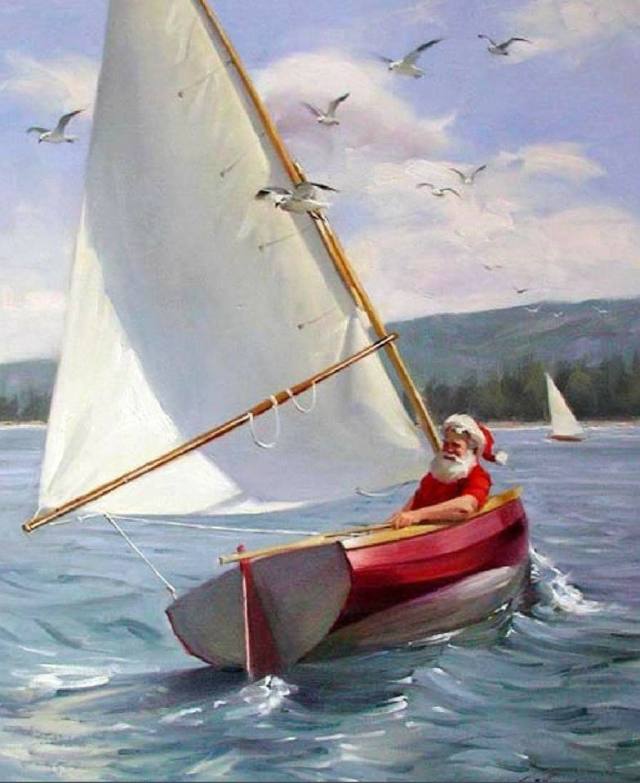
I’m sending out this somewhat secular e-Christmas card to all my readers, but depictions of the Nativity of Christ can be found in my greeting postings of previous years. So I have found this nice painting of Saint (Nic)Claus transposed to our own time having a good sail on his day off. The poor man might have been a tad cold with bare arms at this time of year. Don’t capsize!!!!

I wish you all a happy feast, keeping the essential in the midst of all the commercial and secular noise and hoop-la, the overeating, family squabbles and so forth. A way to put things into perspective is to look out of the window of your house and see the silent gloom of the drizzle-and-drip weather we are having at present in Europe. The only time I have ever had a white Christmas was in 1985 high up in the Swiss Alps with a seminary friend. That silence of the dead of winter reminds us of the events so long ago in Bethlehem and the indifference of the world.

Joseph and Mary were required to fulfil their administrative obligations by going to Bethlehem where all the guest houses were full, and she went into labour. There was nothing of the romance of our carols and cribs with artificial snow and christmassy decorations. Giving birth in a farm building, unless you are a cow, is not very hygienic! We need something of the real Christmas to go with our traditional enjoyment of rich food, gifts and excited children.

If you are alone and sad, perhaps ill or disabled, may this feast bring hope and love of God in your suffering. If you are with your family and doing things the typical way, make a good hypocrisy-check and keep things reasonable. If you are absorbed in the Offices and Mass, like monks, priests and devout churchgoers, may you be blessed by the Incarnation of the Λόγος of God and all that entails. Happy Christmas!

Posted in Uncategorized | Tagged | 4 Comments

The Machine Again

The story is buzzing on Facebook about the appointment of former chief nurse Sarah Mullally as next Bishop of London. One such posting contains a comment:

This woman’s appointment as the 3rd most senior bishop in the Church of England (without having been a bishop first) is, what may be called, the ‘management paradigm’. This is the mistaken notion that the terminal condition of the Church of England can somehow be ‘managed’. Justin Welby had a secular senior management background before he very speedily became an archbishop. A short time ago, he was unable to give a straight answer to a straight question about the Biblical teaching upon sexual morality. No other previous archbishop would have prevaricated in this way. The harsh fact is that the grave situation with the Church of England cannot be ‘managed’ unless by management is meant the management and sale of empty church buildings. Please note: The only apostle who was a ‘manager’ was Judas Iscariot.

I haven’t really gone into this lady’s profile or the details. I have just finished a translation order and still have today’s washing-up to do! I would hope that Mrs Mullally’s  experience as a nurse will give her a special devotion to the sick – but I suspect that being a chief nurse in the NHS has little to do with nursing these days. I cannot judge Mrs Mullally, but the spectre of corporate management in the Church chills me to the bone. I replied in the thread:

There are still a few small RC dioceses in southern Italy where there are less than 10 parishes and just someone at the diocesan curia to help the Bishop manage the registers and the finances. Paul VI merged many of them into larger dioceses but not all. Many priests who have influenced me have spent time in Italy, and I have spent 2 years in that country. This other paradigm brings over the diocesan Bishop as something like a dean or a parish priest, visiting people and spending time with families, schools, the poor and sick – just “mere” pastoral work. It is like the small family firm against the huge and inhuman modern corporation. Most of the RC Church and the Church of England are run like large corporations that stifle humanity and intimacy. They are breeding grounds for psychopaths and narcissists. I have found in the Anglican Catholic Church a spirit that is similar to some of the little Italian and French parishes I have known (whose priests are now dead). Our bishops are first and foremost parish priests, and Bishop Damien Mead is no exception. Oddly, we may well be the most modern and progressive using the Internet and modern communications, not the obfuscation and obscurantism of modern bureaucracy and corporate management.

The question of women’s ordination is a serious one. A part of the raison d’être of the ACC is this issue in “mainstream” Anglicanism. The underlying dystopian element is there and we really wonder what it is all about. I left the Church of England too long ago to really care about the latest developments – but it must be a lesson to us all.

Posted in Uncategorized | Tagged , , , | 23 Comments

O Sapientia

It all starts today in the Use of Sarum, because we have an extra O antiphon, O Virgo virginum. Here is an article on The Other Major Antiphons for the End of Advent which contains a link to another fine NLM article on the Magnificat antiphons for Vespers on these days. We Sarum-ites start today, and the Roman rite from tomorrow the 17th.

They are worthy of our meditation as we prepare for the real Christmas and the incarnation of the Λόγος of God. In the beginning was the Word…

Posted in Uncategorized | Tagged , | 1 Comment

Diagnosis!

It has taken a very long time (mostly being on the waiting list) to go through the process of being diagnosed for various questions in my life, about my relations with fellow human beings and my vocation as a priest. I have just returned home from my  third appointment with the Centre de Ressources Autisme de Haute-Normandie (CRAHN) attached to the main psychiatric hospital in Rouen. The first appointment was with the psychiatrist in charge of this centre, the second with two specialised psychologists and the third (today) with the whole team. They worked with professionalism and a high degree of finesse. It is much more difficult to deal with adults than with children. From the beginning, this was for me about self knowledge and not seeking excuses not to make reasonable efforts to live ordinary life with persons around me.

Like in the psychiatric profession in America, the category of Aspergers Syndrome has been discontinued in favour of a seamless spectrum, a continuum, of the condition known as autism from the most disabled to high-functioning persons with their intellectual abilities intact but with certain “eccentricities” like social awkwardness or things that look odd to the most observant. My diagnosis is that of high-functioning autism which is about equivalent to the old Aspergers Syndrome. Doubtlessly, psychiatrists and psychologists will continue to debate these matters from a scientific and phenomenological point of view. The reasoning is not difficult to understand: instead of putting people in little boxes, you seek to understand them as human souls – as they are – on a spectrum of various characteristics and traits. There are fewer lines to try to draw!

In the meantime, I have to live my life with my talents and difficulties.

Over the past year or so, I have stayed away from internet sites that tend to show “aspies” as being almost “fashionable” or even some kind of Nietzschean Ubermensch. That sort of thing is quite dangerous as with any other kind of label or pseudo-identity like being gay or transsexual or whatever buzzes around these days. Dr Tony Attwood, the most respected specialist in this matter, suggests tongue-in-cheek that this condition might be the next stage in man’s evolution. I’m not an evolutionist (at least in terms of determinism or something mechanical), and I believe that man can find his nobility of spirit from God and a high vision of life. Thus we have such elevated beings – and the low herd mentality of those who follow fashions and ideologies uncritically. Some autistic persons find it easier to elevate their spirit when they see the fallacies, “groupthink” and “bullshit” others take for granted. It can be a gift, a talent, and if we have talents, we are expected to take them to the bank and bring the interest of our investment back to our Creator and Sanctifier.

I will now return to reading Dr Attwood’s famous book The Complete Guide to Aspergers Syndrome, and see if I can participate in local groups. This condition plays havoc with self-esteem and a sense of identity, and I am sure that I could minister to people from a spiritual and philosophical point of view. My own diagnosis came as no surprise, but it made me feel quite shaken for the time it took to shake everyone’s hands and say goodbye and thank you – to the bus stop outside the establishment. I returned home by train and continued reading Dr Robert Lanza’s book on biocentrism, a theory that turns Aristotelian metaphysics upside-down and gives a new look to Idealism, or the idea that consciousness precedes matter. It’s hard going and a challenge, but it will bring a whole new paradigm of the notion of God and life beyond our death as we can observe it. I will certainly have to read this book several times!

I’m not Superman! I’m not the Village Idiot! I have some scientifically observed traits and a reference of self-knowledge (of a relative value) that will certainly help me on my way to a better sense of vocation and purpose in life as a Christian, a priest and philosopher (not someone with academic pretensions but a lover of wisdom). It gives me explanations about my my past so that I can learn for the future and adapt in a special way, unlike the way other people relate to society, their friends and families. This is a challenge, as it should be to anyone who identifies with a minority but has to get on in the world at large.

I’m not interested in Aspie Pride or anything like that – the herd mentality and ideology. We hear about transsexualism, but it is a matter that concerns very few individuals. The hot button issues fly out of the pages of Facebook and Twitter (and others), but we need to shut out the noise and be ourselves – and decent members of the groups of people we associate with in our daily lives.

I have my limits, and some will find my mannerisms difficult to understand. A part of our existence is to ask God in our prayer to docet nos terrena despicere et amare celestia, to be aware that we are alienated from the things of this world and called to God’s Kingdom. This is central to Christian martyrdom and the Romantic soul. Autism is a symptom of awareness of this exile from another world where we belong. At the same time, we live in this world – in it but not of it – and we have to come to terms with that.

I appreciate the prayers of my readers, and I hope this blog will continue to be a part of my ministry as a priest and a human being, because others out there labour with questions for which they have not yet found answers.

Posted in Uncategorized | Tagged , , , , , | 10 Comments

Fourth Sunday of Advent

We find ourselves in something of a quandary this year about the concurrence of the fourth Sunday in Advent and Christmas Eve. My Sarum ordo by Dr William Renwick quotes the following from the Pie:

4th of Advent All of the Sunday until the 3rd. Nocturn exclusive. then all of the service of the Vigil. At Lauds mem. of Sunday with mass of Sunday in Chapter with the little hours as in the vigil without the Ps. Deus Deus meus respice etc.

That is for the Office. For the Mass in Chapter, it is of the Sunday. The last time this concurrence (Sunday 24th December in the Gregorian Calendar) happened was in 2000. We have this article in The Rad TradVigilia Nativitatis: Nulla Fit Commemoratio?

For the Use of Sarum, Dr Renwick has this to say about the fourth Sunday in Advent:

In the earliest sources this Sunday was designated Dominica vacat and had no propers assigned to it. This would account for the variety of proper chants to be found amongst the Gregorian sources. Thus Sarum, in common with York, Rouen and the Dominicans has the Officium Memento while the Roman Missal repeats the Introit Rorate Celi from the previous Wednesday. However, the Ps. Peccavimus in the Sarum Use differs from that in the York, Rouen and Dominican Uses, which is Ps. Confitemini.

Where the Roman Use has the Offertory Ave Maria, the Sarum and Dominican Uses have Confortamini. This is a reversal of the previous Wednesday where the Roman Use has Confortamini and the Dominican and Sarum Uses have Ave Maria.

Officium. Memento nostri. Ps. 105:4-6. ad letandum is omitted.
In the Roman Use the Introit is Rorate celi, repeated from Wednesday in the Ember Days of Advent. Memento nostri appears ‘in the Transalpine regions’, László Dobszay, ‘The Proprium Missae of the Roman Rite’ Uwe Michael lang, Ed., The Genius of the Roman Rite (Chicago: Hillenbrand Books, 2010): 86.

Prayer. Excita quesumus Domine potentiam tuam
The York Use omits quesumus.

69
Epistle. Phil 4:4-7
In the Roman Missal the Epistle is 1 Cor. 4:1-5. In the Roman Missal the Epistle Phil. 4:4-7 appears on Advent 3.

Gradual. Prope est. This Gradual is repeated from Wednesday in the Ember Days of Advent.

Alleluya. V. Veni Domine et noli tardare.
The text is also found in Responsory 7 of the Third Sunday in Advent.

70
Sequence. Jubilemus omnes una. 11th c.
Anon. Translation © 2015 by Matthew Carver. Used with permission.
Roger Sorrell, St. Francis of Assisi and Nature : Tradition and Innovation in Western Christian Attitudes toward the Environment (Oxford: Oxford University Press, 1988):105 discusses the possible influence of this sequence on Francis of Assisi’s Il cantico di Frate Sole. This was also noted by Samuel W. Duffield in Latin Hymn-Writers and their Hymns (New York: Funk and Wagnalls, 1899):393.
The opening notes of the melody clearly reflect the opening pitches of the Alleluya.

71
Gospel. John 1:19-28
In the Roman Missal the Gospel, Luke 3:1-6, is repeated from the previous day.

72
Offertory. Confortamini. After Is. 35:4,5.
The Dominican and Hereford Uses also have the Offertory Confortamini here. The Roman and York Uses have Ave Maria. This is the opposite of the case on Wednesday in the Ember Days of Advent.

73
Secret. Sacrificiis presentibus quesumus Domine

Communion. Ecce virgo concipiet. Is. 7:14.
This Communion is repeated from Wednesday in the Ember Days of Advent.

Postcommunion. Populum tuum quesumus Domine donoroum tuorum
The Roman, York and Hereford Uses have the Postcommunion Sumptis muneribus quesumus Domine.
The Sarum Postcommunion also appears in the Westminster Missal.

What is interesting is the complete divergence between the Roman resumption of the Rorate Mass from Ember Wednesday on this Sunday and the alternatives from the French traditions. In the pre-1962 Roman rite, the solution would be to celebrate the Vigil of Christmas and commemorate the fourth Sunday of Advent. The Rad Trad article has a comment by Paul (I assume Paul Cavendish) affirming that this memory of the fourth Sunday of Advent was not an innovation of Pius X.

In the Sarum missal, the rubric is as follows in the Christmas Eve Mass:

If this Vigil occur on a Sunday, the mass of the Sunday is said in chapter ; and then there shall be a memory of saint Mary, and of All Saints only. But the mass of the Vigil is to he said at the high altar without any memory, with this Alleluya.

V. To-morrow the iniquity of the earth shall be blotted out, and the Saviour of the world shall reign over us.

It would seem logical not to commemorate the Sunday, given that the Sunday proper is recent in the diverging traditions. The Sarum solution is to celebrate two distinct masses on distinct altars, one in capitulo and the Vigil Mass at the high altar. It often happens that there is no memory when the displaced Mass is said on another altar by another priest. In a church where there is only one priest and one Mass on that day (without considering the Mass at the crowing of the cockerel which is in reality on Christmas Day), it might seem reasonable to commemorate the Sunday collect, secret and postcommunion prayers. That is what I am going to do.

Posted in Uncategorized | Tagged , , , | 5 Comments

“New Goliards – Mission” Page

I have just updated the page that originally defined the intentions and purpose of this blog – New Goliards – Mission. Five years later, I find that it was linked with my situation as an “orphaned” priest facing the choice of finding another Church or turning my back on churches to find other human and cultural references. I joined the ACC and am still in it…

This old page attracted some attention because it received some new comments. I left the old page in place, otherwise the comments would have no meaning, and I am scrupulous about “revising”. Since then, I have had to come to terms with my own lack of leadership skills and that others just don’t see things the way I see them. It has ceased to matter for me.

I am grateful for the Christian fellowship with my Church, and I give what little I can contribute in the way of ideas and as a priest. I am living in the wrong place, but that is the story of my life! My role is what I can contribute as an individual and not the idea of grouping or leading, an idea that has proven to be illusory.

Discussion of some of the old ideas seems somewhat moot, but I appreciate feedback from what I wrote five years ago.

Posted in Uncategorized | Tagged | Leave a comment

The Post-Modern Prometheus

My mind has been bothered somewhat over the last few days by some of these “hot-button” issues, and as always, I seek the roots of the malaise. One of the most powerful and accessible articles I have seen recently is Surpassing Man, a dialogue between Dr Sam Vaknin and one of his friends. Dr Vaknin seems quite a high-powered character, but at the same time interested in exposing the narcissistic personality. His approach is partly scientific but mostly philosophical. This page on Nietzsche’s Ubermensch is profound and thought-provoking, misrepresented in the twentieth century and now at a crossroads between the life of the spirit or the ultimate nightmare. Nietzsche lost his Christian faith, but had a spiritual vision that is capable of the most sublime interpretation.

Even my reflections on euthanasia and doctor-assisted suicide have their place in this vast Babel’s Tower of human pride. It is a comprehensive and terrifying vision of man’s future, captured two hundred years ago by Mary Shelley and today in science fiction cinema, the campaign for material immortality and a world order that would make Hitler look like a choirboy. The dystopian (utopian?) vision is that of the man-machine, the cyborg, the present-day version of Frankenstein’s monster.

Before long, humans will design and define nature itself. Whereas until now we adapted very limited aspects of nature to our needs – accepting as inevitable the bigger, over-riding parameters as constraints – the convergence of all breeds of humanity will endow Mankind with the power to destroy and construct nature itself. Man will most certainly be able to blow stars to smithereens, to deflect suns from their orbits, to harness planets and carry them along, to deform the very fabric of space and time. Man will invent new species, create new life, suspend death, design intelligence. In other words, God – killed by Man – will be re-incarnated in Man. Nothing less than being God will secure Mankind’s future.

It is, therefore, both futile and meaningless to ask how will Nature’s future course affect the surpassing of Man. The surpassing of Man is, by its very definition, the surpassing of Nature itself, its manipulation and control, its re-definition and modification, its abolition and resurrection, its design and re-combination. The surpassing of Man’s nature is the birth of man-made nature.

The big question is how will culture – this most flexible of mechanisms of adaptation – react to these tectonic shifts?

This is the stuff of Star Wars, but perhaps – theoretically – possible in a century or two if the “evolution” continues.

The  transforming of earth by technological means. It is the old dream of the titans: to overthrow the gods. But they always lose and are punished, will they win this time? Will this be the century of the titans? It seems so…

History has, at least until now, given the same answer as nature itself, that man’s pride is met with defeat and downfall. We have to surpass ourselves spiritually. We have, each one of us, to meditate on this Promethean nightmare and make of it that fear of God that brings knowledge and understanding – and wisdom.

Posted in Uncategorized | Tagged , , , | 1 Comment

Euthanasia

I came across this video this morning on YouTube.

The video is centred on two persons wishing to die, an old lady in good physical and mental health who could not get over her grief on losing her daughter, and a more borderline case – a young man and father of a family stricken with some disease that caused unbearable head pain.

The first thing that struck me was the complete absence of religious or spiritual notions. The old lady seemed to believe in an afterlife, because she wanted to be with her daughter who died from a surgical complication. She was given a glass of a sugary liquid containing a lethal dose of barbiturates by Dr Marc van Hoay who in 2015 faced a murder charge. The video gives us the impression that Belgian law protects doctors prepared to help people to commit suicide rather than give guarantees that there would be no slippery slope towards compulsory suicide and trains to gas chambers for reasons of money or convenience.

Where is the line drawn? Some cases are known to be quite flippant, sometimes involving children and young adults suffering from depression, far from the cases calling on a sense of compassion of terminal cancer or complete and degenerative paralysis. There are cases that make it difficult to refuse the possibility of a painless death, and others where it is not so sure that the medical profession can be certain that this is really what the person wants without any kind of coercion. In the Van Hoay case and the old woman, we are marked by the seeming lack of emotion and the almost banalisation of death. The woman went about her morning routine as always on the day she had the appointment with Dr Van Hoay.

Pope John Paul II in 1995 taught in Evangelium Vitae:

I confirm that euthanasia is a grave violation of the law of God, since it is the deliberate and morally unacceptable killing of a human person. This doctrine is based upon the natural law and upon the written word of God, is transmitted by the Church’s Tradition and taught by the ordinary and universal Magisterium…

To concur with the intention of another person to commit suicide and to help in carrying it out through so-called ‘assisted suicide’ means to cooperate in, and at times to be the actual perpetrator of, an injustice which can never be excused, even if it is requested…

Laws which legitimize the direct killing of innocent human beings through abortion or euthanasia are in complete opposition to the inviolable right to life proper to every individual…

Abortion and euthanasia are thus crimes which no human law can claim to legitimize.

This is the traditional teaching of the Church, and the ACC certainly teaches the same thing. One thing that struck me in the video was the question of whether medical care could be improved for people expressing a desire to die. One big problem is that interested parties are making excessive profits from health care. There is a true risk that the heart-wrenching cases will lead us to something little better than what the Nazis were doing to get rid of “useless eaters” and races they considered as inferior. Where is the line, and in a society where spiritual values have all but gone? The death of that old woman left me with the idea that her suicide was not justified. We all lose loved ones and have to come to terms with our grief, and she would have found salvation through conversion to Christ and self-transcendence.

I have known people who have died of cancer and other terrible diseases, and have been edified by the way they faced death in whatever way God would bring it to them. It is reassuring to know that hospice care is more available than many people think. The agonising pain from cancer can be very effectively managed with drugs, and many professionals and volunteers dedicate their time and effort to looking after the terminally ill. It certainly takes humility to accept the loss of autonomy and the need of others. The choice of life and death is not ours to make, except – certainly – the choice to forego being (for example) kept alive by a machine. As medicine and the prolongation of life progress, these issues become harder and harder. We also live in a world where Christianity is hardly a reference any more.

I am very preoccupied with the notion of the human person and the “nobility of the spirit”, which are increasingly scarce in today’s world. What really went through the mind of that woman who drank the fatal potion? Did she ever ask for a priest or other minister? Who of us is not torn by these moral dilemmas and calls for compassion?

What does this facial expression mean to you as the potion is poured out of its bottle?

A little research showed the young Belgian man to be Peter Ketelslegers, still alive and relying on medical help a year after this video was made. We should pray for him and for others suffering from the same condition, that they may find relief and hope in God against all hope. It’s not always clear cut, but we must be pro-life in all circumstances.

Posted in Uncategorized | Tagged , | 5 Comments