Seeking the Best

It is some time since I wrote Aristocracy of the Spirit, particularly in the light of some of the Russian stuff (translated into English or French) I have been reading over the years. I must admit that I am not too keen on this word used to describe a highly desirable disposition in the human spirit. It is an analogy based on the Greek ἄριστος meaning excellent or best, the notion in Plato of the Philosopher King or the rule of wisdom he advocated. When we speak of nobility or aristocracy, we think of people born into certain families with or without their ancestral property or wealth. These, along with the clergy, were the guillotine-fodder of the French revolutionaries. We now live under the shadow of a new kind of elitism, that of the extremely rich and sometimes with nefarious agendas as is often the subject of conspiracy theories. The political class are often associated with the banking elite as is the case in France since the election of Monsieur Macron to the Presidency. The kind of aristocracy that interests me is the sort that can be accessible to anyone, even from the modest social classes – it is something internal, not given by your family or the privileges coming from wealth earned through hard work or ill-gotten.

There is another term, little different from Berdyaev’s (however that is said in Russian), which is nobility of the spirit. I have just begun reading Rob Riemen’s Nobility of Spirit: A Forgotten Ideal, a book written in German and translated into English. I am impressed so far by the reference to Thomas Mann (who lived through the Nazi terror) and Spinoza who experienced the tyranny of institutional religion in his time. Pope John Paul II wrote a lot about human dignity and freedom, since he himself had lived under both Nazism and Communism in his native Poland. This Pope was heavily criticised by traditionalists for his universalism, personalism and humanism, but few had really made the effort to read and understand his philosophical works. I am not yet far enough into Riemen’s book to be able to offer criticism or thought it will doubtlessly provoke in me. Going through the various critics’ reviews, it seems to address my line of enquiry.

I am sick and tired of what passes for politics and the erosion of the social contract by the lack of interest of our elites in the common good. Even those who call themselves socialists operate according to a “post-modern” or nihilistic agenda. I read about so-called “antifas” in America, and then about Klu Klux Klan rednecks and others spouting similar ideologies that are roughly equivalent to Nazism. So much hatred, ignorance and prejudice that can only lead to war and death on a massive scale. Conservatism and radicalism are tired ideologies, both sides of the Atlantic. Bring back the Russian Empire or the French Monarchy, or the British Empire for that matter? Many entertain such nostalgia, but the seeds of the hatred against those regimes were there before they were brought down. Thomas Mann is quoted:

The sole corrective for human history. Without nobility of spirit, culture vanishes.

It seems to be a precious pearl that is forgotten, or has never been thought of since the days of Plato! Like in the 1920’s and 30’s and to the end of World War II, our human dignity and freedom are again in peril, whether it be from the misuse of high technology by some kind of “Big Brother” regime à la Orwell or the Islamic caliphate ruled by brutes that have not evolved in any way since the days of the Crusades.

Yesterday, I was snooping around for ideas about the old Gnostic notion of three kinds of people: materialists, establishment conformists and those seeking a spiritual way through institutional religion and not much more – and finally the spirituals, those who either had mystical gifts or a clarity of knowledge that made them critical of both. Much of what the old Gnostics believed in was quite bizarre, and condemned by the Church – to the extent of persecuting and killing people belonging to Gnostic communities. The establishment must have had much to fear! But, this notion of people who have no interest in or knowledge of the finer things of life is something we all observe in our own lives. Some people are only interested in money and the status symbols that money can buy. Others become “possessed” by their electronic gadgets – I use a laptop and a smartphone, but they are simply tools to me. My phone is a miniature computer and contains a GPS receiver – and makes my life easier – but I can still think and live as I did before.

I have been very concerned about the notion of “establishment conformity”, the mainstream of society. How institutions like the Church of England and the RC Church can change just about everything and gut the most revered liturgical traditions – and then demand submission and conformity in the name of authority – is beyond me. They played the card of attracting materialists and not merely the old institutional churchgoers of civic religion, and alienate anyone who has really understood the underpinnings of everything. Berdyaev’s notion of the “aristocracy of the spirit” bowled me over, and then I looked further afield into other cultural and philosophical ideas, especially from German Idealism and Romanticism. There is a dialectic between the rationalism of the Enlightenment and the Romantic eras that preceded and succeeded it. We arrived at a new industrial and rationalistic era, but now one that excluded rational thought and honesty of speech.

One thing that bedevilled much of my adult religious life was being attracted by the liturgy and an artistic culture through which God would speak by love, truth and beauty – and then finding that the real motivation of traditionalist groups was to annihilate the “others” or at least deprive them of freedom and dignity. I was deeply shocked to find some French traditionalists supporting agendas of dictators like Pinochet and Franco (sometimes even Hitler!), and only had a profound understanding of such a mentality when reading the Grand Inquisitor of Dostoievsky, which is a part of his immense tone The Karamazov Brothers. This spirit ultimately comes from the same nihilism as atheism, and is the epitome of evil.

I have also come to a stage in my life when I need to discover Nietzsche and try to understand him profoundly. I’ll start with Human, all too human, then Thus spake Zarathustra and then Beyond good and evil – and finally I’ll get of copy of The Antichrist. I’m sure I will discover what he really meant by the Ubermensch and the role of the will, two notions that were completely perverted by the Nazis, partly through Nietzsche’s sister being enamoured of the Nazi movement in its early days. Nietzsche fundamentally embodies man’s decision to go it alone without God, and that the idea of God was dead. He had once been a theology student and son of a Lutheran pastor. In reality, he sought man’s transcendence, but unfortunately by refusing God his. There was something of an intuition in this soul on fire, which drove him to the hell of madness. The transcendentalism of self-reliance reminds me of the Americanism of Walt Whitman and that movement in nineteenth-century New England. I believe that I will find something more inspiring in Thomas Mann’s ideas expressed through Riemen’s book.

Presented in this way, I do believe that nobility of spirit is something that can be a basis of true culture, not something preserved in a museum but truly part of life. The odds against such an aspiration are staggering, but it is the kernel of the Gospel message. Christ embodied this nobility even if he lived in a modest working family and conveyed the highest virtues of humility and prudence.

Spiritual nobility was found in some of the greatest saints of the Church like Vincent de Paul, Francis and our own slum priests of Victorian England. They didn’t only give food and money to the poor, but raised them to beauty through their acceptance in the parish church and its services. The Workhouse abused the poor and condescended to them in their caricature of charity. The slum priests accepted the poor into their hearts. This is but a part of this nobility that can restore and redeem human nature.

I will forge ahead in my interest in true philosophy, but also my notion of vocation as a priest and a human being in such a marred world. I refrain from usurping anything, but I can say that I feel called to think and write in this direction as I have been allowed to understand and know. As I get further through this book, I will doubtlessly express things in new and different ways as I bring together the new input into a reflection in my mind that essentially goes back to my childhood in its crudest forms.

When someone does touch the sacred treasure (or whatever analogy we are going to use), others are not going to like it! We have to be gentle like doves and cunning like foxes and wolves. We have only to read the Beatitudes to know that if we are persecuted and suffer, we are near the Kingdom of God.

You see, Adso, the step between ecstatic vision and sinful frenzy is all too brief.

Thus I leave this posting with this admonition by Fr William of Baskerville to his young apprentice in Umberto Eco’s The Name of the Rose. The way is precarious, and what goes up can come crashing down and make a lot of noise. We have to be warned. That book (which I am reading yet again) is a fine study of what can go wrong with religious men and the lust for knowledge without possessing the Key. Read, mark, learn and inwardly digest – as my old schoolmaster exhorted his pupils as he quoted from the Prayer Book.

Posted in Uncategorized | Tagged , , , , , , , | 1 Comment

A Couple of Lovely Postings

My brother in the priesthood Fr Jonathan Munn has written two lovely and reflective articles in his blog. Is this a Continuing Anglican blog or not? posted yesterday, and Continuing Anglican History of today. I still think that one thing that has kept his blog and mine going is our “personal” touch. These blogs are personal blogs that happen to be run by Continuing Anglican priests. Our Archbishop Mark Haverland has started a blog – Anglican Catholic Liturgy and Theology, which I can also see continuing for a long time given his scholarly approach to classical Anglicanism and theology. He is someone for whom I have a lot of respect, not only because he is the Metropolitan of our Church, but also on account of his serious theological standing.

For the historical side of the movement, I was with Bishop Hamlett from September 1995 until the following summer. The experience was quite shocking and I returned to the Roman Catholic Church in the autumn of 1996, and lived through other extremely harrowing experiences. For that time, I was graciously lodged by Mr and Mrs Caverargh-Mainwaring of Whitmore Hall in Stafforshire, and I rented a cottage in the village for a very reasonable rent. I served as deacon (ordained in the RC Church) at the little church at Madeley Heath near Newcastle under Lyme. I was quite unprepared for the reality of Continuing Anglicanism at that time. It was not the Church of England and nor did it have the musical tradition or culture I had once known. Parochialism and petty-mindedness are how I could characterise the spirit of what I found. The first cracks began to appear in 1996, though the Bishops’ Brawl occurred only after I was gone.

Here is something I wrote in about 2005:
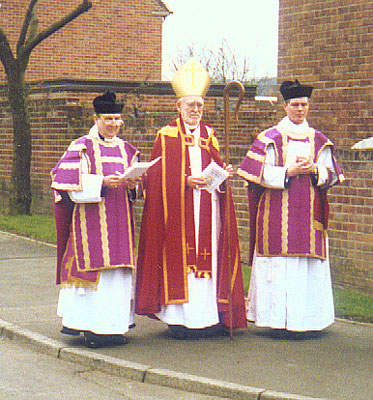
I contacted a community in England called the Anglican Catholic Church, which had been established by the authority of a larger American group by the same name. My emotional state brought me to an extreme nostalgia for my Anglican origins combined with a vision for seeking its Catholic dimension. It seemed at the time to be a relief from the life I was living, and at the same time a new orientation for my vocation. Catholicism was (and is) a part of my being, and it was not in me to abandon it for a form of Protestantism. I was going to another Church that fundamentally celebrated the same rite and held the same doctrines (with perhaps the exception of Papal infallibility) – in fact very similar to classical Old Catholicism.

I left the French country presbytery and returned to England to join this high-church dissidence from Anglicanism.

I found lodgings in a little cottage in the north of England with the help of some of the faithful. As I had to earn my living, I resumed my work in moving organs from England to France and Italy, which at the same time impeded my complete integration into the Anglican Catholic Church. Each Sunday, I drove to the church, a former Methodist chapel converted into a “pro-cathedral”, and fitted out with taste and simplicity. It was totally different from the baroque surroundings of my old seminary or even the French parish. The bishop was a former Anglican vicar, getting on in years, who would show his aggressive attitude in his outbursts like “We are not Roman Catholics!” if I dared to suggest improvements in the liturgy, which was essentially the old Roman rite in Anglican-style English. My constant departures to the European continent to install organs, and my continued associations with Catholic priests masked the error I had committed. Each time I returned to England, I was impatient for my next return to Europe. The dull and grey reality of northern English life was brought home to me, as each week, the parish council would meet to discuss gutter problems or the question of replacing the sacristy light bulb.

There were sessions of “theological formation” for candidates for the priesthood at the bishop’s house. These took place on Saturdays. It was a brave attempt to produce a competent amateur clergy on a shoestring. The classes sounded more like waffling sermons than organised lectures in biblical studies and doctrine. I was increasingly restless and aware that I was in the wrong place. There was something profoundly unnatural about parish life, about the endless meetings to discuss very little, about the bishop’s high opinion of himself, having come from a modest background with its narrow provincial mentality. I was increasingly frustrated about the amateurish way the liturgy was celebrated. There was nothing of the polished refinement of my seminary.

The “click” came from two events in the summer of 1996, being invited to function as a deacon in London for the Office and Mass of the Assumption, celebrated by an irregular but Catholic-minded priest in a small Anglican chapel rented for the occasion. The other event was being told I was to be promoted to the Anglican Catholic priesthood. When the bishop told me the date, which was to be the 30th November 1996, on which he wanted to ordain me to the priesthood, it was at this point when my feet became very cold indeed. I persevered in this dead-end situation until the end of August. During a rehearsal for an ordination ceremony, I had tried to correct some of the movements and ceremonies.

I was taken apart in the sacristy by the bishop, who then uttered the outburst “We are not Roman Catholics!” as if to say that he had every right to celebrate the liturgy as he pleased. Within days, I wrote a letter of resignation and considered the future. On Sundays, I went to Roman Catholic indult Masses, but did not receive Communion.

Leslie Hamlett was only one of a number of bishops in the ACC who were restless, cantankerous and never satisfied. I never thought I would return to the ACC, but this time in completely different conditions. In those years 1995-96, I made friends with Fr Patrick who was the Dean of the South and Bishop Damien Mead’s predecessor as Vicar General, and who returned to the Church of England. When I was lodged at the Presbytery of Bouloire after my departure from England and my 6-month stint with the Benedictine monks, he sent me regular e-mails with attached files detailing the deteriorating conditions in the ACC and the Continuum in general. Here are some of them for the historical record.

* * *

“AND NEVER CONTINUETH IN ONE STAY” (B.C.P. – JOB 14:2)”

The Reverend Leslie Hamlett (hereafter referred to as Leslie Hamlett) headed his parish newsletter on 29 January 1989 with the words “Anglican Heritage – Papal Allegiance”, “St Mary and St John’s Church Anglican Use Catholic Church Community”, “Not R.C. and not C of E but a bridge to Union with Rome for those now ready to continue and develop their Anglican identify within Catholic Unity” In an information leaflet of August 1988 Leslie Hamlett records that in 1979, together with American brethren, he took part in talks at the Vatican with the Congregation for the Doctrine of the Faith.  The purpose, he said, was to seek a union with Rome in which much of the Anglican heritage could be retained.

In 1980 Pope John Paul II approved a Pastoral Provision to make this possible.  Shortly afterwards the first parishes under the Provision were set up in the U.S.A. Leslie Hamlett and his congregation withdrew from the Church of England in 1983 for “union with Rome” (leaflet dated August 1988).  “We believe” said the Newsletter of February/March 1985, that “the Papacy is essential in the Proclamation of the Full Truth of the Christian Faith” and “We believe that the Papacy is the Divinely Established Centre of Unity”.  In 1986 the Roman Catholic Bishops at their Low Week Conference supported a Petition to the Holy See that Leslie Hamlett and his Congregation be received along the lines they had envisaged and in June 1989 Rome responded positively to the request that the Pastoral Provision be extended to England.

“Through our efforts and negotiations alone” said a St Mary and St John’s Church Council letter of January 1990 “Anglican Use Liturgy is now possible within the Roman Catholic Church in England”.  “Who could ever have thought that almost the whole of the Church of England’s 1662 Book of Common Prayer ………………….within Roman Catholic dioceses could be possible in England” continued the letter.  In his newsletter entitled “The Bridge” for October 1989 headed “Anglican Heritage – Papal Allegiance” and “The Anglican Use Catholic Church”, Leslie Hamlett notes in his Editorial “A victory won!  Yes, there is no other way to describe it ! Your efforts for true Unity over the past five years have made it possible for you to enter into the full communion of the Roman Catholic Church and retain elements of your Anglican Heritage.  Rome has now responded to the petition sent to the Vatican in 1986 by Archbishop Couve de Murville of Birmingham with the support of the Roman Catholic Bishops’ Conference of England & Wales” Leslie Hamlett remarked that he was given this news at an interview with the Archbishop in June 1989.  Leslie Hamlett ended with these words to his flock “this historic milestone on the path to true Unity has been made possible by your efforts and prayers.  Well done !  The credit is all yours.  Never forget it.” In spite of proclaiming on 16th July 1989 that “this represents a victory won and that the foundations of Unity are truly laid”; a statement dated 30th July 1989 signed by a Churchwarden, Church Secretary and Assistant Secretary clearly heralded a withdrawal from the Pastoral Provision described above.

By August 1989 withdrawal from the Pastoral Provision was a fact and by 4th February 1990 Leslie Hamlett declared that “a continuing Church is now a pastoral necessity”.

Early in 1990 Leslie Hamlett approached Bishop Mercer C.R. of the Anglican Catholic Church in Canada seeking a licence.  The request was granted, Bishop Mercer agreeing to act as Visitor and to confirm, in a communication at the end of January 1990.

On 29 July 1990 Bishop Robin Connors of the A.C.C. in the U.S.A. preached at Sung Mass at Knutton near Longton. Leslie Hamlett went to a meeting of A.C.C. Bishops and others at Victoria, British Columbia  Canada held from 24th September to 5th October 1990 to seek permission to join the Anglican Catholic Church.  Permission was given for a “Fellowship of Clergy and People” to be set up in the U.K. and within the T.A.C.   Bishop Robin Connors strongly supported Leslie Hamlett’s petition and by 14th December 1990 he had agreed to act as Visitor.   On 27th February 1991 Bishop Connors visited the U.K. and on 3rd March 1991 he blessed the Church building at Madeley Heath and confirmed several candidates.  In the afternoon of 3rd March 1991 there was a meeting of the Executive Committee (of the Fellowship of Clergy and People – see p.1.) at which all recommendations of Bishop Connors were agreed “nem. con.”   Some of the recommendations were to do with intercommunion with other “continuing” Anglicans, notably the A.E.C. (American Episcopal Church  They were agreed to by everyone at the meeting, including Leslie Hamlett.  Later Leslie Hamlett had the agreement to the recommendations set aside.  Whatever the merits or otherwise of this affair, which ended in the Deerfield Beach Event, Leslie Hamlett jettisoned Bishop Robin Connors (who had been so great a supporter) and cast in his lot with the remnant of the A.C.C. in the U.S.A.

On the 14th of March 1992 Archbishop William Lewis presided at a meeting held in the Church at Madeley Heath at 2 pm when Leslie Hamlett was elected A.C.C. bishop of the Missionary Diocese of England & Wales.  From this point and with increasing frequency Leslie Hamlett proclaimed that the A.C.C. was “the one true Church in this land”.  This was a far cry from his remarks of 4th February 1990 that “whatever may happen in the future a division amongst those who “continue” must be avoided at all costs.  The struggle of today, whether one remains in the Church of England or is already a “continuer” is about the future of Christianity itself as a revealed religion.  Satan, who is our real adversary, appreciates the truth of the dictum- “divide and conquer”.   It is essential therefore that charity and tolerance prevail amongst those who are concerned for traditional faith whether they be presently with the Church of England or have already become continuers” Good words, with which many must agree, but at variance with the increasingly rigid and narrow outlook that Leslie Hamlett adopted, leading a former member of the A.C.C. in the U.K. to remark that “it is a spiritual concentration camp”.

In the autumn of 1997 a division occurred in the Anglican Catholic Church, the occasion of which was the reference to the “Perpetual Virginity of the Blessed Virgin Mary” in Father Mark Haverland’s book “Anglican Catholic Faith and Practice”  The reference is confined to less than half a dozen lines in a book of 112 pages.  The “Hamlett faction” (described as such in The Trinitarian of December 1997) regarded his remark as sitting lightly to the Seven Ecumenical Councils, whereas Fr Haverland had written that the belief was common amongst Anglicans (it was, for example, taught by Lancelot Andrews and Jeremy Taylor in the 17th century), but because it cannot be proved from Holy Scripture is not regarded as a doctrine essential to salvation.   An historic Anglican attitude with which the A.C.C., being Anglican (including the Hamlett faction) would have been expected to have sympathy.  The rift, however, persisted and Leslie Hamlett was elected leader of a body consisting of four other bishops, a number of clerics and a comparatively small number of lay people.

This final example of obduracy only serves to emphasise in a stark manner the doubts that can be held about Leslie Hamlett’s judgement and his undoubted ability to turn theological somersaults.  As stated above the 1662 Book of Common Prayer was permitted to be used in the Roman Catholic Pastoral Provision upon which Leslie Hamlett and his congregation set so much store in 1990.  In the A.C.C. Missionary Diocese of England & Wales Leslie Hamlett forbad the use of the 1662 B.C.P. and at least one meeting (no doubt others also unknown to this writer) declared the 1662 B.C.P. to be “heretical” thereby at one stroke alienating the attention and sympathies of his audience.

In December 1989 Leslie Hamlett had noted the Immaculate Conception of the Blessed Virgin Mary, urging the congregation to “honour this significant feast” when Mary was conceived “free from the stain of original sin”.  In “the Bridge” in 1987 at the time of the Assumption Leslie Hamlett remarked that “Our Lady’s Assumption was not defined as an article of faith until 1950”.  The implication is clear, that it is now an article of faith.  Yet in “The Clarion” of December 1997/January 1998, Leslie Hamlett states “let it be known that we do NOT (his emphasis) accept Roman dogmatic definitions, Marian or otherwise”.

On Sunday 22nd January 1989, in the Week of Prayer for Christian Unity, Leslie Hamlett preached at the Parish Sung Mass in the “Church of Our Lady of Stamford” (a 15th century title for this ancient church); towards the end of a stirring, indeed moving, address, Leslie Hamlett proclaimed “You pray for Unity – I am Unity”.  He was of course referring to his belief that his Ecclesial (?) Community was a “bridge” to “Union with Rome” but in the light of events, nine years after that statement was made, one could take it as revealing Leslie Hamlett to be impatient of all authority; that of the Pope, of various  Episcopal Visitors and of Archbishop Lewis.  Of all, that is to say, except his own.  What direction will next be taken and where will he take the members of his faction ?   Perhaps, as a correspondent suggests with only half his tongue in his cheek, “the new A.C.C. will, like the Copts, elect a Pope”.

By The Revd David A G Hampton-Davies MA [Oxon.] 28 years Rector of St Mary’s Stamford  Lincolnshire

* * *

THE DIRGE OF STOKE-ON-TRENT.

Hamlett and the Hamlettites are setting out the Tome –
Proclaiming loud that West is East and Stoke-on-Trent is Rome.
D rest Archbishop Lewis Uncle Leslie cries: “My Word!”
But his claim to the Succession is most palpably absurd.
A Meeting-Town for Synod can by Holy Church be changed;
No! It’s not Archbishop Lewis whom the Faithful call deranged!
Hamlett and his Schism sons think England has been bought –
But GOD’S Truth will surely triumph when the matter comes to Court!
Some disobeyed Christ’s precious words that they be One in Me:
Thus Hamlett rent that Body, calling Stoke the Holy See;
Schismatics, ever puffed with pride, their pompous games will play.
Oh! That all men may be Catholic: Saint Charles of England, pray!
To our dear, late Metropolitan, Stoke proved a traitor base;
But that traitor and that protestant has NOT become ‘Your Grace’!
And as Beaumont, Wright and Rogerson all scramble to succeed
‘T will be then that vain, old Leslie will repent his cunning deed!
To Laughing Stock and Schism hath sweet Leslie brought the Church;
But a nobler Order riseth soon to knock him off the perch.
Pride and disobedience now boast they’ve won the day;
Yet Christ saith: “I’m with thee alway” – Oh! Saint George, for England
pray!
Their new creation fast will wane – the Church hath much to do.
Vanity of vanities – on thee we cast our shoe!
Return ye English clergy and confess thy haughty deed –
or ye’ll wither on the vine, bringing fruit of bitter seed.
Our Holy Faith cannot be squeezed into a diamond box;
And Orthodoxy lieth not in Stoke with one old fox!
Archbishop Stephens is GOD’S Choice – as Christ reigneth from the Tree.
The Hamlettite high heretics ARE NOT THE ACC!

* * *

Letter from Fr Patrick to the Diocese

My dear brothers and sisters in Christ

I write to you in no official capacity and solely on my own account to advise those of you in the ACC of the seriousness of the situation here in the United Kingdom. In returning to what has been dubbed “The Bishops’ brawl” it would seem that this was but the tip of the iceberg. Particularly I want to inform Fr Richard and Rod Fouts and others who have kindly given me what information they had which I was able to pass to others here in the UK and to thank them.

I will leave aside the politics and in-fighting involved and there are plainly many issues of some complexity which may be unsuitable for this forum. Here I will only deal with the reality of what has occurred. Bishop Leslie Hamlett, Ordinary of the Diocese of the United Kingdom has been inhibited with, I believe the Bishop of New Zealand. So far as the ACC is concerned the entire United Kingdom is without proper Episcopal authority as no visitor is appointed and the position is far from clear. I only discovered this as the result of urgent enquiries when I found that all references to the United Kingdom diocese had been wiped off ACCUSA’s webpage. Our hyperlinks which I so carefully set up with ACCUSA’s webmaster earlier this year have been deleted. Whilst I am told that this is only a safety measure in the hope that our bishop will become reconciled with ACCUSA it seems that the entire ACCUK has just been wiped off the map. It seems we are not to be trusted, suddenly, and the fear is that we will use our web page for some unacceptable purpose. What on earth does ACCUSA think we are? The lack of information is monumental It seems that the deans in the UK have not been fully informed and no-one can be sure of where they stand.

I am sorry Fr Richard when I doubted you early suggestion that the brawl was a minor matter – I wish you had been right. To those members who asserted that the brawl was no more than a simple hot-headed assault, easily forgiven, like me knew little if anything of the real surrounding events. For us the results appear cataclysmic.

Some I know, especially those wavering on the brink of a full commitment to the ACC, have been scared off and even my dedication is being sorely tested as I review whether I can stay and ride out this storm and whether it is all worth the effort. As one list member recently, quite wrongly, accused me of looking for an excuse to quit when I answered an honest question from a doubting would-be member may I say that I am rather looking for an excuse to remain. At this time I earnestly ask for your special prayers for the Diocese of the UK and the whole ACC. I ask you to pray for your brothers and sisters her in Britain as we feel rather lost and distanced. Will you also join us in praying for the bishops and for their reconciliation. At a time when our unity and a united front in the world is so desperately needed what is happening is heartbreaking.

* * *

The Metropolitan
THE ANGLICAN CATHOLIC CHURCH
The Most Reverend William Oliver Lewis
225 Fairway Drive
Athens, Georgia 30607
Phone: 706/546-6910 FAX 706/546-5536

A LETTER FROM THE METROPOLITAN

To the Bishops, Clergy, and Laity of the Anglican Catholic Church August 21, 1997

On August 19 with great sorrow I signed presentments and inhibitions of  Bishops Hamlett, Kleppinger, Price, and Seeland. I did so on the advice of nine  other bishops. I might add that their advice to inhibit was supported by the Chancellor of the Church (Canon John Hollister, JD), the Prolocutor and Deputy Prolocutor of the  Senate of the Clergy (Archdeacon Harry B. Scott, III, and the Reverend John McCamey),  the Speaker and Deputy Speaker of the House of Laity (Dr. Frank Wiswall and Colonel  Hork Dimon), and most other Provincial officers and officials. The four bishops in question, along with Bishop McNeley who is already  inhibited, signed on August 6 a document which asserts that Bishop Kleppinger is “Acting Metropolitan.” Three of these bishops also certified me as “incapacitated.” None of the three who felt able to certify me as incapacitated had seen me in mor e than six months, though they all were in Athens in July for a meeting and easily  could-and as an act of simple kindness should-have done so. All interested should know that I have since August 6 had a two hour psychological and neurological examination by a board-certified psychiatrist, who certified me as competent. I would be happy to provide proof of this upon request. Also , all of the bishops who have acted as if Bishop Kleppinger were “Acting Metropolitan” and as if I were incapacitated know full well that three bishops have certified me  to be otherwise, which is all that is required according to Title IV, Canon 10.03 to reverse a certification of incapacity. Proof of this is also available on request. In the light of these facts the actions of the five bishops are manifestly an uncanonical “power grab” and invasion of my office. The lay and clergy officials whom I have just mentioned  and two-thirds of the College of Bishops (Bishops Bromley, Burns, Cruz-Blanco, Deyman, John-Charles, Mote, Rutherfoord, and Stephens, in addition to me) have  concluded that inhibition is a necessary and proper step, pending the trial of the  bishops in question on the presentments filed against them in Provincial Court. A great deal of propaganda has been put about by the inhibited bishops  which requires some response. I do not intend to make a full reply to any of  it. but would like to make a few comments about parts of it. Bishop Hamlett claims that he only agreed to certify me as incompetent  when he learned that I had cancelled a meeting that he believed to be necessary.  I cannot see that to be adequate justification for signing a certificate concerning  someone he had not seen in half a year, but in any case the written record calls his account into question. The certificate of incapacity is dated August 5. The cancellation of the meeting came August 6. And event on the 6th could not have caused one  on the 5th. This is a glaring inconsistency which anyone can see in black and white. Bishop Kleppinger has written a long letter dated August 15 that is filled with half truths and distortions. Bishop Kleppinger professes a warm concern  for my health, while he has been busily attempting to remove me from office and  to replace me with himself. With friends like this, I do not need enemies. Bishop  Kleppinger doubts my competence, but his opinion is irrelevant. I have since the  first of the month met with dozens of people, including three bishops, a psychiatrist, and lawyers, all of whom can judge my competence better than someone hundreds of miles away. Bishop Kleppinger doubts the genuineness of my signature on  a document sent by me August 5 and accuses my wife of forgery. But he and  his friends did not do the obvious thing if their doubt was genuine, which  would be to pick [up) a phone and ask. I was in my office on the 6th, meeting with Bishop s Mote, Stephens, and Bromley and could easily have been contacted. No such atte mpt was made. In fact the document was signed by me and sent to the Holyrood fax machine on the evening of the 5th. Bishop Kleppinger implies that my physical ill-health (which is quite real) has left me ga-ga. [Transcriber’s note: Bishop Lewis suffers from the effect of a  stroke which has left his left side substantially weakened.) On the evidence of his letter, I am more competent sick than he is as he flourishes like a green bay tree. At the risk of boring or scandelizing the reader, I will add a few more to this catalogue of distortions and inconsistencies in Bishop Kleppinger’s August 15 letter. Bishop Kleppinger implies that Bishop Cruz-Blanco supports him and that Bishop  Deyman “seems not to want to choose sides.” But both of these bishops have urged me to inhibit the five bishops. Bishop Kleppinger says that Brother John-Charles has been treated “shabbily” by the majority of the bishops. But Brother John-Charles assures me that the only shabby treatment that he has suffered in this Church has been at the hands of Bishop Kleppinger and other of the five bishops. It is true that Brother John-Charles intended to resign as of this autumn, but he has withdrawn that resignation in the light of our decisive action against the five bishops. It was Bishop Kleppinger and his allies who almost succeeded in driving Brother John-Charles from this Church. Compounding the minority’s attempted usurpation is the fact that if I were to die or otherwise be incapacitated, the Senior Ordinary, who would then indeed become Acting Metropolitan, is NOT Bishop Kleppinger at all. Bishop Cahoon is the Senior Ordinary, as determined by the Provincial Registrar. This determination was challenged, the Provincial Court met to consider the challenge, and the  definitive judgement of the Court is, I learned today, that the Registrar is correct . Bishop Cahoon is the Senior Ordinary of this Church after the Metropolitan. I  should add that I have for many months indicated to the College my willingness to retire  whenever a majority of them ask me to do so. The majority at this point has not wanted me to retire, but I expect to do so soon. Let me make one final point about Bishop Kleppinger’s letter–the suggestion that I should not have inhibited Bishop McNeley as I did. I had no choice. Three eyewitness bishops assured me that Bishop McNeley struck another bishop.  The only contrary view came later in a letter from Bishop Hamlett which contained the major self contradiction that I have described above. Under the circumstances I have to assume that the greater number and consistency of witnesses were correct and that Bishop McNeley had already excommunicated himself. Failure to inhibit him swiftly would have been culpable negligence. If the inhibition deserves  to be reversed, then the Court will no doubt do so. However, when thee bishops tell me that one bishop has hit another, I have to assume that inhibition is appropriate. In any case Bishop McNeley would have been inhibited with the other four, as he signed the usurping August 6 document before I signed any inhibition of him. Let me assure the Church that although we are in the midst of an apparent schismatic rebellion, the Church will endure and flourish. Bishops representing more than 95% of the membership of the ADD world-wide are united and firmly determined  that this should be so. I regret our present turmoil, but at the end of the day  we will look back and see God’s hand in this all. God has favored and blessed us greatly  to this point. I remind those inclined to schism that no schism from the ACC has ever  prospered. Nor will this one. I call upon you all to be loyal to our Church, which is truly being “purified seven times in the fire,” and to the Metropolitan and the College of Bishops. Until  the situation in the affected diocese is clarified, we have an episcopal contact for each. If you are in the Diocese of the Resurrection, you may contact Brother John-Charles.  If you are in the Holy Trinity and Great Plains, you may contact either Bishop Mote or  Bishop Deyman. If you are in New Zealand, you may contact Bishop Bromley. If  you are in the Pacific and Southwest, you may contact Bishop Stephens. If you are  in the United Kingdom you may contact Bishop Cahoon. I have asked Bishop Cruz-Blanco  to become episcopal visitor to the Caribbean on [a] permanent basis, and he  has accepted. As soon as possible we will try to have meeting of the Guardians of the Spiritualities of the affected dioceses with their episcopal visitors.  If need be, we will reconstitute diocesan authorities and select new Guardians. Clergy and  parish treasurers will want to ensure that tithes do not go into hands loyal to  inhibited bishops. If necessary, hold your funds in escrow until the local situation is clear. I regret to say that in the light of Bishop Kleppinger’s extraordinary  actions and strident letter, Provincial Synod will have to be moved from Allentown,  as he was the host bishop. The College of Bishops will meet in two weeks to make further arrangements for a new location. With my metropolitical blessing upon you all, I am faithfully yours in  Christ,

+William O. Lewis
Metropolitan

* * *

There was a lot of bitterness, and some might ask why I am raking all this up. It is history, and we all remember our sins, even when they have been forgiven by God through the ministry of the Church (or directly). What will be achieved this coming month in America will be nothing short of a miracle!

Twenty years have passed, and many of those men – good, bad and ugly – have passed to their eternal rest or may still be lingering in extreme old age. There will be many memories in America. When I approached Bishop Damien in 2013 to join the ACC after being “orphaned” from the TAC, nothing was the same. The old had passed away, and here was a sensible little community. Fr (then Deacon) Jonathan Munn described it to me as being what it said on the label of the jar. No pretences, nothing grandiose, everything true even if very small! Yes, there has been a miracle and the movement originating in the Congress of St Louis in 1977 is moving together in a common witness of Christ’s mercy through western Catholicism and classical Anglicanism.

It must be known that we have come a long way. My own attachment to the ACC was destroyed and then restored in the newly healed Church after my own sufferings elsewhere. As the events unfolded with the Ordinariates and the TAC, the ACC had remained firm in its position of distance from all that, preferring quiet fidelity to what we really believe in. It appealed to me as the smoke and mirrors of Rome and Adelaide dissipated.

It is easy to be bitter about the past, more difficult to learn from it and grow, moving on in life and finding a new sense of purpose and hope. Let us not be demonised by the smug and lewd of this world! Let us keep our eyes open. I would have loved to go to Provincial Synod this October (my Bishop is already over there after his crossing by sea), but I don’t have the money for the flights and the hotel accommodation – so will have to rely on recordings of the Charge to Synod, photos, documents and the way people will say they were uplifted and filled with joy and hope.

Veni Creator Spiritus…

Posted in Uncategorized | 11 Comments

Another Cheap Shot

John Bruce keeps churning them out. They all add up to the same thing: Continuing Anglicanism and the Ordinariates are trash and you have to be a “proper Catholic” (whatever that means nowadays). I usually don’t bother, even though my name comes up occasionally with my archaic ecclesiastical title of Monsieur. Here’s The Root Of The Problem is quite telling:

But let’s revisit the Anglican patrimony here. Anglo-Catholicism has been the effective pretext for Anglicanorum coetibus, with Bl John Henry Newman taken as something of an ur-Anglo Catholic and the patron of some ordinariate communities. But keep in mind that those tractarians who remained in the Church of England were the ones who developed the Anglo-Catholic style, which was distinctly anti-authority.

The use of Catholic vestments in the Church of England was not canonical and after (I believe) 1872 actually illegal, but neither the canonical nor legal provisions could be enforced, since they were so widely violated. The same applied to Roman liturgical forms, most in violation of the XXXIX Articles, which were effectively ignored, with bishops forced to look the other way. The effort to revise the Book of Common Prayer, ultimately unsuccessful, was undertaken to find an enforceable compromise with the Romanizing faction. Same-sex attraction was widely accepted and part of the package, from the 1840s onward.

I thought this kind of rhetoric had more or less died by the late winter of 2012-13. Roman Catholic triumphalism was practically snuffed out overnight with the election of Bergoglio. Many of the trolls who buzzed around my English Catholic blog like demons around St Anthony of the Desert fell silent – and are possibly waiting for Benedict XVII, Pius XIII or Gregory XVII (or should it be Gregory XIX?). The Continuing Anglican blogs mostly died, and I just seem to be keeping mine going because it is my blog – even though I am a priest in an institutional Church under the jurisdiction of a Bishop. Being myself seems to help even if I go through “dry” periods.

Monsieur Bruce seems to seize onto a similar theme I saw under fire in about 2011 in the Continuing Anglican world and Archbishop Hepworth’s wishful interpretation (yes, the famous interpretations of Anglicanorum coetibus). Anglicanism is Protestant, right, and Catholicism is Roman, right? High Church Anglicanism and Anglo-Catholicism were excroissances that were rightfully repressed in the Victorian era, right? He does hit on a note of Anglican Catholicism being largely based on a defiance against episcopal authority, Tradition over Authority, a kind of “English Gallicanism”. At the same time when English ritualist priests were sent to prison, Rome was demolishing the last shreds of Gallicanism as Pius IX affirmed his feeling of being infallible – La Tradizione son’io.

Mr Bruce strangely forgets to mention the discreet presence of the English style, which in time prevailed in most parish churches, thus displacing the triple-decker pulpits and box pews. The use of a more “Roman” or “counter-reformation” style remained in the minority, and mostly in London and the south coast of England.

This is quite a gob-smack: – Same-sex attraction was widely accepted and part of the package, from the 1840s onward. Homosexuality in England was not a good idea in the Victorian era unless you wanted to wind up in prison – as Oscar Wilde found to his cost. Did he mean the 1940’s, at least once the war was over? Even then, homosexuality was still against the law until 1967, and not welcome in most churches.

I discovered Anglo-Catholicism in London in the 1970’s. The “big spikes” in London were spiritual homes to quite a few “camp” characters. Perhaps these people sought a spiritual home and a way to God in spite of their weaknesses. The liturgy was beautiful and appealed to aesthetes. Is not beauty, like love and truth, an icon of God? In the ACC, we seem to have lost the “camp” dimension, and it has to be said that some of the “queens” in the spikey parishes of London and Brighton were quite shallow in their expression. We have more of the provincial parish ethos in the ACC than of London and the south coast, and it is less flamboyant. We are almost mundane, which suits me fine as a plain northener. One who associates Anglican Catholicism and homosexuality as intrinsically bound together shows bad faith.

Personally, I have allowed myself to be influenced by the English style, Arts & Crafts and French monasticism. I emerged from the world of Gricigliano with indigestion, but it was not for me to say it was wrong! I was intrigued by the Sarum revival movement from the early 1980’s and discovered many fascinating books from the Henry Bradshaw Society and the Alcuin Club, attesting an entire movement in the nineteenth and early twentieth centuries. Percy Dearmer was one of the champions of this movement, though he limited himself to using the Prayer Book with Sarum style ceremonial and church furnishings. I don’t think those churches were full of camp “lace queens”. It was a more intellectual movement, and hardly survived World War I. Mr Bruce neglects this aspect in his binary thinking and attitude. The movement for the 1928 Prayer Book in England was more “Sarum” than “Roman” in inspiration.

What we have today, in the Forward in Faith parishes and the Continuum, is little more than a shadow of the pre World War I heyday, once there was more tolerance for ritualism and the Prayer Book revision movement took hold. We do what we can. I do believe that some priests in the Ordinariates are doing fine work, their utmost for the beauty of the liturgy and an inculturated spirituality. English people are as ethnical as any other people in their parts of the world, and we have our culture that asks to be evangelised and filled with the grace of the Christian Gospel.

John Bruce is still on with his business analogies and the viable Church, whilst Christ’s movement with the twelve Apostles, one a traitor, was in such terms a non-starter. He is a classicist in the manner of the old rationalism from the Georgian era. Perhaps he would have been happy with three-hour sermons whilst the organist* went fishing! Like Voltaire, I respect a man for expressing his opinion, but no opinion (including mine) can go unchallenged.

* I allude to the example of Samuel Sebastian Wesley (1810-1876), organist of Hereford Cathedral, according to anecdotes related by organ teachers…

* * *

I won’t go on with a running commentary on all this fellow’s articles, but the one for today makes me wonder what the cat dragged in… I know what conditions can be like for parish priests living in the midst of indifference and hostility. Perhaps priests should be trained like soldiers so that they have the will and impassibility of the Waffen SS, or the notion of the parish needs to be revised and made more intimate and human.

Priests often don’t come up to expectations. We are all human. Some priests have personal issues that can mar their aptitude for ministry. They can either be “eliminated” or imaginative uses can be made of them in chaplaincies, teaching and all sorts of things. We change over the years, and experience can bring us bitterness or wisdom – or both. Who would benefit by our giving up? It would certainly not be God or Christ! The expectations of some laity on priests reinforce the old clericalism, and this is a travesty. I have the impression that most people going to church do so for reasons that are incomprehensible. The death of “cultural Christianity” and the “business model” might be an opportunity for a new beginning. Who knows?

Posted in Uncategorized | Tagged , , , , , | 4 Comments

Fr Graeme Mitchell RIP

Of your charity, please pray for the soul of Fr Graeme Mitchell of the Anglican Catholic Church in Australia (member Church of the TAC). I received this obituary from Bishop David Robarts. When I joined the TAC in August 2005 (Patrimony of the Primate, Archbishop Hepworth), I first contacted Fr Mitchell, who introduced me to Archbishop Hepworth and passed him my file of the usual documents.

I never met Fr Graeme in the flesh, since I have never been to Australia, but we corresponded quite a lot at one time.

* * *

FR I know you knew him and he spoke very highly of you. I refer you to this email
Clergy, members, and friends, of the ACCA,

I must apologize for the delay in this notification as I only returned home last night from a week away on a Pastoral Visitation. I was informed of Fr Graeme’s death at the conclusion of a Mass in Mildura last Sunday. It was my intention to be with him for Mass on Wednesday morning in Melbourne, but he had another appointment with the Lord and I found myself at the altar in his place.

Father Graeme died peacefully in his sleep at home; probably on Thursday morning, 14 September. He was in the house on his own, as Lynette his wife had been in England visiting an ailing sister. She was met by family members at the airport with the distressing news that her husband had just died, while she was in transit.

It would be impossible to describe the loss that his death will mean not only to the ACCA but the wider Continuum and a vast network of friends and colleagues around the globe. Fr Graeme was a foundational member of the Continuing Movement in Australia, well before the beginning of the ACCA and the Consecration of its first Bishop, Albert Haley, in 1988. He was an invaluable resource to a great many of us in this regard, and a vast reservoir of information will now be lost to us with his passing. While much of this was retained in his head, we now face an enormous task in going through ever mounting piles of papers accumulated over the years in his study, waiting to be sorted. He did not believe in throwing things away!

We mourn the passing of a resolute and uncompromisingly faithful traditionalist whose like we will not continue to see. He was a generous friend and encourager of others who sought his support. The ACCA is now bereft of a long-standing Diocesan Registrar, Regional Dean, and Dean of St Mary’s Pro-Cathedral. Please pray for us.

A Requiem Mass for the repose of the soul of Graeme Alan Mitchell will be celebrated at St Mary’s Pro-Cathedral, Cnr Jupiter St and Kooyong Rd Elsternwick (North Caulfield), on Thursday next, 28 September at 11.00am.Following this there will be refreshments at Nelson Bros Funeral Services Cnr Kooyong and Glenhuntly Rds Elsternwick. Please note too that Vespers of the Dead will also be said at St Mary’s on Wednesday evening at 8.00pm.

As we pray for the repose of Father Graeme’s soul please also remember his widow Lynette, children James and Katherine, and other family members. May he Rest in Peace.

It would be an additional kindness to pray for Father Neil Wall who will be taking over Sunday priestly duties at St Mary’s, and for worshippers there at this time of transition.

Yours in Christ,
The Right Reverend David Robarts OAM
Bishop Ordinary, Anglican Catholic Church in Australia.

Posted in Uncategorized | Tagged , , | 3 Comments

Boom Preventer

Prevent us, O Lord, we beseech thee, by thy most gracious favour... No, this time, the word prevent is in the modern meaning – to impede, to stop something from happening.

Sailing boats are notorious for people being hit over the head by the boom when it swings across the boat. This happens by tacking, when the bow is brought through the wind and sails in a close haul on the opposite tack. It also happens with a much more violent movement when running before the wind – the wind is astern of the boat, and the stern is brought through the wind. This is gybing, which should be a carefully controlled manoeuvre. If gybing is uncontrolled or accidental, it has catastrophic consequences on a yacht and causes a dinghy to capsize. It is the most frequent cause of capsizing.

Accidental gybing usually happens when sailing by the lee, with the jib opposite the mainsail in a scissors or butterfly configuration, the wind almost directly behind the boat and the mainsail is on the point of gybing. I often run before the wind in this manner, but avoid taking the boat to the utmost limit. The gybe is caused by the helmsman steering over, by a sudden change in the wind direction or a wave that pushes the stern over too violently to be compensated by the rudder.

The solution to this problem is to be able to control the movement of the mainsail, to bring it through the gybe slowly and gently. An alternative is preventing this from happening until the helmsman and crew are ready for the gybe. There are two devices: a boom brake and a boom preventer. The boom brake is set up when the boat is rigged, and is engaged when the line is pulled tight and cleated. The boom preventer has to be taken by a crew member forward, past the outside of the standing rigging and threaded through a mooring cleat or fairlead at the boat’s bow or a forward mooring cleat. The line is brought back to the cockpit. After the gybe, the line is pulled in and the process is repeated on the other side of the boat. This is nerve-racking on a yacht on a heavy sea and quite impractical on a dinghy.

Here is a presentation of several devices on a yacht and how they work:

With the exception of the boom preventer, which is simply a piece of rope or a warp, the braking devices are bought from the ship chandler’s shop and are quite expensive. The cost is justified by the saving of major repair costs to a broken rig, not to speak of an emergency at sea. That is for yachts with their enormous areas of sail.

A dinghy is that much more reactive and the simpler they are, the better they work, especially for racing. Dinghy cruisers tend to modify their boats and make them into “mini yachts”. An uncontrolled gybe, unlike on a large yacht, does not bear the consequences of breaking the rig. However, the boat rolls over suddenly and the boom end digs into the water, the hull lurches towards the wind, the stern and rudder lift up out of the water and no control is possible. The broached boat capsizes. A highly skilled skipper is able to anticipate the movement from the moment of the gybe, and gets up onto the uppermost side of the boat and clambers onto the centreboard, saving himself a swim. From sailing school, I have always been nervous about gybing, especially in a fresh breeze.

It is possible to avoid gybing altogether. You bring the boat up to the wind gently by hauling in the main and jib, and then you tack, and then ease off both sails after the tack. You always anticipate for the whims of the wind and waves by not going further away from the wind than a full reach. That is possible, but “chicken gybing” is laborious and complex.

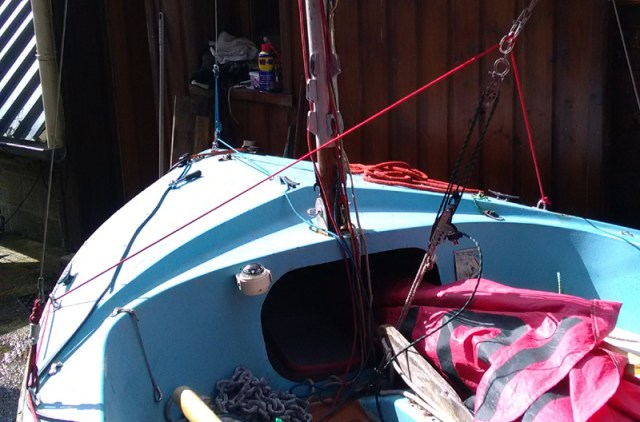
I decided to install a boom brake on Sarum. Here it is:

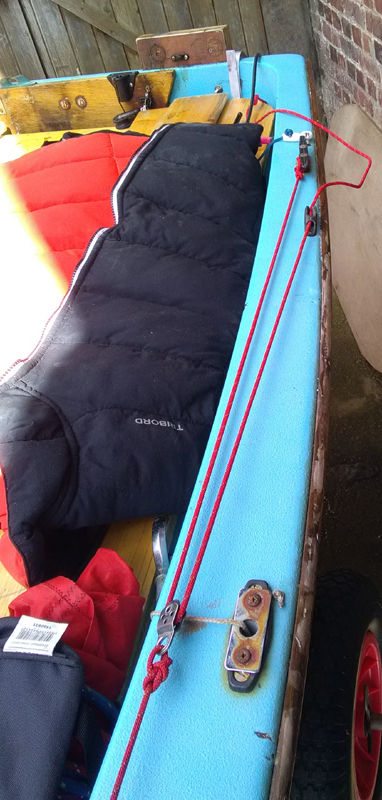
The line is tied with a bowline to a chain plate on the starboard side, through the braking device, through a fairlead on the port side and back along the gunwale of the boat.

I have used a simple nickle-plated brass swivel, which I have attached to the boom vang (kicker or downhaul if you prefer) fitting. Friction is increased when the (red) line is tightened.

It is then taken back along the port side and tied to a pulley. Another line tied to the aft mooring cleat is taken through the pulley and back to a cleat. This second line gives a 2 to 1 force on the brake line. Because the braking device is not attached directly to the boom, there is a bit of shock absorbing, which is ideal.Before doing a gybe, I can take the line off the cleat and ease it out. I can slow the gybing of the mainsail and keep better control of the boat. When I am running before the wind and “on the lee”, I can prevent the boom from going over. The sail might start flapping and wind might start to hit the opposite surface, and this will warn me to correct my helm. Another trick is sailing in such a way as the jib is only just not collapsing, and this will tell me that the main is firmly on the right tack. But there are still those rogue winds and waves, and even the most experienced sailor cannot anticipate them.

The boom brake also works as a boom preventer. Another use for this device is when there is very little wind and the boat is “ghosting”. You can either sit on the lee side of the boat and let gravity keep the boom from falling to the other side and spilling the wind out of the sail, but that might be risky in the event of a sudden gust. You can use a whisker pole (the boat’s gaff) on the boom like on the jib, or this device.

Posted in Uncategorized | Tagged | Leave a comment

Religious Freedom Revisited

The fact that Rod Dreher is trying to inculturate his ideas in ‘Le Pari Bénédictin’ Est Arrivé (the word pari in French usually means a gamble or a bet, but can also be used analogically to mean a challenge) into a French context is very interesting, something which highlights the difference between religious freedom as perceived in the USA and “freedom from religion” in France and increasingly in England. The question is still discussed by Roman Catholic traditionalists under the guise of the “social kingdom of Christ”.

In the Roman Catholic world, the institutional Church was concerned about the Papacy having lost its temporal authority in 1870 as a kind of “super empire” lording it over kings and emperors all over the world. Pius XI in 1922 attempted to formulate a notion of a kingship of Christ in the face of Fascism and Nazism. American Protestants and Catholics alike, when identified with the conservative tendency, want a world in which a religious minority can require that their government should enact laws against moral issues like homosexuality and abortion. This notion of the Church having temporal authority goes all the way back to the Peace of Constantine and in a clear form in Bonface VIII’s Unum Sanctam of 1302. It was challenged in 1870 by the Italian Resorgimento. Since then, the Church has had to refine its authority at a spiritual level, but using every opportunity to regain political power through “sympathetic” dictators like Pinochet, Mussolini and Franco.

This ambition for political power is thus a deeply rooted temptation, but one that has turned many against the Church and encouraged the formation of deeply anti-clerical tendencies in Europe. Many Roman Catholic polemical pundits felt validated by the development of Freemasonry in different and more or less virulent forms and the development of socialism and anarchism.

From lording it over the world, the Church had rapidly to beg for its freedom in Europe, America and elsewhere. How do you go about asking a hostile or indifferent secular authority to grant you civil rights and freedom whilst withholding them from rival religions like Protestants, Jews or Muslims? All of a sudden, the Church has to compete without force and coercion. The days of the Inquisition’s torture chambers are over! From day one, the American Constitution declared the complete separation between State (or federal government) and religious bodies. Such bodies are simply private associations like associations for other human interests.

Here in France, the most “mainstream” way is for everyone to be atheists and adhere to the prevailing socialism. People are free to adhere to the religion of their birth or convert to another and engage in a constant game of self-justification and standing out. In the classical fashion of the Vicar of Bray, mainstream Catholicism has aligned itself with all political ideologies, including Nazism under the Occupation. The current incumbency of Jorge Bergoglio shows the almost complete submission of his Church to the prevailing orthodoxies of socialism and various forms of collectivism.

Give France a shot of Americanism? I can hardly see that happen, when many French Catholics of the milieux bourgeois still only relate to England through stereotypes and ignorance. They still talk about Joan of Arc and Napoleon! I am also sceptical of America’s tired message when that country slides ever more deeply towards the police state and dystopia. The opposition between the antifas and the alt-right is increasingly polarised and violent, brought out by the election of Trump. What is at stake here is not America or Europe, but human nature at its basest. Those who do not learn from history are condemned to repeat it – if I have got the quote right.

Dreyer is right in that massive Islamic immigration has changed the paradigm. The Roman Catholic Church is no longer a force to be resisted, and the laws of separation of church and state are of historical relevance only. As far as I see things, the old laws will continue to be in place to resist radical Islam today like radical Catholicism a hundred years ago. Unlike many, I do not see Islam creating a totalitarian caliphate in Europe for as long as political authorities remain under the influence of atheism, big money and power. At the same time, politicians still need votes from the strong Muslim minority.

Christianity must find a different way from claiming political power and denying freedom to those who are not Christians. “Error has no rights”. It may be correct in the absolute and in metaphysical terms, but what right do we have to coerce people into a our faith and / or morality? As for religion becoming private, I see no other way, certainly not by getting into politics. Then, by culture? Yes, perhaps.

It is interesting to note from one of the comments in this thread that:

Islam is even deader than Christianity when it comes to the spirit of the religion. He says for the young it’s all surface and lots of hypocrisy. Certainly from a few students I know, they seem to suffer from the same embrace of contemporary western liberal culture that we see with many young Christians.

All that means is that diaspora Islam is going the same way as mainstream Christianity.

I am not that sure of using culture to bring Christianity back into society. It depends on what we mean by culture. Most of what passes for culture today, including museums and classical music concerts, is no platform for Christianity. Institutional Christianity has little time for art and artists these days. Even in the past, artists and composers got short shrift from the Church.

The future of Christianity has to come from its intrinsic truth and value as a way of life. Those notions have no need of validation by politicians and legislators. People often feel the need for validation by some small society or association. Don’t we all? I cannot be a legitimate priest without being under a bishop with a working Church and who is in communion with a number of fellow bishops. At the same time, anything worthwhile comes from individual persons, be it prophetic vision, art, music, literature or anything inspiring and beautiful. I have to make a distinction between my vocation as a priest and my personal aspirations. This goes against my seminary formation teaching that a priest sees everything through his priesthood and clerical status.

Being a cleric removed me from the usual categories of social classes. Among other things, I have an instinct for “detecting bullshit” and the less sincere and honest aspects of social life. In my present married life, I spend more of my time looking like a fairly “bohemian” sort of layman than a cleric or gentleman about town. I find myself having largely gone the way of a tendency of post-war French clergy. They stripped themselves of their clerical identity (and the cassock) to live among ordinary people who had long ago been alienated from parish life. The worker priests and the Mission de France largely became political and espoused issues of interest to communists and trade unionists, and that was their greatest mistake. Perhaps, Dreher’s greatest intuition is to emphasise St Benedict, not for the purpose of founding monasteries but a more contemplative and liturgical notion of Christianity to be lived by intentional communities and individuals alike. Someone working in town and showing some difference from most people will attract attention, well or badly intentioned.

I have read most of Nicholas Berdyaev’s books, and I think particularly here of Freedom and the Spirit. There is no way that anyone can legislate over the free human spirit. We can be brought to task for what we say or do, but usually not for what we think. Orwell imagined the frightening concepts of thought crime and thought police, but they are not yet with us, and we can still think as we want. Religious freedom is above all a freedom of spirit, as in the spirit being distinct from the soul.

To continue a theme on which I have written, religious and spiritual life probably prosper better under conditions of pressure and adversity, the need for clandestinity, than being officially validated by the rich and powerful of this world. We live in a world where people kill, steal, abort, fornicate, violate marriage and family, abuse children and just about every other crime against God and man. What can we do about it? Perhaps the only thing is not doing any of these things ourselves! Many so-called “Christians” do, as I read this morning in an article about a Catholic orphanage in Scotland where evidence revealed 300% more mortality among the children in this institution than in the general population during the same era (late nineteenth century to about 1930). We can also cease supporting political ideologies that advocate things like “ethnic cleansing” and other euphemisms for killing certain categories of human beings.

Being powerless is perhaps the most purifying experience of all. I know of no teaching of Christ, neither in the New Testament nor in various apocryphal and Gnostic texts, that advocates the use of political authority or force against those not in agreement with his message. Christ went out to the marginal, the poor, the sick and the weak, those who sought God’s help and blessing, those who had hopes beyond this present world. This is what was attempted by those French priests in the 1950’s and 60’s, with the distinguished example of the Prêtre chez les Loubards, Fr Guy Gilbert. I wish and hope for the day that the black priest’s cassock will cease to be a symbol of alt-right politics, and will again become something that represents the same gentle and compassionate ministry as Fr Gilbert’s motorcycle jacket and long hair.

Posted in Uncategorized | Tagged , , , , , | 8 Comments

Missal Stands

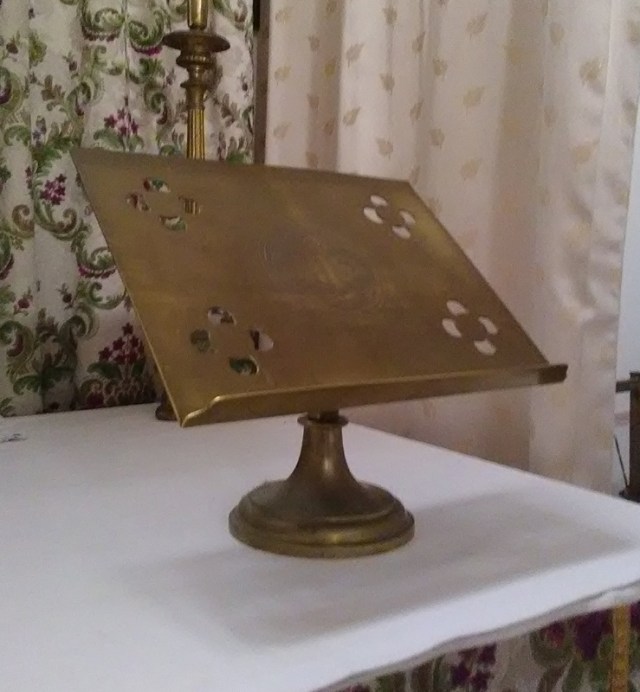
I have just made an improved missal stand for my travelling chapel, because before it was resting on two triangular feet which got in the way of things like the corporal on a very restricted space. I adopted the column and round foot solution.

It is quite stable and has a tipping-over moment of at least 15-20° with a book that isn’t too heavy. The ideal format is a book with something like A5 pages. It can also take the laity version of the Anglican Missal and a small format Roman missal. My Latin Dickinson missal will go on it, though it is a little on the heavy side.

The design is based on the metal pillar stand which I use in my chapel.

I bought it cheaply from a church that also sold me its organ. It is much more stable than my new wooden stand and will take heavier books, but not the big Roman and English missals that were published in the early twentieth century.

An alternative form, which I made some years ago in oak, is foldable and also designed for smaller format books. I presently use it in my sacristy for holding the Ordo.

It has four square feet and will go on most altars without getting in the way. Of course, it is the most stable design, and has three angle positions from almost flat to the angle you see here. I have come across priests who prefer an almost flat position for the missal. In Percy Dearmer’s recommendations and probably in the medieval Church, a cushion was used to position the missal for easy reading and to give it some dignity as a sacred object.

I am not much of a purist and favour the wooden missal stand, preferably with a fairly steep angle. The round pillar allows the missal to be distanced further from the area of the altar covered by the corporal. When the missal is “flitted” (moved from one side to the other) it can be taken by the part holding the book, or with one hand by the pillar, which is what I do.

Some missal stands are very elaborate, like in this catalogue. I don’t really like them and they are very pricey. Many designs are possible, but in the end, I prefer the column type.

Posted in Uncategorized | Tagged | 7 Comments

Human Nature

On opening Facebook this morning, it reminded me of a link I had shared a couple of years ago. It is still there: I love the Victorian era. So I decided to live in it. It’s not something I would want to do myself, but I sympathise with those who want to do their “own thing”. This lady gives her reasons, like her reaction from – always the same bloody thing – consumer capitalism. The prime example is anything mechanical, designed to last and be repaired – or thrown out because it cannot be repaired and replaced with a new one (to the advantage of the manufacturer). We are taught that money is everything and that this marks the end of history, the proverbial boot stamping on the human face forever. There are signs that it will also fail like all the worldly empires that have passed away.

What is most poignant in this story of a couple living the (neo-Victorian) life that enables them to blossom as persons being themselves and not harming anyone else – is the abuse hurled at them by “normal” people.

We live in a world that can be terribly hostile to difference of any sort. Societies are rife with bullies who attack nonconformists of any stripe. Gabriel’s workout clothes were copied from the racing outfit of a Victorian cyclist, and when he goes swimming, his hand-knit wool swim trunks raise more than a few eyebrows — but this is just the least of the abuse we’ve taken. We have been called “freaks,” “bizarre,” and an endless slew of far worse insults. We’ve received hate mail telling us to get out of town and repeating the word “kill … kill … kill.” Every time I leave home I have to constantly be on guard against people who try to paw at and grope me. Dealing with all these things and not being ground down by them, not letting other people’s hostile ignorance rob us of the joy we find in this life — that is the hard part. By comparison, wearing a Victorian corset is the easiest thing in the world.

This is why more people don’t follow their dreams: They know the world is a cruel place for anyone who doesn’t fit into the dominant culture. Most people fear the bullies so much that they knuckle under simply to be left alone. In the process, they crush their own dreams.

Last night, my attention was attracted to the plight of Pitcairn Island, one of the most remote places on this planet where Fletcher Christian and the other mutineers on the Bounty took refuge to avoid being taken back to England and the gallows. The story is fascinating, and now the population is down (as of a couple of years ago) to 49. In the early years of this century, there was a disgusting revelation that nearly all the men living on the island were pedophiles, raped and abused children and kept pornography representing sado-masochistic fantasies. One of them was the Mayor and a descendent of Fletcher Christian. The population seem to have a kind of omertà in place and would be hostile to anyone coming to live on the island. One suggestion has been made that the British Government remove the population, relocate them elsewhere, turn the island over to UNESCO and make it accessible only to professional scientific researchers. Perhaps there are some nice people living there who fear the bullying and tyranny. The story rather reminds me of Lord of the Flies by William Golding in which a bunch of schoolboys are plane-wrecked on an uninhabited Pacific island, all the adults were killed in the crash, and the boys gradually revert to a state of savagery. Two films have been made of this story, but I prefer the older one:

What can we understand of this aspect of humanity, what Calvin called total depravity? Is this within us all? We read about murderers and child rapists, among others who commit evil in different ways, and wonder if this is something normal. Would it be better to wish for the extinction of humanity like what happened to the dinosaurs millions of years ago?

In scientific terms we read of personality disorders of persons without any moral conscience or sense of right and wrong. Some have come up with theories of about 5% of true psychopaths in society and the way that ordinary people can follow them and be “infected” with their evil. The prime example of this was Nazi Germany, something that can happen anywhere, given the rich culture of Germany and its technological and scientific prowess. The phenomenon of the schoolyard bully is particularly relevant, children who seem to be born to victimise other children.

My last posting attracted the comment – Amongst some conservative Christians the Faith has been reduced to smugness about ones own salvation and a moralistic crusade against divorce, abortion and homosexuality. My own reaction is to ask myself whether I am happier in the company of atheists. Perhaps not, since atheism doesn’t make a person immune from ignorance and becoming bullies. Christianity is almost completely covered by this ugly coat of paint that chokes it to inexistence!

I have written quite a lot on the mystery of evil, but I have no more insight than anyone else who has tried to study it from a point of view of theology or philosophy. Have we to knuckle down and accept it as normal, contribute to it, be even nastier than “them”? Hell is an image of many ideas. Probably, the most credible notion is a state of darkness, senselessness, absolute boredom and isolation of one’s sinful ego. George Orwells 1984 dystopia is an image of hell on earth based on the Hitler and Stalin regimes made so much worse by the imagination. The Grand Inquisitor of Dostoevsky was essentially one who wanted to bring about good by the repression of human freedom which is the seat of evil – and thus himself emerges as an evil atheist in spite of his appearance as a priest of the Church.

Evil is essentially something with no ontological existence, something like darkness where there is no light. One of the finest philosophers I have read on the mystery of evil is Nicholas Berdyaev.

God is not culpable in worldly evil, God is not all-powerful in this. He does not rule within the world, but He conquers the dark chaotic principle, which is co-eternal to Him, having been always.

It is a terrifying mystery that we will never comprehend. I have tended to believe that God created us in his image, and therefore we can deduce that the divine image is as tarnished by the principle of evil as we are. The Gnostics saw original sin not in man but in God, somewhere between the “God above God” and the creator God of the Old Testament. Speculation is always possible, but can be no more than analogy. Perhaps good is only good in relation to evil as light to darkness, white to black.

I believe that we are called in life to be aware of this mystery and do all we can to be good and confront evil with good and love. It’s much more easily said than done, and we all come short. The more I go on in life, the more I notice that Christ ministered to the marginalised, downtrodden, poor and maimed. Those who best understood him in history were the victims of the official establishment, but also of the ignorance and cruelty of the mob. This is something beautifully understood by the most unlikely candidates for canonisation by the official Church – St Francis of Assisi, St Benedict-Joseph Labre and others who would have been vilified and punished in our own time.

I don’t think I would want to live like in the nineteenth century or any other time in the past. However, I am attracted to marginal people and those who can slip under the net. This theme has preoccupied me for some time. However, there is a warning. The people of Pitcairn are marginal, and the devil built his “chapel” alongside the marvellous opportunity those folk could have had to construct something fruitful based on relationships of love and a social contract built upon a rock of justice and forgiveness. It is also the mystery of totalitarian cults and sects. Flee away from those who claim to have all the answers, those who are “always right” and live on the unhappiness of others. Evil is not always in the mainstream.

Behold, I send you out as sheep in the midst of wolves. Therefore be wise as serpents, and harmless as doves.

Posted in Uncategorized | Tagged , , | 7 Comments

Christianity and Social Conformity

A very illuminating article has come up from an American point of view – The De-Churching Of America by Red Dreher. Though his emphasis is on his own country, many of his observations reflect the situation in England with the present directions taken by the Church of England. He also mentions the plight of France’s rotting church buildings, increasingly slated for demolition by those public authorities not prepared to continue financing their upkeep.

On reading this article, it occurs to me that Christianity, whether Protestant or Catholic, has depended for too long on bourgeois social conformity and ultimately on the old Latin saying Cuius Rex eius religio – your religious beliefs and practices are not determined by any objective truth but by whoever is running the country you’re living in. If that standard changes, you change with it.

What does it all mean to us? Some will threaten us saying that if we leave civil Christian orthodoxy, we will end up on the radical left or the alternative right. What about the option of being oneself and going a different way, and – by the way – rediscovering Christianity as Christ looking after the little ones and marginalised. Healthy people don’t need the doctor, only when something is wrong and you want to put it right.

My impression of America has always been mixed. It used to be the individual’s dream, like the Transcendentalism about which I have written. Now, the analogy seems to be the anthill and the ants – as with European city dwellers commuting to “bullshit” jobs. If I were a layman in America, which church would I go to? Probably one that would be hundreds of miles away from my home.

Perhaps it is the Rex who is deciding everything. I talk not of President Trump but simply of social conformity. What is happening in America is what happened in Europe, Canada and Australia decades ago. We have contented ourselves for too long with a caricature of Christian culture that we no longer bother to seek something more authentic or which speaks to our inmost being.

Many things will depend on how committed we are to politics and the current polarisation between “right” and “left”, seemingly leading in the minds of some pundits to a second civil war, or whether we decide to be independent from it all even if we conform outwardly to continue to enjoy the advantages of modern consumer capitalism for as long as it lasts. For us, it will depend on whether we still have the money to spend on it.

There are alternatives to being left or right wing militants. Just go away and find a new life in the margins – and you will find others in the margins. I have again been reading about the modern equivalent of hippie communities and folk living in boats. Expressed ideas are often angry and stereotyped, but some are profound and express a message for the future.

Being marginal and unafraid of it is a “sign of contradiction”, a boat being rowed against the current. It might not get very far, no further than the first Christians before the Peace of Constantine when the temptation of becoming establishment was finally swallowed. The moment of success was the failure of what made Christianity true and good. I always return to the quote of St Jerome I found in a book by Soloviev: Ecclesia persecutionibus crevit; post quam ad christianos principes venit, potentia quidem et divitiis maior, sed virtutibus minor facta est (The Church firstly languished under persecution. After this, she turned to Christian rulers who gave her wealth and power, but she thereby grew weaker in virtue). That is the root of the problem, yet Christianity based on personal dignity and spiritual freedom could not last. Christ himself, in temporal terms, did not last very long. The clergy of Jerusalem got the Romans to execute him like a common criminal and his resurrection and ascension were only clear to a few. Outside Christianity, only Flavius Joseph wrote anything significant about Christ. Slender underpinnings indeed.

The thinking of the old Worker Priests and Fr Guy Gilbert among others was not far off, when they didn’t convert everything into political ideology using disembowelled Christian terminology. However, such a mission has no room for traditional Christian culture like organ and choral music, beautiful churches and art. I myself am attached to such things, but they are not enough to get people back into medieval and Victorian church buildings and foot the bill for their upkeep. Administrators in the Church of England and in French Roman Catholicism know that the “game is up”. It’s over and has been for a long time.

We will live long enough to see cathedrals become museums or secular buildings for cultural or business purposes. Churches can no lo longer be maintained, unless they are very small and within the abilities of people who do up houses to work on. The church of the future is no bigger than a garage of a garden shed or a room in someone’s house. My article of yesterday showed the extreme reduction of a place of worship to a corner of a tent on a camp site or on a rock on the beach. The place of worship will follow the number of worshippers from a priest alone to a couple of stubborn souls (where two or three…).

Perhaps, Christianity can be instilled in family life from parents to children – in some cases. It all depends how dependent the parents are on the consumer capitalist world that woos them with lots of stuff and gadgets (which I have to use myself to work in the services industry). Here comes the “Benedict Option” of getting families into alternative societies and intentional communities. Such communities do exist, but most are opposed to any kind of “dogmatism” or institutional church getting its claws in. Perhaps a priest has himself to live alternatively and grow into the community – and that was the essence of priests who were stigmatised in the 1950’s for being too radical and progressive. They just saw the limits of the institutional Church – and the way its discredited itself for hob-nobbing with the Nazis in the early 1940’s. The scars are still there in France! Reading Bonhöffer will clarify many things for us.

What is the “new” Christianity. Simply going to the New Testament and the examples of light shone in the darkness through individual persons (saints) and monasteries. Here are there, there were parishes and dioceses that shone by their love of Christ rather than by the standards of worldly success. We in the margins of society have to rebuild Christian culture through writing, art, and simply by spending time with other marginal folk without trying to sell anything.

I can only get a feeling about Dreher’s Benedict Option. He is an American and I am European. The perspectives are different. Alternative communities or any kind of alternative living is just like the mainstream – you have to have money. Some ways of life need less money than others, and less dependency on The System (The Pit) or whatever you want to call it. There always has to be some compromise. You just have to balance your accounts and make sure that you have the time and space to live a life worth living.

The key will be the greatest independence from the System, and the ability to become ourselves and decide on our priorities. Some will decide to live in intentional communities (as pawns in a cult or buying into some form of cooperative at market prices), or live alone or in families and meet up from time to time, like in the case with nomadic people on the sea or on land.

Is Christianity a marketable commodity to be sold, imposed by persuasion? I don’t think so. It seems to be something to be found and rediscovered when we are dissatisfied by the record of some other religions and ideologies. A part of this blog is one of offering seeds to others – free of charge and with no advantage to myself trying to live life as a priest and an ordinary guy.

Posted in Uncategorized | Tagged , | 7 Comments

Liturgical Minimalism

John Beeler (who regularly writes on Facebook but rarely in his blog) wrote an interesting entry on Facebook about “no-frills Catholicism” showing an Ordinariate Mass in a rather kitschy modern church.

This is apparently somewhere in the USA. One comment says: Astounding- good lighting and merely facing eastward makes mass in a kitschy 60s building come off beautifully. This reminds me somewhat of the Other Modern articles in the New Liturgical Movement. Scroll down the page beyond the eighteenth century chant books, and you will find articles on church art and architecture from the twentieth century. I have often been intrigued by 1930’s and 1950’s churches some find ugly, but which express the reconstruction from the first and second world wars. I discovered some very interesting church buildings in Paris built under the Chantiers du Cardinal scheme.

One aspect common to these churches, as for those built later – when the plan was more or less traditional – was their extreme sobriety and plainness. In a certain way, they revive the ideals of the Cistercian movement in the twelfth century as they reacted from what they perceived as corruptions in Benedictine monasteries. Fontenay Abbey in France is a typical example from that era.

The Cistercians were quite “iconoclast” in their reduction in the number of statues and images, but the keynote of their architecture was harmony, symmetry and nobility. Some of the “other” modern churches tried to recapture this spirit.

Returning to John Beeler’s eastward-facing Mass in a modern church, the effect is quite other-worldly, the congregation deeply in prayer and the priest quietly saying Mass with a single server. One intriguing feature is the use of lights or candles in glass vases. They are just what I use when travelling and living in minimalist conditions. I wrote an article on the tuck box chapel some time ago. It is fiddly to use, and the tent doesn’t allow me to stand up fully.

Tea lights in glass vases are ideal for when there is wind (you have to be careful that the Host doesn’t get blown away!).It is quite amazing how much a modern tent blocks out most of the wind. The missal stand, though small, is unwieldy. I have ideas of making a new one on a round turned wood stand. I have the tiny travelling chalice and paten which my parents gave me on the day of my ordination.

Saying Mass outdoors is another experience. When I went on a sailing course at the Glénans in 2009, a large granite rock on the beach was my altar.

It all folded away into my rucksack, since I left my van at Concarneau and was isolated for a week on those lovely islands. What a way to begin the day!

There are many rational and historical arguments for the “eastward position” as Anglican ritualists in the nineteenth century once called it. One of the finest authors on this subject was Monsignor Klaus Gamber who found favour with Cardinal Ratzinger. These few notes and photos show the question from a more aesthetic and “emotional” point of view, even a pastoral point of view.

Finally, I should add that minimalism should not be a norm or an ideological refusal of beauty. Mass is normally celebrated in a consecrated church, and is only celebrated elsewhere in cases of necessity, for example being excluded from celebrating in historical churches because of not belonging to the establishment, being victims of persecution and brought to worship in clandestinity. It is better to worship in less than ideal conditions than not at all.

In terms of taste of church furnishing, I gradually “grew out” of my baroque formation at the seminary of Gricigliano and elsewhere, and gravitated to simpler styles influenced by the Pre-Raphaelite and Arts and Crafts movements. Things did go a little over the top in the mid eighteenth century and with the grandiosity of the Victorian era. The twentieth century brought an attempt to simplify and seek a more “medieval style” – see the Parson’s Handbook by Percy Dearmer as an example of that ideal. Such inspirations continued for a long time, and I cite Guildford Cathedral and St Alban’s Holborn as examples of fine architecture from the 1960’s.

I tend to simplicity myself. I have not worn lace surplices or albs for many years, preferring plain white linen or cotton with simple vestments. I don’t impose my preferences on others, nor do I think they are wrong if they prefer more baroque or “Victorian” styles. Either way are options that indicate a frame of mind and preference in their living the Church’s liturgy. More is perceived by personal experience than arguing – something very exasperating in the English-speaking Catholic and Anglican world.

Posted in Uncategorized | Tagged , | 15 Comments