Boom Preventer

Prevent us, O Lord, we beseech thee, by thy most gracious favour... No, this time, the word prevent is in the modern meaning – to impede, to stop something from happening.

Sailing boats are notorious for people being hit over the head by the boom when it swings across the boat. This happens by tacking, when the bow is brought through the wind and sails in a close haul on the opposite tack. It also happens with a much more violent movement when running before the wind – the wind is astern of the boat, and the stern is brought through the wind. This is gybing, which should be a carefully controlled manoeuvre. If gybing is uncontrolled or accidental, it has catastrophic consequences on a yacht and causes a dinghy to capsize. It is the most frequent cause of capsizing.

Accidental gybing usually happens when sailing by the lee, with the jib opposite the mainsail in a scissors or butterfly configuration, the wind almost directly behind the boat and the mainsail is on the point of gybing. I often run before the wind in this manner, but avoid taking the boat to the utmost limit. The gybe is caused by the helmsman steering over, by a sudden change in the wind direction or a wave that pushes the stern over too violently to be compensated by the rudder.

The solution to this problem is to be able to control the movement of the mainsail, to bring it through the gybe slowly and gently. An alternative is preventing this from happening until the helmsman and crew are ready for the gybe. There are two devices: a boom brake and a boom preventer. The boom brake is set up when the boat is rigged, and is engaged when the line is pulled tight and cleated. The boom preventer has to be taken by a crew member forward, past the outside of the standing rigging and threaded through a mooring cleat or fairlead at the boat’s bow or a forward mooring cleat. The line is brought back to the cockpit. After the gybe, the line is pulled in and the process is repeated on the other side of the boat. This is nerve-racking on a yacht on a heavy sea and quite impractical on a dinghy.

Here is a presentation of several devices on a yacht and how they work:

With the exception of the boom preventer, which is simply a piece of rope or a warp, the braking devices are bought from the ship chandler’s shop and are quite expensive. The cost is justified by the saving of major repair costs to a broken rig, not to speak of an emergency at sea. That is for yachts with their enormous areas of sail.

A dinghy is that much more reactive and the simpler they are, the better they work, especially for racing. Dinghy cruisers tend to modify their boats and make them into “mini yachts”. An uncontrolled gybe, unlike on a large yacht, does not bear the consequences of breaking the rig. However, the boat rolls over suddenly and the boom end digs into the water, the hull lurches towards the wind, the stern and rudder lift up out of the water and no control is possible. The broached boat capsizes. A highly skilled skipper is able to anticipate the movement from the moment of the gybe, and gets up onto the uppermost side of the boat and clambers onto the centreboard, saving himself a swim. From sailing school, I have always been nervous about gybing, especially in a fresh breeze.

It is possible to avoid gybing altogether. You bring the boat up to the wind gently by hauling in the main and jib, and then you tack, and then ease off both sails after the tack. You always anticipate for the whims of the wind and waves by not going further away from the wind than a full reach. That is possible, but “chicken gybing” is laborious and complex.

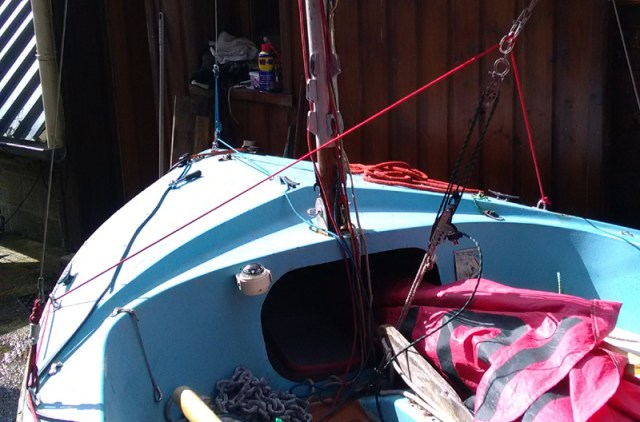
I decided to install a boom brake on Sarum. Here it is:

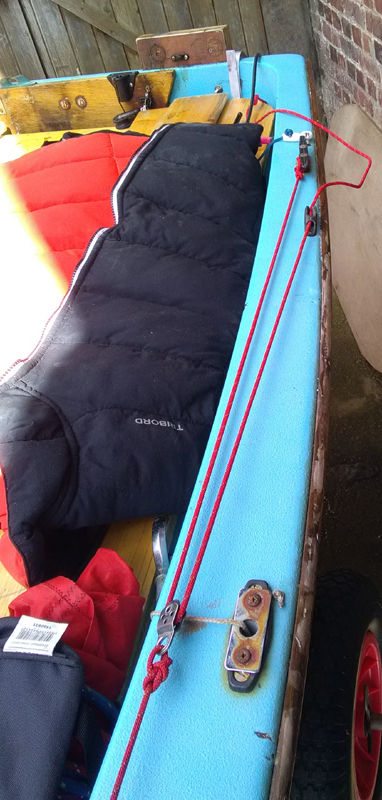
The line is tied with a bowline to a chain plate on the starboard side, through the braking device, through a fairlead on the port side and back along the gunwale of the boat.

I have used a simple nickle-plated brass swivel, which I have attached to the boom vang (kicker or downhaul if you prefer) fitting. Friction is increased when the (red) line is tightened.

It is then taken back along the port side and tied to a pulley. Another line tied to the aft mooring cleat is taken through the pulley and back to a cleat. This second line gives a 2 to 1 force on the brake line. Because the braking device is not attached directly to the boom, there is a bit of shock absorbing, which is ideal.Before doing a gybe, I can take the line off the cleat and ease it out. I can slow the gybing of the mainsail and keep better control of the boat. When I am running before the wind and “on the lee”, I can prevent the boom from going over. The sail might start flapping and wind might start to hit the opposite surface, and this will warn me to correct my helm. Another trick is sailing in such a way as the jib is only just not collapsing, and this will tell me that the main is firmly on the right tack. But there are still those rogue winds and waves, and even the most experienced sailor cannot anticipate them.

The boom brake also works as a boom preventer. Another use for this device is when there is very little wind and the boat is “ghosting”. You can either sit on the lee side of the boat and let gravity keep the boom from falling to the other side and spilling the wind out of the sail, but that might be risky in the event of a sudden gust. You can use a whisker pole (the boat’s gaff) on the boom like on the jib, or this device.

Posted in Uncategorized | Tagged | Leave a comment

Religious Freedom Revisited

The fact that Rod Dreher is trying to inculturate his ideas in ‘Le Pari Bénédictin’ Est Arrivé (the word pari in French usually means a gamble or a bet, but can also be used analogically to mean a challenge) into a French context is very interesting, something which highlights the difference between religious freedom as perceived in the USA and “freedom from religion” in France and increasingly in England. The question is still discussed by Roman Catholic traditionalists under the guise of the “social kingdom of Christ”.

In the Roman Catholic world, the institutional Church was concerned about the Papacy having lost its temporal authority in 1870 as a kind of “super empire” lording it over kings and emperors all over the world. Pius XI in 1922 attempted to formulate a notion of a kingship of Christ in the face of Fascism and Nazism. American Protestants and Catholics alike, when identified with the conservative tendency, want a world in which a religious minority can require that their government should enact laws against moral issues like homosexuality and abortion. This notion of the Church having temporal authority goes all the way back to the Peace of Constantine and in a clear form in Bonface VIII’s Unum Sanctam of 1302. It was challenged in 1870 by the Italian Resorgimento. Since then, the Church has had to refine its authority at a spiritual level, but using every opportunity to regain political power through “sympathetic” dictators like Pinochet, Mussolini and Franco.

This ambition for political power is thus a deeply rooted temptation, but one that has turned many against the Church and encouraged the formation of deeply anti-clerical tendencies in Europe. Many Roman Catholic polemical pundits felt validated by the development of Freemasonry in different and more or less virulent forms and the development of socialism and anarchism.

From lording it over the world, the Church had rapidly to beg for its freedom in Europe, America and elsewhere. How do you go about asking a hostile or indifferent secular authority to grant you civil rights and freedom whilst withholding them from rival religions like Protestants, Jews or Muslims? All of a sudden, the Church has to compete without force and coercion. The days of the Inquisition’s torture chambers are over! From day one, the American Constitution declared the complete separation between State (or federal government) and religious bodies. Such bodies are simply private associations like associations for other human interests.

Here in France, the most “mainstream” way is for everyone to be atheists and adhere to the prevailing socialism. People are free to adhere to the religion of their birth or convert to another and engage in a constant game of self-justification and standing out. In the classical fashion of the Vicar of Bray, mainstream Catholicism has aligned itself with all political ideologies, including Nazism under the Occupation. The current incumbency of Jorge Bergoglio shows the almost complete submission of his Church to the prevailing orthodoxies of socialism and various forms of collectivism.

Give France a shot of Americanism? I can hardly see that happen, when many French Catholics of the milieux bourgeois still only relate to England through stereotypes and ignorance. They still talk about Joan of Arc and Napoleon! I am also sceptical of America’s tired message when that country slides ever more deeply towards the police state and dystopia. The opposition between the antifas and the alt-right is increasingly polarised and violent, brought out by the election of Trump. What is at stake here is not America or Europe, but human nature at its basest. Those who do not learn from history are condemned to repeat it – if I have got the quote right.

Dreyer is right in that massive Islamic immigration has changed the paradigm. The Roman Catholic Church is no longer a force to be resisted, and the laws of separation of church and state are of historical relevance only. As far as I see things, the old laws will continue to be in place to resist radical Islam today like radical Catholicism a hundred years ago. Unlike many, I do not see Islam creating a totalitarian caliphate in Europe for as long as political authorities remain under the influence of atheism, big money and power. At the same time, politicians still need votes from the strong Muslim minority.

Christianity must find a different way from claiming political power and denying freedom to those who are not Christians. “Error has no rights”. It may be correct in the absolute and in metaphysical terms, but what right do we have to coerce people into a our faith and / or morality? As for religion becoming private, I see no other way, certainly not by getting into politics. Then, by culture? Yes, perhaps.

It is interesting to note from one of the comments in this thread that:

Islam is even deader than Christianity when it comes to the spirit of the religion. He says for the young it’s all surface and lots of hypocrisy. Certainly from a few students I know, they seem to suffer from the same embrace of contemporary western liberal culture that we see with many young Christians.

All that means is that diaspora Islam is going the same way as mainstream Christianity.

I am not that sure of using culture to bring Christianity back into society. It depends on what we mean by culture. Most of what passes for culture today, including museums and classical music concerts, is no platform for Christianity. Institutional Christianity has little time for art and artists these days. Even in the past, artists and composers got short shrift from the Church.

The future of Christianity has to come from its intrinsic truth and value as a way of life. Those notions have no need of validation by politicians and legislators. People often feel the need for validation by some small society or association. Don’t we all? I cannot be a legitimate priest without being under a bishop with a working Church and who is in communion with a number of fellow bishops. At the same time, anything worthwhile comes from individual persons, be it prophetic vision, art, music, literature or anything inspiring and beautiful. I have to make a distinction between my vocation as a priest and my personal aspirations. This goes against my seminary formation teaching that a priest sees everything through his priesthood and clerical status.

Being a cleric removed me from the usual categories of social classes. Among other things, I have an instinct for “detecting bullshit” and the less sincere and honest aspects of social life. In my present married life, I spend more of my time looking like a fairly “bohemian” sort of layman than a cleric or gentleman about town. I find myself having largely gone the way of a tendency of post-war French clergy. They stripped themselves of their clerical identity (and the cassock) to live among ordinary people who had long ago been alienated from parish life. The worker priests and the Mission de France largely became political and espoused issues of interest to communists and trade unionists, and that was their greatest mistake. Perhaps, Dreher’s greatest intuition is to emphasise St Benedict, not for the purpose of founding monasteries but a more contemplative and liturgical notion of Christianity to be lived by intentional communities and individuals alike. Someone working in town and showing some difference from most people will attract attention, well or badly intentioned.

I have read most of Nicholas Berdyaev’s books, and I think particularly here of Freedom and the Spirit. There is no way that anyone can legislate over the free human spirit. We can be brought to task for what we say or do, but usually not for what we think. Orwell imagined the frightening concepts of thought crime and thought police, but they are not yet with us, and we can still think as we want. Religious freedom is above all a freedom of spirit, as in the spirit being distinct from the soul.

To continue a theme on which I have written, religious and spiritual life probably prosper better under conditions of pressure and adversity, the need for clandestinity, than being officially validated by the rich and powerful of this world. We live in a world where people kill, steal, abort, fornicate, violate marriage and family, abuse children and just about every other crime against God and man. What can we do about it? Perhaps the only thing is not doing any of these things ourselves! Many so-called “Christians” do, as I read this morning in an article about a Catholic orphanage in Scotland where evidence revealed 300% more mortality among the children in this institution than in the general population during the same era (late nineteenth century to about 1930). We can also cease supporting political ideologies that advocate things like “ethnic cleansing” and other euphemisms for killing certain categories of human beings.

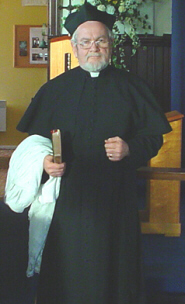
Being powerless is perhaps the most purifying experience of all. I know of no teaching of Christ, neither in the New Testament nor in various apocryphal and Gnostic texts, that advocates the use of political authority or force against those not in agreement with his message. Christ went out to the marginal, the poor, the sick and the weak, those who sought God’s help and blessing, those who had hopes beyond this present world. This is what was attempted by those French priests in the 1950’s and 60’s, with the distinguished example of the Prêtre chez les Loubards, Fr Guy Gilbert. I wish and hope for the day that the black priest’s cassock will cease to be a symbol of alt-right politics, and will again become something that represents the same gentle and compassionate ministry as Fr Gilbert’s motorcycle jacket and long hair.

Posted in Uncategorized | Tagged , , , , , | 8 Comments

Missal Stands

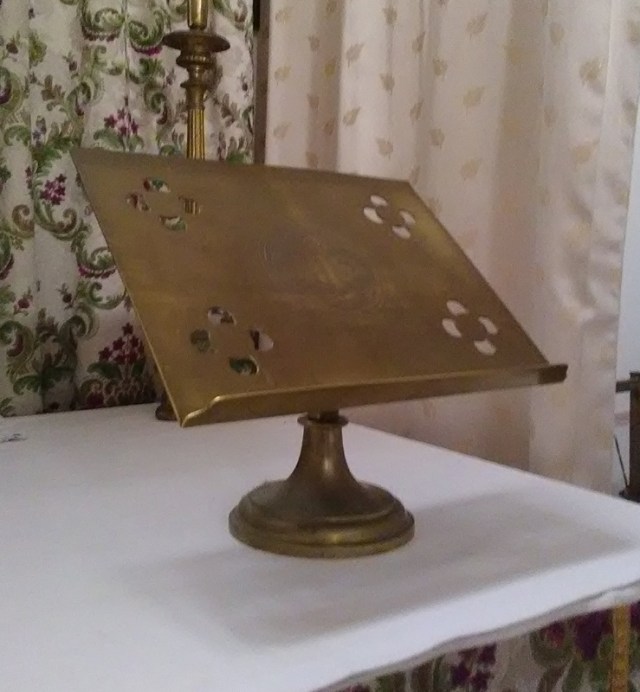
I have just made an improved missal stand for my travelling chapel, because before it was resting on two triangular feet which got in the way of things like the corporal on a very restricted space. I adopted the column and round foot solution.

It is quite stable and has a tipping-over moment of at least 15-20° with a book that isn’t too heavy. The ideal format is a book with something like A5 pages. It can also take the laity version of the Anglican Missal and a small format Roman missal. My Latin Dickinson missal will go on it, though it is a little on the heavy side.

The design is based on the metal pillar stand which I use in my chapel.

I bought it cheaply from a church that also sold me its organ. It is much more stable than my new wooden stand and will take heavier books, but not the big Roman and English missals that were published in the early twentieth century.

An alternative form, which I made some years ago in oak, is foldable and also designed for smaller format books. I presently use it in my sacristy for holding the Ordo.

It has four square feet and will go on most altars without getting in the way. Of course, it is the most stable design, and has three angle positions from almost flat to the angle you see here. I have come across priests who prefer an almost flat position for the missal. In Percy Dearmer’s recommendations and probably in the medieval Church, a cushion was used to position the missal for easy reading and to give it some dignity as a sacred object.

I am not much of a purist and favour the wooden missal stand, preferably with a fairly steep angle. The round pillar allows the missal to be distanced further from the area of the altar covered by the corporal. When the missal is “flitted” (moved from one side to the other) it can be taken by the part holding the book, or with one hand by the pillar, which is what I do.

Some missal stands are very elaborate, like in this catalogue. I don’t really like them and they are very pricey. Many designs are possible, but in the end, I prefer the column type.

Posted in Uncategorized | Tagged | 7 Comments

Human Nature

On opening Facebook this morning, it reminded me of a link I had shared a couple of years ago. It is still there: I love the Victorian era. So I decided to live in it. It’s not something I would want to do myself, but I sympathise with those who want to do their “own thing”. This lady gives her reasons, like her reaction from – always the same bloody thing – consumer capitalism. The prime example is anything mechanical, designed to last and be repaired – or thrown out because it cannot be repaired and replaced with a new one (to the advantage of the manufacturer). We are taught that money is everything and that this marks the end of history, the proverbial boot stamping on the human face forever. There are signs that it will also fail like all the worldly empires that have passed away.

What is most poignant in this story of a couple living the (neo-Victorian) life that enables them to blossom as persons being themselves and not harming anyone else – is the abuse hurled at them by “normal” people.

We live in a world that can be terribly hostile to difference of any sort. Societies are rife with bullies who attack nonconformists of any stripe. Gabriel’s workout clothes were copied from the racing outfit of a Victorian cyclist, and when he goes swimming, his hand-knit wool swim trunks raise more than a few eyebrows — but this is just the least of the abuse we’ve taken. We have been called “freaks,” “bizarre,” and an endless slew of far worse insults. We’ve received hate mail telling us to get out of town and repeating the word “kill … kill … kill.” Every time I leave home I have to constantly be on guard against people who try to paw at and grope me. Dealing with all these things and not being ground down by them, not letting other people’s hostile ignorance rob us of the joy we find in this life — that is the hard part. By comparison, wearing a Victorian corset is the easiest thing in the world.

This is why more people don’t follow their dreams: They know the world is a cruel place for anyone who doesn’t fit into the dominant culture. Most people fear the bullies so much that they knuckle under simply to be left alone. In the process, they crush their own dreams.

Last night, my attention was attracted to the plight of Pitcairn Island, one of the most remote places on this planet where Fletcher Christian and the other mutineers on the Bounty took refuge to avoid being taken back to England and the gallows. The story is fascinating, and now the population is down (as of a couple of years ago) to 49. In the early years of this century, there was a disgusting revelation that nearly all the men living on the island were pedophiles, raped and abused children and kept pornography representing sado-masochistic fantasies. One of them was the Mayor and a descendent of Fletcher Christian. The population seem to have a kind of omertà in place and would be hostile to anyone coming to live on the island. One suggestion has been made that the British Government remove the population, relocate them elsewhere, turn the island over to UNESCO and make it accessible only to professional scientific researchers. Perhaps there are some nice people living there who fear the bullying and tyranny. The story rather reminds me of Lord of the Flies by William Golding in which a bunch of schoolboys are plane-wrecked on an uninhabited Pacific island, all the adults were killed in the crash, and the boys gradually revert to a state of savagery. Two films have been made of this story, but I prefer the older one:

What can we understand of this aspect of humanity, what Calvin called total depravity? Is this within us all? We read about murderers and child rapists, among others who commit evil in different ways, and wonder if this is something normal. Would it be better to wish for the extinction of humanity like what happened to the dinosaurs millions of years ago?

In scientific terms we read of personality disorders of persons without any moral conscience or sense of right and wrong. Some have come up with theories of about 5% of true psychopaths in society and the way that ordinary people can follow them and be “infected” with their evil. The prime example of this was Nazi Germany, something that can happen anywhere, given the rich culture of Germany and its technological and scientific prowess. The phenomenon of the schoolyard bully is particularly relevant, children who seem to be born to victimise other children.

My last posting attracted the comment – Amongst some conservative Christians the Faith has been reduced to smugness about ones own salvation and a moralistic crusade against divorce, abortion and homosexuality. My own reaction is to ask myself whether I am happier in the company of atheists. Perhaps not, since atheism doesn’t make a person immune from ignorance and becoming bullies. Christianity is almost completely covered by this ugly coat of paint that chokes it to inexistence!

I have written quite a lot on the mystery of evil, but I have no more insight than anyone else who has tried to study it from a point of view of theology or philosophy. Have we to knuckle down and accept it as normal, contribute to it, be even nastier than “them”? Hell is an image of many ideas. Probably, the most credible notion is a state of darkness, senselessness, absolute boredom and isolation of one’s sinful ego. George Orwells 1984 dystopia is an image of hell on earth based on the Hitler and Stalin regimes made so much worse by the imagination. The Grand Inquisitor of Dostoevsky was essentially one who wanted to bring about good by the repression of human freedom which is the seat of evil – and thus himself emerges as an evil atheist in spite of his appearance as a priest of the Church.

Evil is essentially something with no ontological existence, something like darkness where there is no light. One of the finest philosophers I have read on the mystery of evil is Nicholas Berdyaev.

God is not culpable in worldly evil, God is not all-powerful in this. He does not rule within the world, but He conquers the dark chaotic principle, which is co-eternal to Him, having been always.

It is a terrifying mystery that we will never comprehend. I have tended to believe that God created us in his image, and therefore we can deduce that the divine image is as tarnished by the principle of evil as we are. The Gnostics saw original sin not in man but in God, somewhere between the “God above God” and the creator God of the Old Testament. Speculation is always possible, but can be no more than analogy. Perhaps good is only good in relation to evil as light to darkness, white to black.

I believe that we are called in life to be aware of this mystery and do all we can to be good and confront evil with good and love. It’s much more easily said than done, and we all come short. The more I go on in life, the more I notice that Christ ministered to the marginalised, downtrodden, poor and maimed. Those who best understood him in history were the victims of the official establishment, but also of the ignorance and cruelty of the mob. This is something beautifully understood by the most unlikely candidates for canonisation by the official Church – St Francis of Assisi, St Benedict-Joseph Labre and others who would have been vilified and punished in our own time.

I don’t think I would want to live like in the nineteenth century or any other time in the past. However, I am attracted to marginal people and those who can slip under the net. This theme has preoccupied me for some time. However, there is a warning. The people of Pitcairn are marginal, and the devil built his “chapel” alongside the marvellous opportunity those folk could have had to construct something fruitful based on relationships of love and a social contract built upon a rock of justice and forgiveness. It is also the mystery of totalitarian cults and sects. Flee away from those who claim to have all the answers, those who are “always right” and live on the unhappiness of others. Evil is not always in the mainstream.

Behold, I send you out as sheep in the midst of wolves. Therefore be wise as serpents, and harmless as doves.

Posted in Uncategorized | Tagged , , | 7 Comments

Christianity and Social Conformity

A very illuminating article has come up from an American point of view – The De-Churching Of America by Red Dreher. Though his emphasis is on his own country, many of his observations reflect the situation in England with the present directions taken by the Church of England. He also mentions the plight of France’s rotting church buildings, increasingly slated for demolition by those public authorities not prepared to continue financing their upkeep.

On reading this article, it occurs to me that Christianity, whether Protestant or Catholic, has depended for too long on bourgeois social conformity and ultimately on the old Latin saying Cuius Rex eius religio – your religious beliefs and practices are not determined by any objective truth but by whoever is running the country you’re living in. If that standard changes, you change with it.

What does it all mean to us? Some will threaten us saying that if we leave civil Christian orthodoxy, we will end up on the radical left or the alternative right. What about the option of being oneself and going a different way, and – by the way – rediscovering Christianity as Christ looking after the little ones and marginalised. Healthy people don’t need the doctor, only when something is wrong and you want to put it right.

My impression of America has always been mixed. It used to be the individual’s dream, like the Transcendentalism about which I have written. Now, the analogy seems to be the anthill and the ants – as with European city dwellers commuting to “bullshit” jobs. If I were a layman in America, which church would I go to? Probably one that would be hundreds of miles away from my home.

Perhaps it is the Rex who is deciding everything. I talk not of President Trump but simply of social conformity. What is happening in America is what happened in Europe, Canada and Australia decades ago. We have contented ourselves for too long with a caricature of Christian culture that we no longer bother to seek something more authentic or which speaks to our inmost being.

Many things will depend on how committed we are to politics and the current polarisation between “right” and “left”, seemingly leading in the minds of some pundits to a second civil war, or whether we decide to be independent from it all even if we conform outwardly to continue to enjoy the advantages of modern consumer capitalism for as long as it lasts. For us, it will depend on whether we still have the money to spend on it.

There are alternatives to being left or right wing militants. Just go away and find a new life in the margins – and you will find others in the margins. I have again been reading about the modern equivalent of hippie communities and folk living in boats. Expressed ideas are often angry and stereotyped, but some are profound and express a message for the future.

Being marginal and unafraid of it is a “sign of contradiction”, a boat being rowed against the current. It might not get very far, no further than the first Christians before the Peace of Constantine when the temptation of becoming establishment was finally swallowed. The moment of success was the failure of what made Christianity true and good. I always return to the quote of St Jerome I found in a book by Soloviev: Ecclesia persecutionibus crevit; post quam ad christianos principes venit, potentia quidem et divitiis maior, sed virtutibus minor facta est (The Church firstly languished under persecution. After this, she turned to Christian rulers who gave her wealth and power, but she thereby grew weaker in virtue). That is the root of the problem, yet Christianity based on personal dignity and spiritual freedom could not last. Christ himself, in temporal terms, did not last very long. The clergy of Jerusalem got the Romans to execute him like a common criminal and his resurrection and ascension were only clear to a few. Outside Christianity, only Flavius Joseph wrote anything significant about Christ. Slender underpinnings indeed.

The thinking of the old Worker Priests and Fr Guy Gilbert among others was not far off, when they didn’t convert everything into political ideology using disembowelled Christian terminology. However, such a mission has no room for traditional Christian culture like organ and choral music, beautiful churches and art. I myself am attached to such things, but they are not enough to get people back into medieval and Victorian church buildings and foot the bill for their upkeep. Administrators in the Church of England and in French Roman Catholicism know that the “game is up”. It’s over and has been for a long time.

We will live long enough to see cathedrals become museums or secular buildings for cultural or business purposes. Churches can no lo longer be maintained, unless they are very small and within the abilities of people who do up houses to work on. The church of the future is no bigger than a garage of a garden shed or a room in someone’s house. My article of yesterday showed the extreme reduction of a place of worship to a corner of a tent on a camp site or on a rock on the beach. The place of worship will follow the number of worshippers from a priest alone to a couple of stubborn souls (where two or three…).

Perhaps, Christianity can be instilled in family life from parents to children – in some cases. It all depends how dependent the parents are on the consumer capitalist world that woos them with lots of stuff and gadgets (which I have to use myself to work in the services industry). Here comes the “Benedict Option” of getting families into alternative societies and intentional communities. Such communities do exist, but most are opposed to any kind of “dogmatism” or institutional church getting its claws in. Perhaps a priest has himself to live alternatively and grow into the community – and that was the essence of priests who were stigmatised in the 1950’s for being too radical and progressive. They just saw the limits of the institutional Church – and the way its discredited itself for hob-nobbing with the Nazis in the early 1940’s. The scars are still there in France! Reading Bonhöffer will clarify many things for us.

What is the “new” Christianity. Simply going to the New Testament and the examples of light shone in the darkness through individual persons (saints) and monasteries. Here are there, there were parishes and dioceses that shone by their love of Christ rather than by the standards of worldly success. We in the margins of society have to rebuild Christian culture through writing, art, and simply by spending time with other marginal folk without trying to sell anything.

I can only get a feeling about Dreher’s Benedict Option. He is an American and I am European. The perspectives are different. Alternative communities or any kind of alternative living is just like the mainstream – you have to have money. Some ways of life need less money than others, and less dependency on The System (The Pit) or whatever you want to call it. There always has to be some compromise. You just have to balance your accounts and make sure that you have the time and space to live a life worth living.

The key will be the greatest independence from the System, and the ability to become ourselves and decide on our priorities. Some will decide to live in intentional communities (as pawns in a cult or buying into some form of cooperative at market prices), or live alone or in families and meet up from time to time, like in the case with nomadic people on the sea or on land.

Is Christianity a marketable commodity to be sold, imposed by persuasion? I don’t think so. It seems to be something to be found and rediscovered when we are dissatisfied by the record of some other religions and ideologies. A part of this blog is one of offering seeds to others – free of charge and with no advantage to myself trying to live life as a priest and an ordinary guy.

Posted in Uncategorized | Tagged , | 7 Comments

Liturgical Minimalism

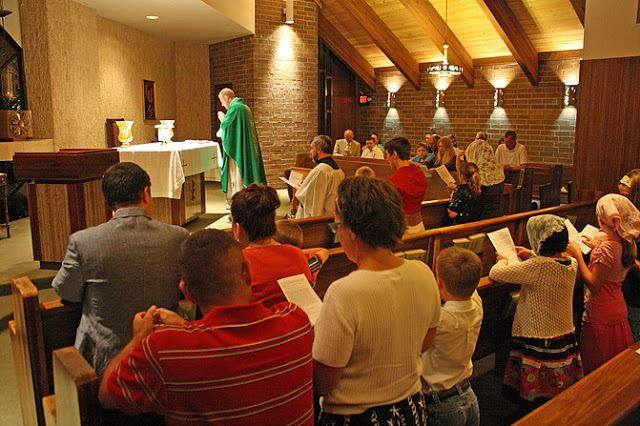
John Beeler (who regularly writes on Facebook but rarely in his blog) wrote an interesting entry on Facebook about “no-frills Catholicism” showing an Ordinariate Mass in a rather kitschy modern church.

This is apparently somewhere in the USA. One comment says: Astounding- good lighting and merely facing eastward makes mass in a kitschy 60s building come off beautifully. This reminds me somewhat of the Other Modern articles in the New Liturgical Movement. Scroll down the page beyond the eighteenth century chant books, and you will find articles on church art and architecture from the twentieth century. I have often been intrigued by 1930’s and 1950’s churches some find ugly, but which express the reconstruction from the first and second world wars. I discovered some very interesting church buildings in Paris built under the Chantiers du Cardinal scheme.

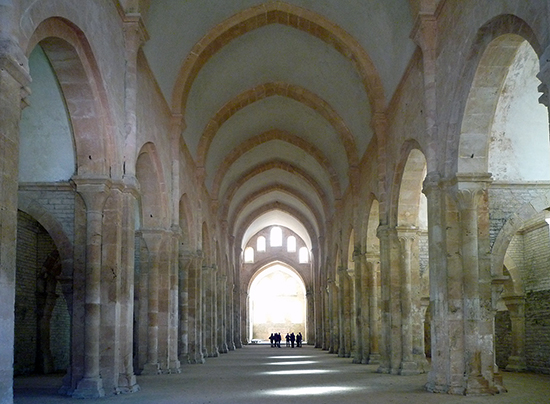
One aspect common to these churches, as for those built later – when the plan was more or less traditional – was their extreme sobriety and plainness. In a certain way, they revive the ideals of the Cistercian movement in the twelfth century as they reacted from what they perceived as corruptions in Benedictine monasteries. Fontenay Abbey in France is a typical example from that era.

The Cistercians were quite “iconoclast” in their reduction in the number of statues and images, but the keynote of their architecture was harmony, symmetry and nobility. Some of the “other” modern churches tried to recapture this spirit.

Returning to John Beeler’s eastward-facing Mass in a modern church, the effect is quite other-worldly, the congregation deeply in prayer and the priest quietly saying Mass with a single server. One intriguing feature is the use of lights or candles in glass vases. They are just what I use when travelling and living in minimalist conditions. I wrote an article on the tuck box chapel some time ago. It is fiddly to use, and the tent doesn’t allow me to stand up fully.

Tea lights in glass vases are ideal for when there is wind (you have to be careful that the Host doesn’t get blown away!).It is quite amazing how much a modern tent blocks out most of the wind. The missal stand, though small, is unwieldy. I have ideas of making a new one on a round turned wood stand. I have the tiny travelling chalice and paten which my parents gave me on the day of my ordination.

Saying Mass outdoors is another experience. When I went on a sailing course at the Glénans in 2009, a large granite rock on the beach was my altar.

It all folded away into my rucksack, since I left my van at Concarneau and was isolated for a week on those lovely islands. What a way to begin the day!

There are many rational and historical arguments for the “eastward position” as Anglican ritualists in the nineteenth century once called it. One of the finest authors on this subject was Monsignor Klaus Gamber who found favour with Cardinal Ratzinger. These few notes and photos show the question from a more aesthetic and “emotional” point of view, even a pastoral point of view.

Finally, I should add that minimalism should not be a norm or an ideological refusal of beauty. Mass is normally celebrated in a consecrated church, and is only celebrated elsewhere in cases of necessity, for example being excluded from celebrating in historical churches because of not belonging to the establishment, being victims of persecution and brought to worship in clandestinity. It is better to worship in less than ideal conditions than not at all.

In terms of taste of church furnishing, I gradually “grew out” of my baroque formation at the seminary of Gricigliano and elsewhere, and gravitated to simpler styles influenced by the Pre-Raphaelite and Arts and Crafts movements. Things did go a little over the top in the mid eighteenth century and with the grandiosity of the Victorian era. The twentieth century brought an attempt to simplify and seek a more “medieval style” – see the Parson’s Handbook by Percy Dearmer as an example of that ideal. Such inspirations continued for a long time, and I cite Guildford Cathedral and St Alban’s Holborn as examples of fine architecture from the 1960’s.

I tend to simplicity myself. I have not worn lace surplices or albs for many years, preferring plain white linen or cotton with simple vestments. I don’t impose my preferences on others, nor do I think they are wrong if they prefer more baroque or “Victorian” styles. Either way are options that indicate a frame of mind and preference in their living the Church’s liturgy. More is perceived by personal experience than arguing – something very exasperating in the English-speaking Catholic and Anglican world.

Posted in Uncategorized | Tagged , | 15 Comments

In the midst of madness

Facebook and other avenues of information are producing some quite horrifying tendencies. One was a video of some people tearing down Confederate statues in America as a kind of belated revenge for the Civil War. I have never really sympathised with American history and what made the background to today’s hysteria. The ingredients seem to be there for what happened in Europe in the 1930’s with the dictatorships (I’m not talking about Trump) and the so-called “antifias”, but a profound and terrifying mystery: that of evil.

Nazi Germany was a kind of death cult that involved more than politics and violence: it demanded the total and all-compassing obedience of all the people of Germany and then the occupied countries. There are many studies of this phenomenon from philosophical and psychological points of view. Some of Berdyaev’s most profound work was written from about 1933, the point when Hitler took over Germany and democracy was finished. The Führer‘s power increased as more and more blame was put on the Jewish people and the so-called “sub-humans”. Your death is my life, unlike the sacrifice of Christ: his death being our life. In this, we see the true Antichrist in all its horror.

The influence of Nietzsche and Darwin are uppermost: the denial of God and humanity (except the Ubermensch) and the survival of the fittest, no compassion for the weak. The Nazis took the Ubermensch as the archetype of their so-called “master race” of Aryans with blond hair and blue eyes, though Nietzsche’s notion was much more subtle. Darwin observed the bleakness of nature, the food chain and the absence of compassion for the weak and deformed. They have to be abandoned to their fate or killed so that the strong may survive. A turtle lays hundreds of eggs, and only two or three of them will become adult turtles. Wastage seems to be built into nature and genetics. If we see humanity from this point of view, then abortion, euthanasia and eugenics are normal and right, as are programmes of genocide and industrial murder by means of gas chambers and other “economic” and “efficient” methods. In materialistic terms, it is right and proper to purify races and get rid of the dross.

As soon as anything spiritual enters the picture, everything changes, and we do all we can to help and defend the weak and crippled, other human races and cultures. Compassion and empathy enter the picture, and we have no more rights to life and health than any other, be he rich or poor. Do unto others as thou would have done to thyself. It is the essence of the Christian Gospel, the message of Christ that is far above mere morality and convention, an essential spiritual understanding.

The other most important thing is being independent from “group-think”, from the memes of the masses. We have to find our calling in life, a way that will bring us spiritual, intellectual and emotional growth. We have to fill the void of our own ignorance with knowledge, and it is our own journey to make.

We begin to observe a separation of people into unthinking cults, increasingly polarised and suggestive of the brawling fascists and communists in the streets of Munich and Rome in the 1920’s. The media is of no help, quite the opposite. We need to think for ourselves and declare our independence. I don’t think there is a formula that goes for everyone, but the fundamental point would seem to be our spiritual and not material nature. If we are material, we are ants in an anthill to be willingly destroyed or empowered by the strong and powerful, by those with the most will. Knowledge is not secret or reserved to a few. It is accessible to us all. We have simply to desire it.

We live in society and in relationships with others, and our consciousness can regress in conditions of duress and fear. When manipulated by people of certain types of personality, we begin to lose interest in the things for which we have been most passionate for a lifetime. When we become conscious of this, we see the need to do something about it. If we allow ourselves to fall, the abyss will never be deep enough. We can find ourselves regressing under the influence of spouses, places of employment, political powers and just about everything. It is vital for us to study the history of twentieth-century Europe, how an entire population was brought to follow Hitler! We need to understand the perverse personality, the ways of the evil powers of which St Paul warns us.

For we wrestle not against flesh and blood, but against principalities, against powers, against the rulers of the darkness of this world, against spiritual wickedness in high places.

The darkness is within each of us when we have regressed from our spiritual level of life. It is essential to have time alone to “take stock” of our consciousness, and then to relate to people without perverse personalities. If we find our ability to be creative being eroded away, something is very badly wrong in our lives.How we set about finding our self-awareness and consciousness will change with each of us: prayer, meditation, solitude, exposure to nature – whether it be the sea, the mountains or forests, reading the Scriptures and other writings of wisdom.

I am far from the goal, as we all are. But knowing that this is the essential in life is half the battle – at a time when I face changes in my own life.

* * *

And so it continues: Professor: Reason Itself Is A White Male Construct. Of course, our response needs to be nuanced. Romanticism reacted against the extreme rationalism of the eighteenth century. I don’t see in Postmodernism a form of Romanticism, but rather the collapse of what little remains of classical, medieval and renaissance culture. A Wahhabi caliphate would perfectly serve the anti-humanist and nihilist agenda of postmodernism, post-humanism or whatever. The mind boggles…

Just let me know when such a monster is coming my way, and I’ll sail away from it…

Posted in Uncategorized | Tagged , , , | 3 Comments

Catholics

I saw an article from Tony Equale’s Blog about the film Catholics (aka The Conflict) that was made in 1973 from a novel.

My attention was first brought to this film when I went on a trip to the USA in 2002 and someone gave me a copy of the VHS cassette. It seemed to me to be a story of the Recusants in the 16th century transposed to the issues surrounding Roman Catholic traditionalists like Archbishop Lefebvre in that era. Then came the surprise, this staunch Irish abbot turned out to have lost his faith – the major twist in the story.

I have already had some acquaintance with articles by Tony Equale, a laicised Roman Catholic priest with a frustrating philosophy of life, a sort of materialism that claims in some way to be spiritual. I feel discouraged from going into his thought in any great depth. In terms of metaphysics, only the particular has any existence, not the universal as in Plato. The usual precedent of this notion is Nominalism, said by some to be largely at the origin of Protestantism in the sixteenth century. I have some sympathies for Nominalism, because one can love a person but not humanity or “people”. You can see and touch a chair, not the universal idea of “chairness”. I feel some repulsion in terms of strangers and people I don’t know, with whom I have never related in any way. Plato’s universal idea can give us an explanation of the notion of spirit and symbol, but seems awfully cerebral and un-Romantic. At the same time, my love for Eastern Orthodox (especially Russian) theology and philosophy brings me close to the Platonic notion of metaphysics and the essential unity of everything.

The story of Catholics is quite harrowing, on the surface a tale of hypocrisy or a complete lack of coherence. Why defend the Mass of the Ages (la “Messe de toujours”) if you have come to “grow out” of faith, belief in symbol and miracle, all that is contemplative and wondrous in Christianity, all that sets it apart from a simple moral teaching or a system for “controlling the masses”? It is almost disappointing not to see a victory of the recusants, but rather the capitulation of the leader and the scattering of the flock.

There might be an under-flowing thought that the 1970’s are back with a vengeance in the Roman Catholic Church with the election of Jorge Bergoglio to replace both John-Paul II and Benedict XVI, closing the loop with the aspects of Paul VI most influenced by the aggiornamento ideology following Vatican II. Our story may seem to one of bog-Irish folk surrounded by the harsh environment of the sea, one of stubborn Irishmen – though there was less of a traditionalist reaction in Ireland than in France. The Irish were more obedient to the Pope, as were the Italians and some of the English RC’s to an extent.

Equale suggests that the reality was much less binary than liberals and traditionalists, but that Roman conservatism simply assumed other appearances and forms: Paul VI was no less “reactionary” than Pius XII, and Francis is something of a paradox. For a “liberal”, Vatican II was never implemented, and authoritarianism continued in a re-looked version. Perhaps a less authoritarian and contemplative viewpoint would be more sympathetic to a liturgical life – where most of the RC traditionalists are more in favour of totalitarian politics to make their ideas compulsory for all, an essentially Enlightenment and moralist view. Perhaps not Hitler and Mussolini in style, but at least Pinochet and Franco!

As we get through the film, we find the tortured state of the Abbot’s spiritual life and belief. To quote Equale:

Can a monk be an atheist? … can there be Christianity without God? We learn from the private conversation between O’Malley and Kinsella, that the abbot’s support for the regressive practices of his monks is ironically driven by a guilty compassion: he does not want to deny the people the consolations of the Catholicism that his atheism rejects. The irony is profound. An abbot who does not believe in God feels compelled to promote an archaic, superstitious ritual that educated Christians and the Vatican no longer accept as valid, simply to protect the uneducated from disillusionment.

It is not always “plain sailing” for a priest or a monk when circumstances of life change the essential premisses of a religious conversion. We seem to have something that suggests the struggle of Bonhöffer as he saw the Lutheran church of which he was a pastor collaborate with Hitler. He conceived of an idea of Christianity without God. One cannot feign belief without shattering his own integrity. Equale seems to present his own motivations for leaving the priesthood and pursuing another way of life. Is it possible to remain a Christian without believing in God? What or who is God? Will we seek a scientific or a mythological explanation, or simply deny everything that is not material? Equale mentions that this agonising choice lies at the basis of the Grand Inquisitor. I do find it preferable to go to thinkers like Berdyaev who have harmonised Slavophile thought with the influence of Romanticism, German Idealism and ancient Gnosticism in its more orthodox or moderate expressions. A finer notion of God begins to emerge, one with which we can relate.

The Abbot is characterised by his altruism, his care for simple Catholic folk who sought faith and hope in symbol and miracle. He and other real and fictitious characters have fought this combat between their loss of faith and sense of pastoral duty, and it is interesting to dwell on this state of things. Sometimes we find ourselves in a way of life that is absolutely not ours. It can be the priesthood or marriage – or both. We all have to return to roots to perform essential “reality checks” on ourselves – and only the bravest will act according to their convictions. Then there is our notion of God: has it developed beyond the “Demiurge” of the Old Testament who rewards and punishes towards a notion of a universal consciousness in which everything participates with our own consciousness? We can know nothing of the essence of God if not by Revelation, but we can make the effort to get some idea. That is the point of studying theology.

I have only ever heard of miracles at second or third hand. A miracle is not simply something wonderful like a sunset or a scintillating sea, a towering cliff or a mountain or the birth of baby humans and animals. It is something like the unexplained cure of a disease or disability, exorcisms, blind recovering their sight, someone with almost no brain tissue having a normal life and rational faculties. I have lived a very ordinary kind of life, but I do remember an exorcism at Triors Abbey, and I overheard some of the guttural cries from one of the rooms of the guest house. Whatever it was, it was not mental illness and it frightened the wits out of me! Some people do relate sincere accounts of miracles and wonders. Why should we assume they are not telling the truth even without scientific proof? Some people are charlatans, and others are honest and sincere.

There are the miracles of the New Testament and in the history of the Church. Why should they be all assumed to be false or lies? Miracles also happen in worlds outside our experience of “matter”. Unlike Equale, I don’t believe in matter, but rather in energy and consciousness which produce an illusion of matter. In such a perspective, anything is possible.

Certainly the Church has made too much of a “machine” of God, grace, miracles, forgiveness of sin and everything we hope for from God and the Church. Country parish religion can sometimes be a little much to swallow for someone with a humanist education, but it beats materialism hands down!

It is perhaps salutary to see how priests have lost the faith and kicked everything in. What do they end up with? I can only begin to imagine what many priests went through in the 1960’s as they eschewed an authoritarian Church in the pursuit of something closer to the plain reading of the Gospels and a fairly anarchical Christ. Many priests met women and married. Others sought solace in science and sociology to get away from the Deux ex machina of neo-Scholasticism. Others become Protestant pastors or converted to other religions. Dom Bede Griffiths sought to harmonise the Christian message with Hinduism and its tradition of the wise elder. The quest for the spiritual can take us in all kinds of directions as happened with Thomas Merton. When I was a working guest at Triors Abbey, I quickly saw that I was entirely foreign to a monastic vocation in the reality of that community – even though I respected and esteemed the Abbot and the monks. The spiritual idea in our Romanticism is so elusive and unattainable. Either it is false and illusory – or simply we are unworthy due to our sins and blindness.

Another message comes through from Catholics. As we read in Pascal’s Pensées: L’homme n’est ni ange ni bête, et le malheur veut que qui veut faire l’ange fait la bête. Man is neither an angel nor a beast, and the problem is that whoever wants to act like an angel, acts like a beast. The translation isn’t perfect but it will have to do… When we try to excel in spiritual life beyond reasonable limits, it is often the “dark side” or simply our weakness that takes over. The worst enemies of the Church have often been the most bigoted and devout, as many of the worst revolutionaries in the 1790’s were former Jansenists. We need to seek reasonableness and moderation, which are not to be confused with mediocrity or lukewarmness. This has always been a strength in Anglicanism.

I would not tar all traditionalists with the same brush as the Abbot who was faithless yet tried to be a father to his community and the lay people who attended his Mass. Many are excessive, and others are worthy of respect in their constance and Christian witness. We need to make vital distinctions.

We all have lessons to learn.

Posted in Uncategorized | Tagged , , , , , , , | 5 Comments

Homage à Jacques Sternberg

My thoughts are brought back to Jacques Sternberg who must have been quite a character. He was a journalist and novelist, and sailed a small boat in almost all weathers on the English Channel.

sternberg

Jacques Sternberg was born in Belgium in 1923 into a Jewish family. He had a particularly hard time during World War II, taking refuge in the south of France. He began to write short stories, poetry and a diary – and learned to sail a dinghy. His family had to leave the Côte d’Azur and tried their fortune in Spain. They were caught by the Germans in 1943, but Jacques managed to escape during a transfer operation. After the war, Sternberg went to Paris and lived a very poor life, at the limit of being a down-and-out. The American Army took him back to Belgium in October 1944. From 1945 until the mid 50’s, he wrote several novels, but they were refused by publishers. It was during that time that he married Francine, aged 22 years and a Jewish and Communist resistant. Jacques worked in a factory to earn his living. He continued to write novels and found round-about ways of publishing them. From 1956, he ventured into science fiction. In that year, he acquired a Solex, a heavy bicycle with a small petrol engine mounted on the front wheel, which he rode until 2002.

He bought his first boat, a Zef, in 1970 and sailed it on the English Channel at Trouville where he lived for six months every year. He went on long cruises along the coasts whatever the weather. He considered crossing the Channel or even the Atlantic or the Pacific in his tiny dinghy, a temptation he wisely resisted. An anarchist at heart, he eschewed the world of yachting clubs and racing, and covered hundreds of nautical miles on the sea. He died of cancer in 2006.

* * *

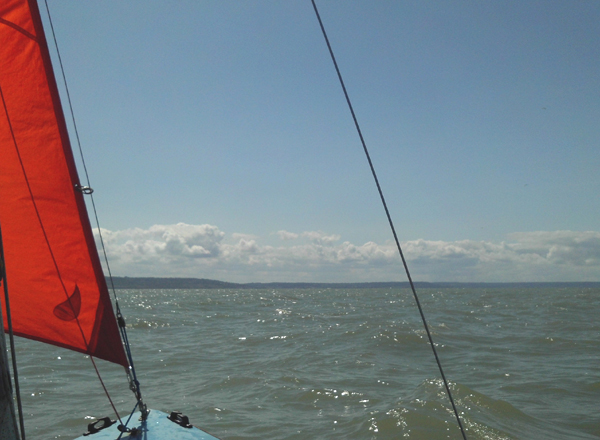
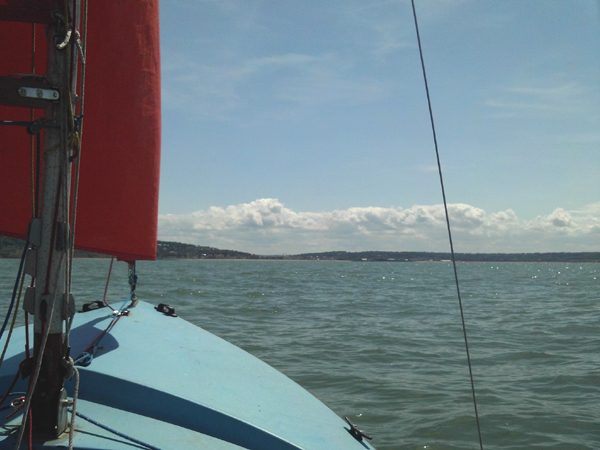
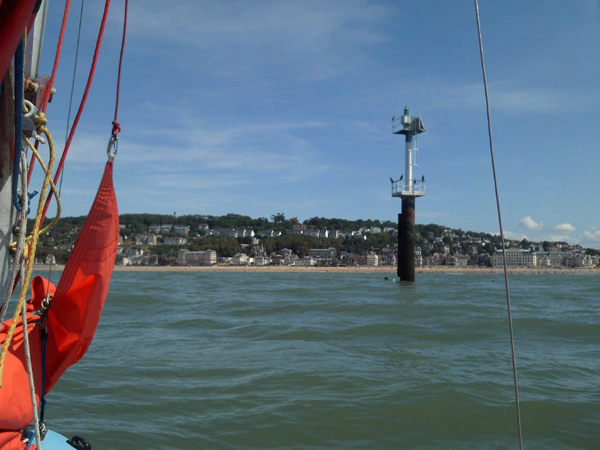
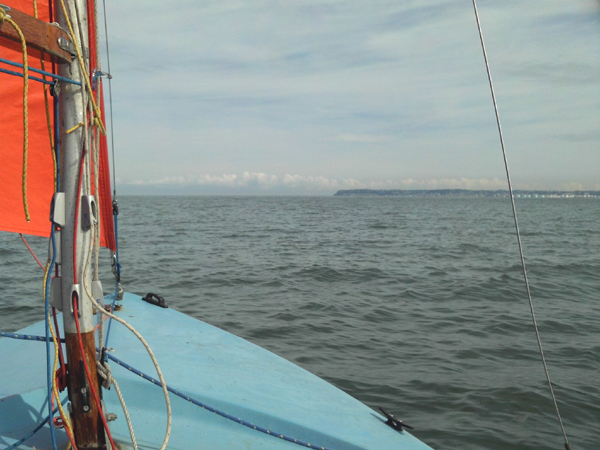
My own experience of the Zef is one of a highly seaworthy and stable boat, especially when fully loaded with stuff. I have just been out for two days over the Seine Estuary and back, about eight nautical miles each way. The tidal currents are strong and there are three shipping lanes to cross. The local authorities hate seeing tiny dinghies on such a wide stretch of water with its dangers – and the Gendarmerie de Mer did come and see me, but they didn’t even check the safety equipment I have for up to 6 nautical miles from the coast. I did wonder if what I did was illegal, but I was reassured that it was not. These diligent officers did wonder if a child had wandered astray in an Optimist from a sailing school, since they were observing me from at least ten miles away!

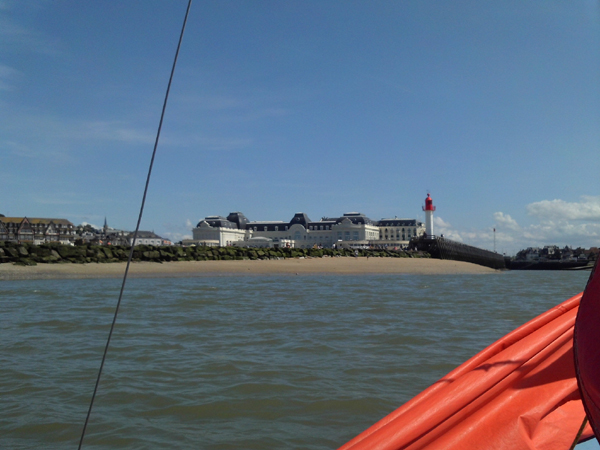
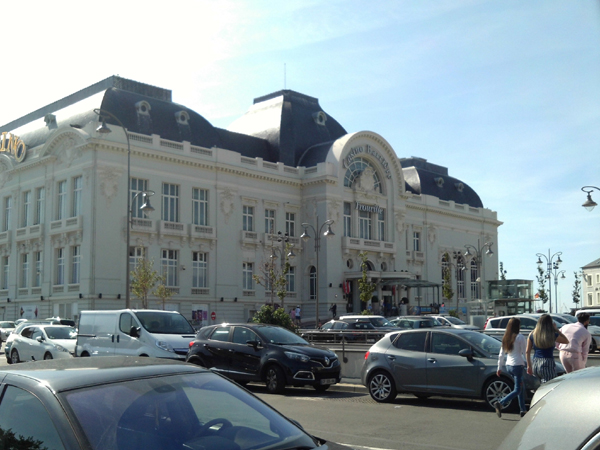
The weather was fair and sunny and the wind was at times fresh and at others a bit slow coming. I enjoyed every moment of the crossing which took about four hours each way. I stayed at Deauville overnight before returning to Le Havre. It is a pleasant little port in a rather snooty Parisian resort. The casino is very imposing, and one could imagine James Bond in there winning every game of Baccarat to the despair of the proprietor of the establishment. I also took a photo of an early twentieth century block of shops and flats in medieval style. All elegance and tourism…

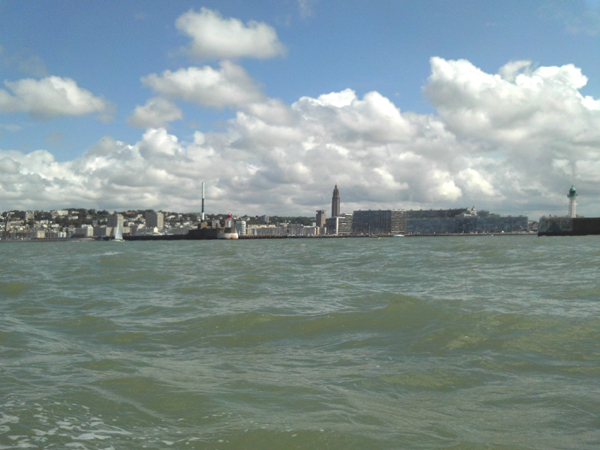
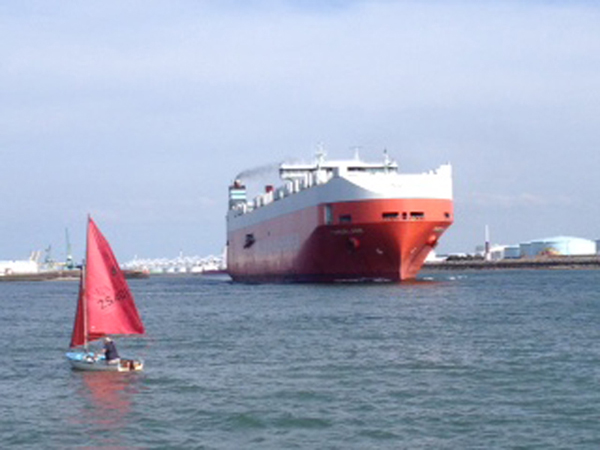
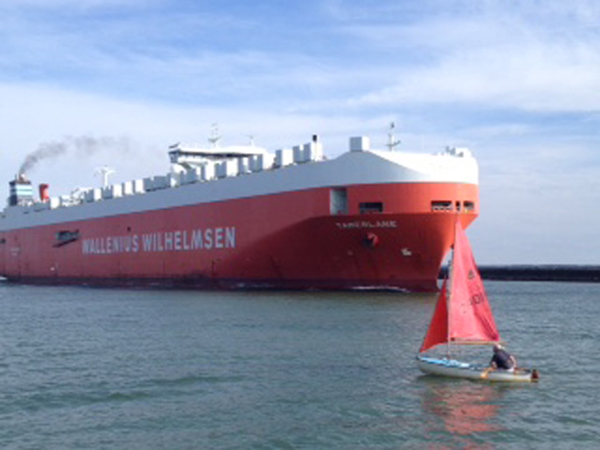
As I arrived at Le Havre, I entered port by the port side of the entrance to avoid an oncoming giant cargo ship accompanied by the Harbour Master’s boat. The last three photos were taken by the skipper of a yacht who moored just two places away from me. This situation in Le Havre port looks dangerous, but everything was watched very carefully by the Harbour Master’s boat. I was well to the ship’s starboard beam. I had to row a few strokes as I passed the port wall that took away all my wind. My engine had already broken its propeller spring… So I had to sail into port.

The ship is Tamerlane, operated by Wallenius Wilhelmsen Logistics. She is a vehicle carrier weighing 39,401 metric tonnes, and can carry nearly five and a half thousand vehicles. Tamerlane is one amazing piece of modern marine engineering.

* * *

Leaving Le Havre

Looking towards DeauvilleGetting nearer to Deauville

The starboard entrance buoy at Deauville The port entrance lighthouse and the CasinoSarum beached whilst waiting for high tide and entry into the portThe Casino, another life from mine!Returning to Le HavreDavid and Goliah?

The mighty ship passes by under the watchful eye of the Harbour Master’s launch.

Posted in Uncategorized | Tagged , | 4 Comments

Analogies: the Bank, the Law Court and the Hospital

I found this on Facebook from Fr Guy Winfrey.

What is Orthodox Christianity?

Finding a starting place is difficult, but I think the best place is to say that Orthodoxy focuses on healing the soul of man. It is not about appeasing God–because God already loves us. In our prayers we say that God is the only lover of mankind. So the problem is that man is sick and needs healing. We need healing from all our passions; we need to heal from the wounds caused by our past sins; we need healing in our minds, because we don’t even know how to think correctly—our intellects are fallen. This means that the Orthodox life is a life of struggling with the proper medicine to become truly human. It’s very much like being in physical therapy. We have a therapist (a priest) to help us struggle to recover our strength. Sometimes we do better than other times.

This is a very important foundation to have because it changes the understanding of what justification and salvation is. In Orthodoxy these are not juridical positions. The Church is not a divine travel agent created to give you a ticket to heaven. The Church is a hospital to cure sin and its effects on our souls. Remember, God loves us. The problem is that we don’t love him as we should. None of our actions are done to appease an angry God—God doesn’t need therapy to get over being mad at us. We need healing which comes from Jesus Christ through his Church.

That’s a pretty good place to start understanding why Orthodox Christianity is so very different from the forms of Christianity that may be more familiar in the US.

That may be true, but I hardly see it as the preserve of Orthodoxy. It comes down to three analogies of man’s relationship with God, someone at the end of his financial tether owing a lot of money to the bank (Christ himself uses this analogy in a parable), someone being judged in a court of law for something he has done wrong and facing justice, and finally a sick person requiring the attention of doctors and nurses for a cure or palliative treatment for an incurable illness.

The “medical” analogy can be found in all churches and Christian writings. The emphasis has differed from period to period in history. Roman Catholicism and Protestantism tended to favour the banking and juridical analogies of salvation, especially from St Augustine to St Anselm to Calvin and exponents of the “work ethic”. I suppose that any system that preaches man as being at a disadvantage in relation to God has a means of political control over populations.

As I have discovered when reading “Orthodox Blow-Out Department” and other comments on similar themes, there seems to be Orthodoxy and Orthodoxy, just as there is a gentle version of Catholicism and Anglicanism alongside Jansenist and Puritan harshness. There will always be a difference between the political and contemplative / religious aspects of Christianity as between Sufism and Wahhabism in Islam. The more mystical tendencies will move beyond the notion of salvation and saving to deification and θέōσις.

Divinisation and participation in God figure in the non-Calvinist currents of Anglican theology and spirituality, particularly in the works of Lancelot Andrewes and John Wesley among others. I recommend you the book Participation in God: A Forgotten Strand in Anglican Tradition by A. M. Allchin. Allchin found the heart of this tradition in the Caroline Divines and the beginnings of the Oxford Movement as well as Methodism.

These are important aspects to rediscover in our own traditions, be they Roman Catholic, Anglican, Non-conformist or Orthodox. Above all in ourselves…

Posted in Uncategorized | Tagged , | 12 Comments