
I don’t know what Mr Bruce means by “recently”, because it is a long time since I concerned myself with his ongoing narrative about continuing Anglicanism and the Ordinariate. I have just left off and done other things.
My most obvious thought is that so few people care about any kind of religion, even the Roman Catholic Church and its papacy. See Damian Thompson’s It’s 1978 all over again. The bottom line is “… they will look in vain for the meticulous, expensive and even-handed coverage squeezed between the ads for bourbon and Buicks in my vintage magazines. Time, like the rest of the world, has moved on“. This sets intra-church polemics in perspective, at least for me.
For the record, I might come over as angry from time to time, but I tend to empathise with the people around me, even good honest and morally upright people, who have other things than religion to occupy their minds. The “official” RC parishes have difficulties in getting any kind of market share. I know something about business, because I am self-employed – but my status is simplified for low incomes. I keep work and religion separate! I am not angry about being mentioned again, but am rather flattered that Mr Bruce would bother remembering the nobody I am.
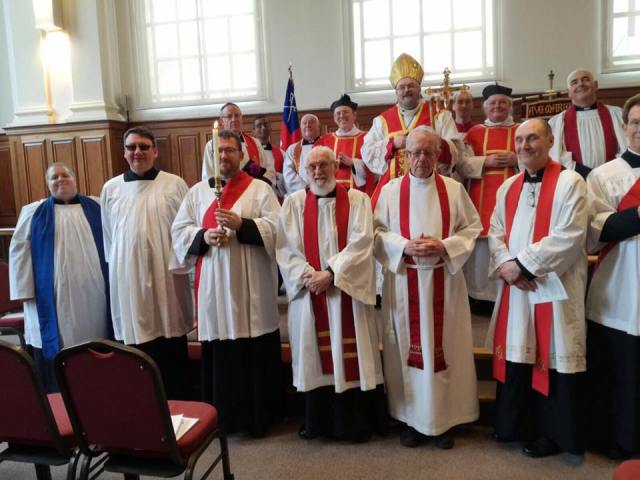
I belong to a church that has to concern itself with temporal matters, as I heard in our recent Synod meeting and the Bishop’s council meetings I attend (I have just been re-mandated for other three years). We have a bank account and figures of income, expenditure and the budget for the coming year. It’s all very professional, and we do what is required by the Charities Commission in England. We are actually quite mainstream, and no fly-by-night operation. But, all the dreary stuff is but a means to the end, the end being our mission, worship of God and outreach to anyone who is attracted to our way.
Indeed, we need to heed the message of Christ about prudential decisions, and not doing anything without counting the cost. On the other hand, a person offering his very life in martyrdom is pure gratuity. Gratuity is a major part of the Christian way, and Biblical references could be found – look them up for yourselves.
Mr Bruce’s messages seems to be that the Ordinariate is not viable, and should be dissolved and the people and clergy told to join the mainstream Roman Catholic structures. Continuing Anglican churches are just written off at a stroke with the casual wave of a hand. What happened to religious freedom? Can these people and clergy not decide for themselves according to their consciences rather than being managed by someone playing board games? Fortunately, Mr Bruce isn’t the one in authority, and I would be surprised to hear that the RC Archbishop of Los Angeles consults him for advice.
I haven’t read Deborah Gyapong’s interventions, so can’t judge. I was simply surprised to find my own name in the same sentence as her so long after the disappearance of the blog on which we both wrote until 2012. Even if you plan churches using businesslike methods, there are large businesses and small businesses. In the former, you have a board of directors, consolidated and audited accounts, shares, the whole shebang. In my business, I am a sole trader and have only my turnover to declare for income tax and social contributions as it is done in France. My diocese has very detailed accounts, and everything is declared to the proper authorities, and we are credible. Our treasurer is doing things very professionally and wisely. It’s not an easy job!
What about the Parable of the Talents. We are not in it to collect paying customers and rake in the money. We have to cut our cloth according to what we have. We have small churches and home-made chapels, showing the dedication of people prepared to do voluntary work for nothing. We are no less a Church because we don’t have what the Church of England or the Roman Catholic Church in England and Wales has. We just have to live within our means and look to the essential – that is certainly harder than laying on the laurels of some “mega-church” outfit.
No one has the guarantee of perennity or lasting into the future a hundred, fifty or ten years. Each one of us is called to die one day, and mortality is something we have to live with – conflicted with our instinct of wanting to go out knowing that we made a difference. Again, the Parable of the Talents. But, that difference may be something invisible and intangible, spiritual and personal.
I am thankful that the Church is not a business like Mr Bruce’s vision or what prevails in the bureaucracy of the Church of England that axes parishes and schools for simple questions of financial viability. When a church ceases to be financially viable, the building may have to go to pay the debts to the bank, who knows what else, but it would be hoped that some spiritual life or common prayer might survive somehow. Maybe “orphaned” churchgoers might go to another parish that is still going, or perhaps they are too alienated to go anywhere, too hurt, too “used” and burned-out. This is also a part of religious freedom which is a universally recognised human right.
I can’t judge on the Ordinariate, because I don’t bother myself with it one way or the other. As a priest of the Anglican Catholic Church, I am confident that our ministry and reunion with other continuing Anglican Churches has many years and good days ahead of us. I am optimistic even if I share concerns about our perennity and viability.
Maybe we’ll disappear and die off. Then again we might survive and prosper in the future.
I was taught in canon law that the positivism applied in civil and penal law does not apply in canon law. There are principles of interpretation (by the Legislator) that require that the end of canon law is the salvation of souls, a totally different finality of the temporal common good and order that secular law upholds. It is the same as an ecclesiastical entity. It is not a business with the end of being profitable, but needs money and material goods to fulfil its supernatural mission and vocation. The question of viability becomes relative, and some of us have to make do with very little. That is also a part of the Parable of the Talents.
Otherwise we are going into some kind of “prosperity Gospel” or Protestant work ethic, which is as foreign to Catholicism as to any kind of Christianity that has not suffered institutional corruption.



 Methods of reserving the Blessed Sacrament have changed over the centuries. The tabernacle only became standard from the Renaissance and Tridentine era, mainly for the sake of security: to prevent the Blessed Sacrament being stolen by people with evil intentions. Two other methods have existed in northern Europe, the Sakramentshaus in Germany, a tabernacle set not on the altar but on the Gospel side. The aumbry of middle-of-the-road Anglican churches is certainly inspired by these beautiful structures in Germany.


 The Blue Flower