Fools’ Gold?

A kind correspondent has written to me, particularly to draw my attention to an article written by (Fr) Tony Equale, a Roman Catholic priest who left the priesthood and became highly critical of classical Catholicism, especially the heritage of the Council of Trent. The article is Sex, Celibacy and the Nature of God. I have a link to this blog, but I have always come away from it unsatisfied by his “materialism”. What I mean by this word here is not the “consumerism” of the masses but the idea of considering matter as an absolute rather than an illusion created by energy. What is “spiritual matter”?

I haven’t had the energy to study Fr Tony’s work in detail, but I suspect he is more influenced that he would want to admit by nineteenth century philosophies from the likes of Nietzsche, Darwin and Marx. Institutional Christianity does have a lot to answer for, but I see no good coming out of its destruction. As I corresponded by e-mail, I saw a blog article coming out of this, so here it is, reworked and refined.

Like the Modernists of the 1890’s and the early twentieth century, I do think that presenting God in a similar way as we relate fairy tales to children does the Church and the Christian message a tremendous amount of harm. We need to find new and different ways to present the ineffable Mystery in such away as people at different cultural levels can relate to it and develop human knowledge and spirituality. In terms of knowledge of God, the eastern Fathers tended to present an apophatic approach, the so-called “negative theology”, an attempt to approach God by negation. We can only say and think what God is not. We find ourselves in adoration before an ineffable Mystery, something beyond our rational understanding, but recognised to have some kind of ontological reality. Some dimensions of modern science speak of a universal consciousness in which we as humans and living creatures participate by our own consciousness of self, the cogito ergo sum of Descartes. I think and know, so therefore am in existence. Already we have a new approach to which many thinking people of our times can relate as opposed to the usual catechetical teaching given to children, out of which they grow when they become adults. In this, I share the view of someone like Fr George Tyrrell who got himself into hot water in the 1900’s with the Pope (Pius X) for Modernism. If you actually read him, you will see that he was opposed to the demythologising exegesis of German liberal biblical scholars. He sought a notion of God that would be credible to men of science and more spiritual than legalistic and rationalistic.

Fr Tony has a similar kind of aspiration, perhaps to “save” a notion of God from the ruin of institutional religion. However, I am deterred by his insistence on the absolute of matter rather than energy. Traditional theology has distinguished the creator and the created, super-nature and nature. I would tend to favour a more pantheistic notion of everything, including evil and suffering, being divine or participating in divine consciousness. Such a notion might do more to give a spiritual outlook on everything than the “material” that comes into being and dies its death. Without doubt, I have not studied Fr Tony’s work enough to avoid coming out with a caricature, but at least I would say something to contribute to the discussion.

If everything is consciousness and energy, there are certainly more things than are dreamt of in our philosophy, to misquote Shakespeare. Matter would only be an illusion to us who live on that “wavelength”. I can well believe in the ideas of multiverses, or universes existing in parallel, but on different “wavelengths” of energy. Sometimes, there would be a certain measure of communication between the universes giving rise to unexplained phenomena: angels, ghosts, UFO’s, so-called aliens, near-death experiences and many more experiences of sincere people.

What comforts me in the idea that human consciousness, in which universal consciousness subsists, can live independently from the brain and the physical organism. What exactly happens, we don’t know, but the general idea is that we continue to be conscious with personality and memories intact. Tony Equale seems to suggest that our consciousness “goes somewhere” but we no longer have personalities or memories. That seems depressing. There is the possibility of reincarnation, but that creates philosophical problems and is incompatible with traditional Christian eschatology.

We see very quickly that the article is not so much about repressed sexuality but the entire religious construct that brought about such sexual moral teachings. We can easily get obsessed about the issues of sex, celibacy and sensuality. It all exploded in the 1960’s and ended up with disillusionment and AIDS. Many of us have had to deal with moralism and legalism, both very unhealthy. Materialism is no solution, and I have seen few westerners adapt well to eastern religions and philosophies. We can recover aspects of Gnosticism and monastic spirituality that haven’t been institutionalised.

Tony Equale isn’t easy to read and his “line” isn’t easily identifiable. He is not someone I would want to follow uncritically.

Since the US presidential election, I have come to discover a young American by the name of Tarl Warwick living in the Vermont countryside. He is a current affairs pundit, writes books, is a professed Pagan and shows a great amount of talent as a Youtuber. Don’t be put off by his “Satanism” because it doesn’t seem to mean what we find in horror films. Here is an interesting talk –

This young man talks very eloquently and makes sense, both in his political commentaries and his spiritual view. He is not above criticism for his appearance, but it’s a free world. He comes over well on YouTube. I would be too introverted for such work, and have put very little on YouTube. He has written and done video presentations on Gnosticism, Paganism, his journey away from his original Evangelical Christianity and his world view. He is quite gritty, and likes f*** words! Again, it’s his way. He’s something of a character!

One thing that I did appreciate was his idea that wiping the slate clean can be good for some people. After a phase as an atheist, he began to research into what he called satanism, but he tells us that he was not worshipping an evil entity in the way we Christians usually understand Satan, the Devil, or whatever you want to call that dark entity. He seems rather to be interested in pre-Christian paganism, the old Mystery Religions, folklore and things like Druidism or the spirituality of the Native Americans. I think we certainly need to acquire knowledge of such phenomena in history in the same way as St Paul brought Christianity to the Hellenic and Roman world. Keep an open mind, but a critical one.

A part of our pilgrimage is to question and rediscover ourselves and what we believe in. Two forces have been in play from the beginning: Christianity for Jews and Christianity for Latins, Greeks, Egyptians, Persians, etc. – the heritage of the Mystery religions which expressed ideas that either influenced the “myth” of Christ or prefigured a fulfilment. I think we need contact with those who live according to a “natural religion” and try to understand something.

At the stage where we are, post-Tridentine Catholicism is a red herring, with no more influence than those who think the earth is flat or hollow with cities ruled by alien reptile Nazis! The real problem in today’s world is the spectre of the jihadist caliphate and the complete rolling back of humanism, the Enlightenment and the Renaissance. We face humanity at its worst, at its cruellest and most base. That is the real enemy along with some kind of Orwellian dystopia brought about by the moneyed elites. We are returning to feudalism with an “aristocracy” far more merciless than in 1789.

Evolving moral consciousness? Only a few of us who think about these things. Maybe the “fools gold” of classical Catholicism is an illusion, but the coming tyranny isn’t! Many priests have abused children, but children are openly sold as sex slaves in countries like Libya and everywhere ISIS / Daesh is found. They don’t have sacraments, priests or liturgies. If we get rid of Christianity, what do we replace it with?

I do think Christianity has to be more personal and spiritual than institutional or clerical. This is happening. I am a priest but very much live the life of an “ordinary guy” with few outward trapping, except when I am in contact with the small institutional Church I belong to.

Where are we going with our reflections? What do we want? A “pure truth” of some kind? A way of life that brings happiness and satisfaction? It is easier to destroy than build anew. This was the lesson of the Marxist ideology that is only seeing something of a resurgence through the opposition of “populism”(both left and right) against elite globalism. The “magic church” now only exists in our imaginations. It is dead and not worth fighting against. But, not all Churches are peddling stories without credibility. It all just needs to be looked at differently.

I am fascinated by the idea of quantum theory, multiverses and consciousness. I was quite overcome when I saw a comparison between a microscopic view of human brain neurons and then a view of galaxies strung together with something looking like nerves. Is it the same thing at the level of the atoms that make up what we can sense? Could the immense view of the universe(s) only be a microscopic view of something even more immense and so forth to infinity? This kind of thinking kept me awake many times as a small boy. Everything is so mysterious and beyond our finite rational understanding. There are those who say that even the sub-atomic particles (protons, electrons, etc.) are pure energy and that there is only empty space or nothingness between them. There goes the matter, but we only experience “matter” because we are on its “wavelength”. However, I admire Fr Tony for his courage and open enquiry into what he seeks to understand and teach.

My correspondent mentioned Jean-Yves Leloup, a French former Dominican friar, who is fascinating. I have read some of his introductions to translations of Nag Hammadi texts into French and have heard some talks he has given via YouTube videos. The Gnostic paradigm needs to be looked into, but not taken literally as we are wont to do. “Fundamentalist Gnosticism” or a “Gnostic Church” would be something quite ghastly! It would be worse than anything else. But at a personal level, it is a breath of fresh air.

There you have it, a few reflections without any real conclusion. Will pre-Christian paganism or Jewish or Islamic monotheism bring us happiness and fulfilment? Would we do better becoming Buddhists or Hindus? We can’t change our culture and our fundamental world view. Materialism and atheism have shown their fruits in the bloodbaths of the twentieth century and to the present day. Does Christianity harm us? Certainly some Christian-based ideologies harm individuals and societies. Christianity has always been more humanist and humane than anything else, notwithstanding the excesses of the medieval Church, the Inquisition and the Crusades. Something is not necessarily true because it pleases us or gives us a pleasant “fix”.

There are apologetic arguments for the truth of Christianity, but they have their limits. There is some evidence of Christ from ancient non-Christian sources. It has endured centuries of persecution and change. Other religions have too. The question keeps coming into my mind: what would we be without Christianity? We would surely be worse rather than better. It isn’t an argument, but it is a good and valid question.

I choose to go on with Christianity, both in my Church and following my own pilgrimage as a priest and a believer.

Posted in Uncategorized | Tagged , , , , | 8 Comments

La France!

Almost on the eve of the first ballot in the French Presidential election, we consider the many threats facing this country and the rest of Europe. Rod Dreher has just written The Grave Crisis Facing France. It is an analysis that will need several readings to capture the essential themes. I am not at present a French citizen even though I have lived in this country for donkey’s years, so I cannot vote in anything other than a Municipal election for a new mayor. Looking at the array of candidates, the prospect of “more of the same” like under Sarkozy or Hollande fills me with La Nausée! If Marine Le Pen wins, she will push for Frexit. Together with Brexit, the days of being allowed to live and work freely in another European country are limited. I will need to apply for French citizenship and ask to be allowed to keep my British nationality and passport. Perhaps it will be Melenchon, a Communist populist, the French counterpart of Jeremy Corbyn – but does that message have any credibility after the collapse of Soviet Communism and the impending end of the regime of North Korea?

The conditions are quite daunting, but I should be able to satisfy them. I speak the language and accept the general principles of democracy and human rights that came out of the early phase of the Revolution. I work for a living and pay my taxes and social contributions to the welfare state. I was described at seminary as being the most “French” of the English. I could be said to be integrated, though emotionally and culturally, I do not relate to many things. Unfortunately, my “Englishness” is something that does not correspond with the real England of our own times! As I write this, I am listening to Elgar’s Enigma Variations. We now arrive at Nimrod, which was played at my mother’s funeral.

The threat is radical Islam based on jihadism and terrorism. We really need to learn more about Islam, its history and different denominations. I have still known a time when I could walk around Marseille in my cassock and walk round the Muslim neighbourhoods buying spices and other foodstuffs in their shops. They dress in long flowing thobes and wear a white cap on their heads. There seemed to be a feeling of respect between these men who lived according to their spiritual tradition that seemed not so far removed from ours as Catholic Christians. Then came the jihadists.

I have heard about the threat of civil war for decades, ever since I was in seminary more than twenty years ago. The idea of civil war and persecution seemed to validate a more radical commitment to Christianity. It is a great temptation, but the day seems to be drawing near. A political regime that decides actually to do something about this threat would trigger a bloodbath between radical jihadists and native French people. This is no time to live in a city! However, we country dwellers sometimes have to go into town, and we are at our most vulnerable when travelling. Calais is a frightening place, though less so than a couple of years ago.

The fall of the European Union, massive Muslim immigration and their right to our money and resources – and the resentment builds ever more. There was the Terror, the Napoleons, the various republics and attempts to restore the Monarchy. France has only known excess and instability through the twentieth century, the anti-clerical era, the Nazi Occupation and the changes of the 1960’s. Many believe in a messianic role of France on account of its illustrious Christian past, but I wonder. Maybe we might see a great miracle of grace! Pray for France and Europe, for my native England and for the world faced with a real threat of World War III and a nuclear holocaust. We still don’t know what North Korea is capable of, especially with their submarine and satellites in space.

I am filled with foreboding but yet a feeling of hope and peace. We can only go on with our Christian lives and prayer. A la volonté de Dieu!

* * *

 PS. I recommend this lucid article on Anti-Christianity in France.

* * *

Since the first round of the election:

The results are in and the run-off will take place on 7th May. Most of us with any interest in politics would have read mainstream news articles and the fact that the old mainstream conservative and socialist parties are in the minority. The real opposition is between globalism and the elites on one hand against populism which expresses itself through the ideology of Trotsky via Melenchon and the nationalism of Marine Le Pen on the other. As mentioned, I don’t have the vote because I have not applied for French citizenship (but will certainly need to because of Brexit).

Most friends with whom I discuss the question are wary about Macron, seemingly a vacuous puppet of the bankers and globalist elite. They tended to vote for Fillon, the mainstream conservative. The choice is now clearly between Macron and Le Pen. I am not a Le Pen fan any more than for Trump. I just see with Macron the problems of multiculturalism and the rise of Islam (the radical and anti-human variety) not going away, and the old institutional corruption becoming ever more entrenched until something really horrible happens. Of course, if Le Pen wins, I think the “snowflake” backlash could be worse than in the USA. I’m just so glad to be out of the cities and in a relatively safe place. France has been polarised and unstable ever since the Revolution of 1789 and the Terror of 1793.

All we can do is pray. I think we would be better with Le Pen, if she knows her stuff and can get the right people in her government to manage the money and the mundane aspects. Either way, we are in trouble, whether the European Union goes into pallative care or collapses, or saves the essential, that of the right of someone from one European country to live and work in another.

I am very confused by the fake news coming both from mainstream journalism and conspiracy theorists or alt-right sources. We just can’t know the truth about anything. At least there haven’t been any nukes going off, until now at least. There is a God in heaven, and he is looking after us! I live in France, I speak the language, but I am not French. I feel alienated from England and its very dark heart.

I pray that God will send us a sign to his lost and confused humanity…

Posted in Uncategorized | Tagged , , , , , | 6 Comments

What is Catholicism?

This question comes up in my mind, and not for the first time. The idea came from a blog post written by a convert to Roman Catholicism with a highly critical attitude in regard to Continuing Anglicanism and even to the Ordinariates in the RC Church. He is entitled to his view as I am to mine. I have linked to his blog before, but this time I don’t want nastiness, whether on this subject or other issues recently discussed.

I am not embarking on a piece of apologetics or nastiness in regard to the Roman Catholic Church. My subject is not strictly theological or ecclesiological, but some such ideas may well creep in. The article I have in mind is remarkably secular in its criteria of Catholicity, very American, with a business analogy of market. Etymologically, the word Catholic means universal, for all. Apologetics often interpret the concept in different ways to sound convincing – in view of the fact that Roman Catholics are very numerous in the world, but are a minority against non-religious people and other world religions. The RC Church is open to all, but so are other Christian Churches and communities.

We tend to associate the word Catholic with the notion of liturgical and sacramental Christianity that appeals to more senses than simply hearing the words of Scripture. Rome doesn’t have the monopoly here, because there are many liturgical and sacramental Churches that aren’t formally and canonically in communion with the Pope. I find nothing more natural than the idea that Catholicism subsists in Anglican, Orthodox and Old Catholic Churches as well as the Roman communion. Ecumenism in the RC Church softened the old Extra Ecclesia nullus salus position, but it is still implicit in official teachings and opinions of Roman Catholics.

The problem, the way I see it, is the profound change brought to European Catholicism by the Reformation and the Counter Reformation, which correlated with the Renaissance and Enlightenment movements. Much as my own mind has been formed by scientific and philosophical rationalism for the sake of serving humanity and the modern notion of human rights, I do believe that we need to recover much more of medieval Catholicism. What is in my mind is what an English parish in the fifteenth century would have had in common with a comparable Orthodox parish in the Greek islands or mainland. What I would like to emphasise is a spirit, not so much academic theology or liturgical minutiae. Much of this notion persisted in parts of Europe, France in particular, but was ruthlessly destroyed in the Protestant world and heavily reformed and rationalised in post-Tridentine Roman Catholicism.

My Bishop and most of my brother priests tend towards a Tridentine liturgical expression with trappings like lace and baroque vestments. I have no problem with that, and I still have both from my Institute of Christ the King days. I prefer a more medieval or monastic expression with plain albs and simple vestments in keeping with the spirit I mentioned above and my option of using the Sarum liturgy. Our Church is broad enough to encompass everything because these things concern culture and human sensitivity more than faith or morals. I have not rejected the Baroque expression, but feel more at ease with things like neo-Romanticism, Arts & Crafts and the yearning for things medieval. This is reinforced by my experience of French Catholicism through “recusant” parishes and the heritage of Gallicanism that formed and gave shape to the early Traditionalist movement of Archbishop Lefebvre in the early 1970’s.

One can be criticised for flights of Romantic imagination and fantasy, idealising the artistic expressions of the past whilst accepting Enlightenment ideas and the benefits of modern technology and science. After all, who would want medieval medicine, sanitation or cruel punishments of wrongdoers? We Anglican Catholics often do come under this criticism, and are encouraged to “get real” and learn about contemporary (Roman) Catholicism. In most of Europe, such “real” Catholicism is confined to metropolitan cities and is nearly dead in small towns and the countryside. It is essentially secular and rationalistic, and would only appeal to those who might also be attracted to Evangelical Protestantism, with few exceptions like in the Diocese of Versailles where Catholics are convinced and well-to-do.

Am I the only one to “get it right”? Far from it, I argue not for a totalitarian, regimented or uniform expression – but diversity and a spirit of freedom, joy and all the positive aspects of Renaissance humanism. We need to abandon the “one true church” or “we are right and everyone else is wrong”, and offer something beautiful and appealing in contrast with the bleakness of our modern urban world and the threats facing us in the coming years. I prefer to approach Christ in freedom, love and attraction to beauty, not the old threat of being thrown into the outer darkness and tortured by demons for all eternity. Anglicanism doesn’t need to be “liberal” or unfaithful to be loving, tolerant and ready to discuss rather than dominate or dictate. Perhaps it is Anglicanism and Lutheranism that have remained closer to medieval liturgical Catholicism than post-Tridentine Rome.

A part of being Christian and Catholic is living the dream, the dream of Christ and the Gospel, in a world that tells us that Christianity is finished and that the future is Orwellian globalism and head-chopping jihadism. I am reminded of Wordsworth’s elation on seeing the back of the Ancien Régime and then his nausea on seeing the baskets of severed heads and stinking corpses being taken from the Place de la Concorde to the Picpus cemetery. What a memory to take back to England and the daffodils of Grasmere! Sometimes, dreams and imagination are the only way to keep ourselves sane in spite of the adversity we or others live through.

We are not the “only” ones, but we try to do our bit alongside others in other places with similar ideas. That’s what is important and what really is Catholic.

Posted in Uncategorized | Tagged , , , , , , , , , | 3 Comments

Another Anniversary

I celebrate the fourth anniversary of my reception into the Anglican Catholic Church, Diocese of the United Kingdom. Here is the blog post of the time Received into the Anglican Catholic Church. It is quite a shock to see my hair the way I used to have it in a crew cut! I also remember being almost crippled by very painful gout in my left foot. I rarely get attacks of gout, but I always have my little packet of pills in case I need them.

Easter was earlier in 2013, and we always have our Synod on the Saturday after Low Sunday, so it was the day after, second Sunday after Easter in Canterbury. I will be travelling to England again for our Synod and will be providing some organ accompaniment and music at Mass in Canterbury the following day. It will be good to see my Bishop again and our people – and I also have my new boat engine to pick up for use on Sarum, my little twelve-foot cruiser.

Spring brings so much joy and brightness, especially when Easter is in mid April like this year. I saw a swallow flying around for the first time today as I did some gardening. I took the boat (Σοφία, not Sarum) out for the first time this year yesterday. The water was cold and I was glad not to fall in it. Launching was touch and go because it was high tide and the breaking waves were forbidding. The wind was perpendicular to the beach, making launching under sail impossible. I waited until the wind turned more to the north-east as forecast and high tide was past and the waves became smaller in the shallower water. It was quite good fun on the choppy sea with a light breeze, and I stayed out for only an hour and a half so as not to allow myself to get too cold! It is spring, but it is still April!

Four years have gone quickly, and this year will be my fifth Synod. I have been on the Bishop’s Council of Advice for quite a while, and am happy to take part in the work of our Diocese. If you look at our website and Facebook pages, you will see we are slowly growing. We all try to do our little bit to help. My belonging to this Church has given legitimacy to my priestly vocation and a true mission as one sent by Christ through my Bishop. For this I am thankful.

Posted in Uncategorized | Tagged , , , | 1 Comment

He is risen, Alleluya!

I wish all my readers a happy Easter, after presumably having celebrated the various ceremonies of Holy Week and the Triduum.
There is always a lot to do, between the Maundy Thursday Mass and the stripping and washing of the altars. In the Use of Sarum, we don’t have an altar of repose like in the Roman rite, but the Easter Sepulchre on Good Friday which receives the third host consecrated at the Maundy Thursday Mass and the crucifix that was venerated on Good Friday. Then everything is prepared for the Paschal Vigil ceremony and put away afterwards.

I was entirely alone this year, since Sophie was with relatives to help with preparing the food for some anniversary celebration. However, the entire Church is present in spirit at in every place where these ceremonies re-actualise the Mystery of Christ in his salvific work of the Incarnation and Redemption.

I am about the remove the Blessed Sacrament from the Sepulchre this Easter Sunday morning prior to Mass and put it in the hanging pyx.

May these celebrations renew in us the grace of our Baptism and commitment to persevere in faith and the Christian life, in joy and hope in spite of everything the world can throw at us. The victory is already won! Alleluya!

Posted in Uncategorized | Tagged , | 3 Comments

The Stripping of the Altars

As the liturgy of Maundy Thursday instructed me to strip and wash the altars of my chapel, the thought came into mind of the title of a famous book by the historian Dr Eamon Duffy. His subject was the English Reformation and the iconoclasm that occurred in the sixteenth century, the worst happening under Oliver Cromwell and the Roundheads during the English Revolution in the mid seventeenth century.

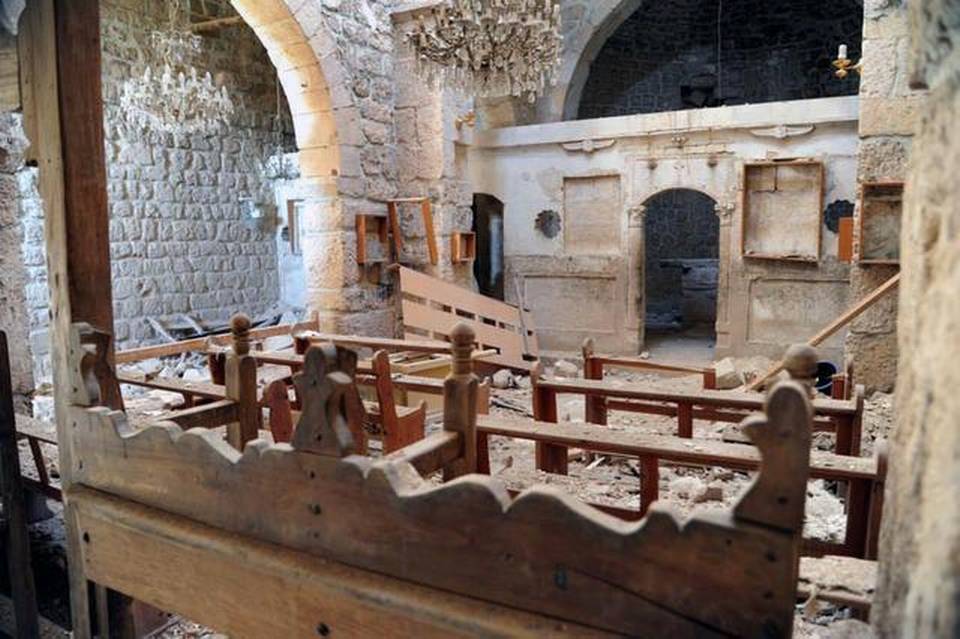
Christendom has seen fanaticism and hatred over the centuries, but nothing in comparison with our own times. As I write, churches are destroyed and Christians are martyred by Daesh and other jihadist Muslims. Once again, churches are destroyed, gutted, burned and desecrated, all in the name of a divinity that millions of people in the world worship.

I hope and pray Mr Trump will look at these pictures too before blaming everything on the secular regime in Syria and launching any further attacks on the very forces defending Christians. This is my particular intention as I celebrate the succeeding elements of the Mystery during this Triduum.

Let us pray also for Europe, that we may never fall under the same scourge as befell England in 1649 and in the Middle East now, as we discover horror after horror on reading the news on the Internet and seeing videos on YouTube.

Άγίος ό Θεός, Άγίος ίσχυρος, Άγίος άθανατος, έλεήσον ήμάς.

Posted in Uncategorized | Tagged , , , , | 7 Comments

Hair Update

An old posting from January 2014 – Vestri Capilli Capitis – has been looked at four times today. I wrote about long hair on men. OK, mine has grown a little longer since then. Here’s a quick selfie from February this year:

It has just about reached mid-back length and ties up nicely into a queue when I’m in clericals.

Posted in Uncategorized | Tagged | 2 Comments

A Reflection for Holy Week

Doing my rounds this morning, I came across this article The Virtue of Despair. I immediately identified with the reflection of the nihilist philosopher Nietzsche:

Out of such abysses, from such severe sickness one returns newborn, having shed one’s skin, more ticklish and malicious, with a more delicate taste for joy, with a more tender tongue for all good things, with merrier senses, with a second dangerous innocence in joy, more childhood and yet a hundred times subtler than one has ever seen before.

I had the impression of having been through something like that from about last November until a couple of months ago. I have to say that I emerged freer and more myself, able to deal better with various feminine shenanigans.

For us in the northern hemisphere, it is no accident that the Paschal Cycle falls in the lunar cycle of spring, and that the Passion and Resurrection of Christ are reflected in nature – including ourselves and the effects the changing seasons have on us. The experience of more daylight and sunshine does wonders!

We should see this reflection on despair as an analogy. At a moral level, despair is the sin against the virtue of Hope. If there is hope, despair is never absolute but a passing period of suffering. I often mention the quote of Léon Bloy: Souffrir passe, avoir souffert ne passe jamais. The idea is also found in the writings of Saint Thérèse de l’Enfant Jésus. Perhaps she had read Bloy’s writings. Pain leaves us, but we remain marked, as the risen Christ will remain with the stigmata of his Passion.

These thoughts should accompany us as we approach the sacred Triduum and the Transitus Domini of which we find the archetypes in the Old Testament, the Mysteries of the ancient world and in our own lives.

Posted in Uncategorized | Tagged , , , | 1 Comment

Diocese of Amritsar and Rome

I have just received some information from Dr William Tighe to answer a question I asked back in 2012 about the Anglican Diocese of Amritsar in India.

“The Diocese of Amritsar is curiously mentioned by Cardinal Levada in his announcement of 20th October 2009: “Sometimes there have been groups of Anglicans who have entered while preserving some “corporate” structure. Examples of this include, the Anglican diocese of Amritsar in India, and some individual parishes in the United States”. This being said, there is no knowledge of an Anglican diocese of that Indian city being received corporately into communion with the Catholic Church. I don’t know what to make of the Cardinal’s words. However, the churches of this diocese are the original buildings of the Anglican Communion of before the formation of the Church of South India.

The Diocese of Chotanagpur has seven parishes and eight priests. The Archdiocese of Lucknow, headed by Archbishop Prakash has six churches and eight priests. I have no information about the numbers of faithful. The Diocese of Nandiyal has 41 congregations “with 2672 communities”. The Diocese of Travancore & Cochin has eight priests, a seminary, an orphanage, a house for elderly people and a nursery school. Two new churches have been built.”

I quote Dr Tighe’s message:

* * *

Your question about the Diocese of Amritsar and Rome posed here in 2012: https://sarumuse.wordpress.com/2012/12/27/the-anglican-church-of-india/

seems to be answered in the course of Bishop Lopes’ lecture, here:

https://www.ordinariate.net/documents/2017/4/Bishop_Lopes_28March17_Lecture.pdf

“Third, one of the things that became clear from that internal examination of the CDF files on the various attempts at corporate reunion is that the CDF has always exercised particular care for the liturgical life of those Anglican communities seeking full communion with the Catholic Church. Your own colleague here at the University of Vienna, Daniel Seper, has done some important research on the petition of the Anglican Diocese of Amritsar, India, to enter into full communion in 1977-1982. In that case, the very same decree of the Congregation which authorized full communion for this group of Anglicans also articulated a rather robust liturgical provision for them, identifying which rites could be pulled from the Book of Common Prayer and which sacraments had to be celebrated from exclusively Roman sources. Sadly, this is one of the cases which really did not work, as the implementation of this decision was left to the local Conference of Bishops in India and someone at that local level decided that this liturgical provision was not necessary and so it was never implemented. Perhaps consequently, the clergy and faithful of that Anglican diocese of Amritsar faded away and only two priests and maybe 200 lay faithful were reconciled.”

Posted in Uncategorized | Tagged , | 3 Comments

Terrena despicere?

Someone thoughtfully forwarded a link to me this morning – Reading Dreher with Schmemann and MacIntyre (and thus Marx). The subject is the so-called Benedict Option expressed in writings by Rod Dreher and others, especially in America. The article is quite long and challenging, and is worth a good read.

I have mentioned before that the idea quite intrigued me, and I could see the obvious comparisons with monasteries, less enclosed religious orders, the Brüderhof, charismatic communities, various intentional communities based on ecology or other common themes. There are also the Amish communities in the USA which, perhaps, are to be “admired but not imitated”. If such a community is founded and those in it find fulfilment, I can only encourage them to continue in this vast human experiment in known history. The New World was a powerful archetype in history, but now the new world has become the old in terms of human impiety and iniquity. The first European Americans set out to found something new, not merely escape from the world that oppressed them. The Benedict Option seems to be different in that it seeks to create new micro-societies or tribes away from society. The difference seems to be subtle but real.

Several things emerge from this article. One is the analysis of the modern world. Another is how the micro-society is intended to work, not fall victim to the worst aspects of human nature. Can Christianity only subsist in a Christian society, or can it live in a neutral or hostile world like in the Roman Empire before the Peace of Constantine? We are constantly reading things on the internet, full of foreboding warnings of a collapse of civilisation or the end of the world – neither of which have occurred despite prophecies that they were imminent. Many such prophecies are tired out and old. Apocalypticism seems to be a psychological need for some people, like conspiracy theories that turn out to be fallacious.

The article discusses the theme of the guru, the leader of a totalitarian sect or cult. A monastery has its prior or abbot, and unquestioning obedience is demanded of the community’s members. Where is the dividing line between asceticism and spirituality, and depersonalisation and abuse by an amoral leader? It also happens in non-religious communities, unless, perhaps, a democratic or collegial system is put in place where the leader is bound to consult his peers. How many dictators in history asked their people to choose between “me or chaos”?

The argument is put forward that the plight of the Church and Christianity are never beyond hope, since both have been threatened in the past. The Church rebounded where it was least expected. Is Christianity finished in western mainstream society?

There is also a danger of like-minded people seeking to build a society in which thinking alike is a prerequisite. That is something that needs thinking about. I usually find that people can get very nasty the more they share an interest. I have even found this in the sailing world where there can be bad disputes about whether one may have an engine on his boat for when sailing isn’t possible or what kind of life-jacket should be worn. These are purely practical matters, and are compounded when it is a matter of ideology! This happens in various identity groups like gays and people with Aspergers. One can only take so much in the hothouse.

Is Christian living to be another “lifestyle” for those who can afford it and come from a yuppie or bourgeois-bohemian background? In the intentional community world, the choice is essentially between a guru and unpaid work – or buying-in at more than it costs to buy a house in the countryside. A solution? I don’t think there is any one solution for the future of Christianity. It depends to a great extent on where we live, in cities, suburbs or the countryside. Then, whether it is with families and children, alone, with an intense social life, involved in local community activities and politics, whatever. All communities are exposed to the risk of human nature: corruption, abuse, exclusion of “others” and everything else that has happened, causing the community to reform itself or fall apart.

It is a good thing that I have been exposed to monastic life for my six-month stint. The Abbot made it easy for me, because he knew that I did not aspire to a monastic vocation. I had interesting work to do corresponding with my knowledge and skills. I had some realistic idea of the life of the monks. It is essentially a totalitarian “Orwellian” society where each person allows his personality to be eclipsed by the collective. It is the most radical Communism that exists, the only difference being that it is voluntary – accepted by the pronouncement of the Vows. Not everyone is made for that. I am not. Monastic life is everything that is the most ordinary, commonplace, boring and earthly. The corridors smell of sweat and boot polish. It could almost be compared with the Army except for the absence of noise and weapons! The various bits of advice for a young man thinking about monastic life have a ring of realism – go and get some boring job in an office or a factory and don’t think of yourself as anyone special. The almost-nihilism of it is quite surprising! It is the exact opposite of Romanticism, in which the creative imagination is exalted, but Romantics are not always very holy people…

Fr Charles de Foucault comes back to me. He was a hermit, though he intended to found a very austere monastic community. The people around him were all Muslims. There is something to be said for “monastic” life in a city without any trappings or habit, just service to others. I have thought of leaving my present life to live alone in some remote place – but it just won’t work. It would be based on wrong, and that can’t be justified. Nor would I be justified in joining some intentional community where I would be followed by — myself.

Those are a few of my reflections on reading this article, which might be a little too hard on Dreher’s idea and desire to escape the quagmire of modern American or western life. Usually, we do God’s will by staying put, being where He put us so that we can do good in some small and insignificant way. Communities do exist and are said to do good and work out for the best. There are none anywhere near where I live, apart from a couple of Roman Catholic monasteries, so it seems to be something of a non-sequitur. That is the limit of the internet unless we have the lack of responsibilities at home, time and leisure to travel.

Thomas Merton once said succinctly, the entire wisdom of the desert fathers and mothers, thus: “Shut up, and go to your cell!”

Indeed.

Posted in Uncategorized | Tagged , , , | 26 Comments