Temple Grandin

I have just made the discovery of an amazing American woman by the name of Temple Grandin. I have just ordered the DVD by her name, a film about her life as an autistic. You can find clips from this film and talks by searching on YouTube. I was very struck about her as a little girl when her mother takes her to the psychiatrist. Temple looks at the wallpaper and two pieces that were misaligned by a sloppy decorator, and she visualises the pattern as it should be. I often did this as a child, and loved looking at a world map and how continents would have fitted together before the Continental Drift millions of years ago. Even looking at random forms like knots in a piece of wood, I sometimes catch myself looking for patterns and something logical. It just doesn’t occur to most people!

Another scene is at a Christmas party when some friendly people come to engage Temple in small talk. It ends up with a meltdown in another room, such is the confusion coming from the way most people socialise. An austistic or Aspergers person just can’t handle the contradictions and strategies of manipulation. The little I have seen of the film through the YouTube clips (the full film is only available from streaming merchants – so I ordered the DVD) is impressive. It is full both of intimate familiarity and strangeness.

Apart from being a university professor and an accomplished scientist, Temple Grandin is distinguished for having designed humane animal slaughtering systems. Animals like cattle, sheep and pigs are kept in a state of calmness. When they are shot with a a captive bolt pistol or electrocuted prior to being bled, their death is instantaneous – far better than if they were caught by a lion in Africa. In the short presentation Stairway to Heaven, she outlines her slaughterhouse inventions involving curved and walled pathways and ways to prevent the animals from seeing the plant’s employees doing their job.

As the son of a veterinary surgeon, I have seen plenty of animal blood and gore from post-mortems, euthanised dogs and cats on the floor in the cremation room, and even a view through an open door of the local slaughterhouse in Kendal. A stunned animal hanging by the back leg moves a lot, giving the impression of being still alive, and the impression is quite revolting. I once had to finish off a mortally injured cat on the road, and I have killed fish that I caught and which were good for eating. With the cat, it was an act of euthanasia. It is a terrifying truth, but in order to live, we have to kill. That is true even if you are a vegan, because plants are also living things and they die when you cook and eat them. If we use milk, cheese and eggs, the animals and birds concerned will still be killed and eaten by others. The leather for our shoes and belts also comes from dead cows!

It is very reassuring to relate that many slaughterhouses in the USA have adopted Temple Grandin’s invention. It certainly represents a significant capital investment, but the meat of relaxed animals is of much better quality, and the animal is respected until the instant it is stunned and killed. Not so here in Europe, where business demands the killing of all animals except pigs using Kosher and Halal methods: using a very long and sharp knife to slit the beast’s throat once it is turned upside down in a special revolving pen. The top part is sold for Jewish and Muslim consumption, and the bottom part, considered ritually impure, is sold to “ordinary” butchers. The best steaks come from the rear end, but beef chops are much more expensive because they come from the “pure” part. There is a significant level of protest here in France and other European countries against the bleeding of animals without prior stunning, and conditions are often barbarous.

Here is a video of such a killing – warning, not for the squeamish! It is sickening – so be warned. The animal is reckoned to be dead when its tongue hangs out, but conscious life is likely to continue for the time it takes for the brain to become starved of oxygen – generally three to four minutes. The properly stunned animal (captive bolt pistol, electricity or carbon dioxide) is certainly completely unconsciousness before it is bled. The law in the USA and all European countries requires stunning. I fail to understand the issue with ritual slaughter, because a stunned animal is just as completely bled as a conscious one when the man with his knife does his job. Why refuse modern stunning? Even on traditional farms, for the Saint-Cochon in November, the pig gets a bullet in the head or a hard hammer blow before being hung up and bled (think of those yummy black puddings).

Temple Grandin can be proud of the fact that she has devised ways of respecting the animals whilst they are alive and giving them a painless and instantaneous death.

I eat meat myself, but I increasingly buy it from farms that breed their animals humanely and in good conditions of comfort and health. I eat very little beef or lamb, and tend to eat more pork and chicken. I know that pigs are killed properly and cleanly because they are not eaten by our non-Christian monotheistic brethren. Her view of death has been to a great extent formed by the slaughterhouse but also by accounts of near-death experiences of people whose brains were totally flat lined. As a visual thinker, formal religion makes little sense to her, but she has this original approach to death which is as inevitable for us as for the steer in the slaughterhouse.

She is a fascinating person to listen to, so logical and tidy in her thought processes. I will be watching more videos of her talks and interviews. She can be quite intimidating with her chiselled and gaunt face and her twangy accent. Above all, she makes the point that however much we are held back by disability, we can all succeed by working hard and applying ourselves. Instead of getting addicted to video games, young aspies and ASD people need to learn skills and do something they are really good at. Schools seem to be improving in this respect as I could not know in the 1960’s and 70’s when we were just upbraided and punished for laziness or disobedience to authority. No one gets it served up on a plate. We all have to work hard. The world doesn’t owe us a living! It is said that Mozart didn’t get “inspirations” when composing his music – but worked long and gruelling hours. I know what it’s like to work in a counter-subject in a coherent chordal progression, and produce something that has form – and above all beauty. Good old-fashioned work seems a little out of date these days – but this is the way for us all, whether we are “on the spectrum” or “neurotypical”.

Posted in Uncategorized | Tagged , , , | 2 Comments

Quid est Veritas?

vicar-brayLike in the political world, black seems to be white in the RC Church. I have received several links to news articles about the ongoing war between conservatives (including Cardinal Burke) and Pope Francis.

Given that degree of Francis’ vehemence against “rigid” thinkers, things seem to be moving forward for the Society of St Pius X – Pope Francis’s traditionalists by Damian Thompson. Regarding the conflict between Cardinal Burke and the Pope, I’m not sure that the Cardinal is being any more rigid in terms of moral teaching than Popes Paul VI and John Paul II. It is simply that the “liberal” expectations are becoming increasingly excessive and unrealistic – and typically “feminist”.

If I were an atheist, I would be having a field day with all this nonsense and conflicting messages! We have the American journalist telling us that we are on the point of getting some “reincarnation” of Hitler or Mussolini (and Paolo Sesto?). If I have to give a political opinion, I would favour some versions of American Libertarianism, Distributism à la Hilaire Belloc or some other socialist vision from the nineteenth century. I believe in private property, owning the means of production and being allowed to earn one’s living by work, but I also believe in humanitarianism and helping the less fortunate than ourselves. I detest “champagne socialism” as much as unlimited capitalism (big companies preventing small businesses from having any share of the market by unfair means) and elitism. I find nothing good in party politics in America and Europe. It burns me out. I don’t think Pope Francis knows what he is talking about when he simply echoes, parrot fashion, the agenda of some very evil people in this world. For this reason, I evoke the rhetorical question of Pilate facing Christ – What is truth?

Then we have Pope Francis being ready to take in the SSPX – unless it’s all “bait & switch”. In which case, would the SSPX be so stupid, given that they have reneged on previous regularisation attempts under John Paul II and Benedict XVI?

Perhaps there is a clue in this quote from St Ignatius of Loyola, the founder of the Jesuits: What seems to me white, I will believe black if the hierarchical Church so defines. The more lenient viewpoint would describe this notion in analogical and rhetorical rather than literal terms: trust the Church more than your own possibly erroneous judgement or belief. Taken literally, the idea is quite monstrous. For centuries, the Jesuits have been known for playing games with words and ideas. I have known some saintly Jesuit priests in England like Fr Hugh Thwaites, but most are just – – – boring.

Decidedly, this RC Church has definitely forfeited any claim it might have had to represent revealed Truth or being the “true” Church exclusively of all others. “Emotional” and “intellectual” sedevacantism are growing. I am finding both opposing camps toxic. Again, I thank God for the continuing Anglican Churches and all the little communities inside and outside the “mainstream” institutions. Thank goodness, Catholic Christianity can continue without becoming abject nonsense fit only to disposed of in the household rubbish!

Maybe, cujus rex ejus religio: Pope Francis will stop supporting the agenda people like Obama and Hillary Clinton represented, and will turn to the new nationalist and authoritarian tendencies – and no one will bat an eyelid.

When royal James possessed the crown, and popery came in fashion,
The penal laws I hooted down, and read the Declaration.
The Church of Rome, I found, did fit full well my constitution
And I had been a Jesuit, but for the Revolution.

When William was our King declared, to ease the nation’s grievance,
With this new wind about I steered, and swore to him allegiance.
Old principles I did revoke; Set conscience at a distance,
Passive obedience was a joke, a jest was non-resistance.

When Royal Anne became our queen, the Church of England’s glory,
Another face of things was seen, and I became a Tory.
Occasional conformists base; I blamed their moderation;
And thought the Church in danger was from such prevarication.

Posted in Uncategorized | Tagged | 3 Comments

Aspie Archbishop?

This is quite amazing – Michael Ramsey – an autistic archbishop ?

Diagnosing a dead person is not easy to say the least (it has been tried with King George III and Mozart among others), but people did notice some strange things about this great man of God and the Church of England. Asperger’s Syndrome manifests itself in many different ways and degrees, but when the symptoms fit…

Posted in Uncategorized | Tagged , , | Leave a comment

The French RC Continuum

I am probably the only Continuing Anglican priest with experience of French Catholicism, both in the Parisian mainstream and the traditionalist scene. I see many parallels between French Catholicism and Russian Orthodoxy: the identification of the Kingdom of God and the French Kingdom. The elephant in the room is the French Revolution and the various times when anti-clericalism and atheism have surfaced. This love-hate relationship with God and the Church has characterised French culture and thought for the past couple of hundred years. It penetrates the writings of great authors like Victor Hugo, Joseph de Maistre, Léon Bloy and Georges Bernanos among so many others. We find this aspiration in the great nineteenth-century churches of Paris. I give you here the example of Saint-Augustin near the Gare Saint-Lazare:
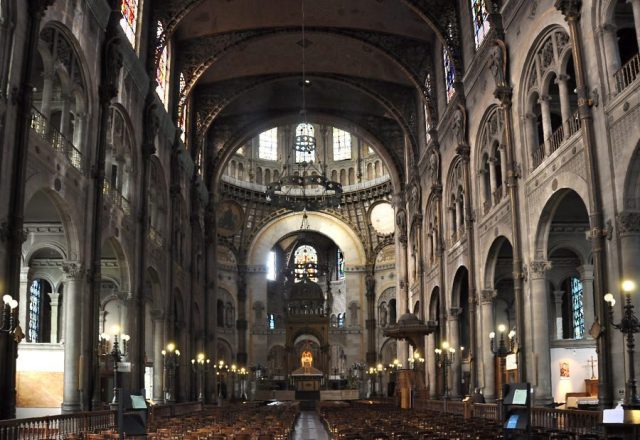
st-augustin-parisThe building is by Haussmann, like many of the residential buildings of the city from the time of Napoleon III. It is something like the music of Gounod, grandiose and expressive of human hope and aspiration (and pride). I last visited this church some six years ago when I saw a friend in Paris and we spent several hours in a warm café facing this church on a freezing cold January day. I had a nasty bout of flu, but yet the massive iron-framed building haunted me.

France was politically unstable throughout the nineteenth century, vacillating between self-styled emperors who were drunk with power and the various attempts at a Masonic republic, excluding God and the Church for a particular ideological view of human rights. From the Revolution, it was all about imposing rationalist notions of virtue on humanity on pain of banishment or death! We find the same themes in America, a political idea that was based on France in many ways.

The French notion of the priesthood is something I hold very precious. For those of us who are ordained by a bishop in Apostolic succession, the priesthood becomes a part of us. We identify with it intimately. It is not something that can be put on or taken off like the cassock. It is part of us, even the laicised priest and the young sick priest of Barnanos’ Journal d’un Curé de Campagne. I have experienced something of the tail-end of parish life as it used to be, before parishes were grouped into pastoral sectors and run according to principles of corporate management. This is something that formed the Opus Sacerdotale of Canon Catta in 1964, which still exists today rather like some priestly associations in the Forward in Faith movement in England.

With all the instability and struggles of the nineteenth century, which led to the separation of Church and State in 1905, Catholicism became quite polarised and political, generally split between nostalgia for the old Kingdom and acceptance of the anti-religious and Masonic republic. One thing that I have learned in life is to distinguish creative persons from their countries of origin. Bach, Schumann and Brahms would make me dream of Germany and love the land that nurtured them – until we know what happened under the Nazis. I love my own country for the great men of culture it mothered, but I see the mess of the present day, the fact I could never return because I could not afford housing or have pension rights. I know that men of my country have committed horrible atrocities in the name of the once-proud Empire. France had Devil’s Island and the guillotine, a passionate hatred of priests and decades of soul-destroying “champagne” socialism. This is the condition of an exile…

French Catholics refer everything to the Revolution, and this is how they perceived Vatican II. Both brought destruction and a kind of zero point, a mysterious turn of fate in history. We only look to an unknown future without end. In the writings of French authors in the nineteenth century, we find many themes about which Russian philosophers like Berdyaev wrote in the twentieth in the wake of their own Revolution. I see many parallels between France and Holy Russia, something that attracted me to this country in the early 1980’s. We arrive at the end of the Renaissance, enter a new dark age and await the light of a new gothic era. I have written on this theme many times when discussing Romanticism. If the world was to survive, the Church would emerge from the ruins, maybe with the wailing and gnashing of teeth the Apocalypse speaks about. But, this would be the Eternal Church, the Church to which Christ promised indefectibility, not the illusion which is the fruit of rationalistic humanism.

French Catholicism succumbed to Ultramontanism by the middle of the nineteenth century. Gallicanism became marginalised and ostracised after Vatican I. It was the time when Masonry became increasingly vehement and anti-clerical. The Church reacted with attempts at yet more triumphalism. There were “Modernist” or “Liberal” reactions from the most cultured academics and historical critics. The mainstream of the French Church was the reactionary bourgeoisie in central Paris and Versailles, as it is today in Tradieland. The Dreyfus Affair was a landmark in the conflict between Modernists and reactionaries in line with Rome. The story is well known and a leading cause of anti-Semitism and Catholic conspiracy theories at the beginning of the twentieth century. Dreyfus was wrongly accused of treason, but the Catholic party wanted to maintain his conviction and blame Judaism for the crime of treason. Emile Zola’s J’Accuse named the officers involved in the condemnation of Dreyfus, and this caused many anti-Semitic riots in France.

The polemics go back to the Revolution and the persecution of Catholics, almost a prototype of genocide when one considers the events in the Vendée and Brittany. The polemics between royalist Catholics and radical republicans were always implicit under the surface throughout the nineteenth century. This radicalism, unlike English socialism, was atheistic. The free-thinkers seemed to express common sense against the bigotry of religion and obscurantism. We see the same thing today. Resistance against and collaboration with the Nazi occupation of France from 1940 until 1944 was also an expression of similar polarised themes, the anti-Semitic theme of Nazism remaining highly symbolic. The bitterness festers to this day.

The story of Archbishop Lefebvre is complex. His parents were anti-Nazi during the war, which earned them deportation. He had spent most of his life outside France, in the missions. This did not prevent the Society of St Pius X from becoming increasingly reactionary and “anti-Dreyfus”. The old Kingdom of France came to be associated with The Tradition, meaning the totality of Catholic beliefs and practices. It came to mean more than Tradition as a source of revelation and doctrine alongside Holy Scripture. Another notion of Tradition is highly significant in France, the perennial Tradition expressed by men like René Guénon and Henry Montaigu, with which I have a great deal of sympathy. Vatican II and its aftermath could have been so much more sensitive and less politically motivated and iconoclastic. Largely, in the 1960’s, the salt had lost its savour and bishops and priests had lost sight of their spiritual and deeply pastoral vocation and mission. Archbishop Lefebvre and his society of priests seemed to represent something both heroic and mediocre. It seemed to represent contentment with the status quo ante, timorous counter-revolutionaries, nostalgic bigots, collaborators from the time of the Occupation. They made of The Tradition an ideology. This problem of a total lack of critical sense has remained ever since in that weird “other” world.

During my days in that world, and in the traditionalist communities approved by Rome since the 1988 episcopal consecrations at Ecône, one of the main issues was the “true church” against the perceived Universalism of John Paul II. This is another issue where the traditionalists and I differed. I saw little wrong with the Pope praying with Buddhists, Hindous and others during a get-together of world religions in 1986. What was all the fuss about? Perhaps if I found myself in a service of another religion, I would be silent in the midst of the unfamiliarity, but I would silently pray to Christ (from whom light is given to all believers). This was always the bee in the bonnet of traditionalists, unless they were given the treatment they would mete out to “heretics”, “schismatics” and “infidels”. This was a contradiction I always found hypocritical. This attitude would spread through anything that smacked of ecumenism and religious freedom. Perhaps, if we read more Dostoievsky, we would have a deeper notion of spiritual freedom. The same goes with human rights, born of the French Revolution, but which brought the traditionalists the freedom to set up seminaries and chapels without prosecution, imprisonment and exile – as they would mete out to others.

The greatest intuition of the traditionalists was to keep the old liturgy (I won’t go into the issues of the Pius XII and John XXIII revisions). It kept the ethos of the western liturgy, not only the Roman rite but also the various other rites and uses from before the Council of Trent. Their liturgical theology is not evolved as in Orthodox theological schools or the Ressourcement in the west. They are still too attached to neo-scholasticism, but the practical conservation of the liturgy has always been positive.

We do need a better understanding of the notion of Tradition. It is a part of the discipline called fundamental theology on which Ressourcement theologians have worked considerably. Newman theorised about the development of doctrine, a kind of organic or homogenous growth with identity of being. Joseph Ratzinger resumed these ideas in his hermeneutic of continuity as an attempt to defend Vatican II. We need to continue working on these themes, since a living Tradition seems more appealing than a dead or static one. This was certainly one motive that brought Benedict XVII to welcome Anglicans into the RC Church via something like the ordinariates, to offer a new theological think-tank, new blood and a way out of the traditionalists vs. liberal polemics.

The main problem with the RC traditionalists, and indeed with some Anglican quarters, is intellectual confusion and deep ignorance, the use or abuse of language, analogy and euphemisms. Most are simple conservatives who hanker for a reproduction of the 1950’s or some other stereotyped image of the “old days”. They also suffer from the “bourgeois” spirit, hardness of attitude and erroneous interptretations. Many fail to see that the Council was the perfect hermeneutic of continuity from a corrupt and bad Catholicism in the same way as Calvinism emerged from bad sixteenth-century pseudo-Augustinian scholasticism.

We need to find a way above the old dialectics between conservatism and radicalism. I have always had my sympathies with Ressourcement theology and an “orthodox” Gnosticism (Origen, St Clement of Alexandria, etc.). We need to develop a contemplative spirituality outside monasteries, and the “Benedict Option” is appealing if it can be refined and explained. There needs to be a sense of stability and certitude, without smugness and triumphalism. The heart and the head need to work together, the heart solidly governed by the rational faculties. There needs to be a notion of living Tradition, but one that needs more study and contemplative prayer. Perhaps it comes more easily to Anglicans when we are not processed in the totalitarian mould!

The study of the “perennial philosophy” seems to lose steam these days, and many of those who promoted it thirty years ago seem to have lost interest or disappeared. René Guénon needs to be studied, but critically, without making yet another ideology. The notion of conversion and initiation needs to be better understood. There needs to be a better understood notion of the transcendent unity of all religions, to express the idea that the one God is the source of all traditions and ideas.

Can Christianity still lead to the sacred? It is a good question, since most of the time it doesn’t! If Christianity is divinely revealed, divine knowledge is not limited by human infirmity, ignorance and materialism. The outward Evangelical dimension of Christianity is important, but so are the hidden, contemplative and esoteric dimensions.

In the debates about Gallicanism and Ultramontanism this country has experienced, it is a paradox that the theme of Anglicanism has not been understood other than as a manifestation of the Protestant Reformation. A few French minds understood the real value of Anglicanism, Louis Bouyer for example. A few French traditionalists have shown affinity towards Anglicanism, but they are thwarted by the usual Roman Catholic teaching on our Orders being invalid. I sensed this profoundly when I was interviewed on the radio and invited to conferences to talk about Anglicanorum coetibus and the TAC in 2009-10. There was a limit to the sympathy. Now, I am out of it. I no longer exist, but there is no reason why I should. My blog usually gets a few French hits per day, and most French people learn some English at school!

Continuing Anglicanism remains marginal, and has no effect in France. The link between Gallicanism and Anglicanism is not established in people’s minds. Gallicanism was marginal before Vatican I and the generalisation of the Roman rite in France. There are some independent churches and bishops calling themselves Gallican, sometimes in reference to the pre-Ultramontanist French Church, sometimes to the old Gallican rite of before Charlemagne. Most are exorcism and faith-healing mills, and I have nothing to do with them. Some Anglican churches of the Diocese of Europe have attracted a few French faithful and some services are in French. Are such people of any particular conviction or simply disaffected Roman Catholics? It is difficult to tell. Traditionalists would not go anywhere near Anglican churches, and Novus Ordo Catholics would find our liturgy a little on the “stuffy” side. My own wife certainly does.

I know more about what goes on in America than in France! There may be an Orthodox monastery or two I would like to visit, just to pray and experience the peace of the place. I find traditionalist RC monasteries too “military” and rigid, as I found Triors and Fontgombault, sublime as the Gregorian chant is. There were initiatives by men like Jean Vanier for mentally handicapped people and the Abbé Pierre for the homeless. There was something beautiful in the post World War II Church with its opening to the poor, the weak and the dispossessed after so many decades of occupation by the bourgeois – something like Anglicanism in the 1860’s. The Church went to the poor, the weak and the broken of this world. There is even a monastery for mentally handicapped people. I ought to visit it and understand how brokenness can be reconciled with holiness and contemplative life. Throughout my RC days, I dreamt of the slum priests and Fr Montgomery-Wright having been quite radical in the 1950’s due to his Anglo-Catholic past. This dimension is entirely missing in the traditionalist world, preoccupied as they are with the strong and wealthy.

I live in a strange country where faith has almost completely evaporated. I hear a lot about Islam, but I am too afraid to go into those areas around our towns and cities. There is a new movement with Trump, Le Pen and even Fillon – and things might change radically after the years of socialism and social alienation. If that tendency wins next May, it would be unpredictable in France. The traditionalists would certainly cry “triumph” and try to use the system to their advantage as the collaborators did with the Nazis against the radical republicans of their day. Now, it is not only France but the entire European experiment. I feel unable to relate to the political debate, since it burns me out too quickly, even from my little house in the Normandy countryside.

I will continue with this blog – in my own language, since the English language is a part of our Anglican culture. I look forward to getting my life into better order to write books and music and relate to the world in my own little way. I have tried French language blogs, but they fell flat, and my written style in French is just not up to it! The Anglican way just seems too good to be true, and remains ignored and passed over with silly and ignorant talk. That’s the way it is.

I would certainly go back to England in a heartbeat if I had the money to buy a decent house and make provision for my old age! That ain’t gonna happen.

Posted in Uncategorized | Tagged , , , , , , , | 2 Comments

Why Hast Thou Forsaken Me?

triors-churchHere is a very poignant article by Fr Ray Blake in England – My God, my God why have you forsaken me?

When I was in Rome (1985-86) at the Nepomucene College, there was a priest who had been tortured by the KGB (or the Czech equivalent). There were scars on his face, and a great sadness exuded from him. Indeed the whole place exuded sadness. A young fair-haired seminarian had walked out of his country over the mountains with his papers in one shoe and some money in the other. He reached Austria, and then on the Church in Austria helped him on his way to Rome. The sadness of the place was oppressive and had its effect on the little American community I belonged to as a first-year seminarian.

My own grandfather was a prisoner of war from 1940 until the end of the war in an Oflag near Linz (Austria but then under Nazi rule). He did his duty and attempted to escape twice, and was probably badly treated by the German soldiers charged with camp security. His journal, which I have read and kept by my sister, is poignant. They were only required to try escaping twice, because a third attempt would be punished by the firing squad. I could not understand why he would not talk about the war when I was a little boy, with a romantic idea about nation and war against the Hun, but he must have been traumatised to see death, destruction and inhumanity on such a scale.

Fr Blake’s story about the monk at Quarr Abbey is poignant. There are many stories of mental illness with those who slipped through the psychological screening of modern communities and dioceses. I knew a monk of Hauterive Abbey near Fribourg who was (is) a brilliant canonist and theologian, but could not live in the community. He obtained a special dispensation called exclaustration, and, though still officially a monk, lives and works in academia at my old alma mater. The story of Dom Peter at Quarr is not unique, and the job of being an abbot is made difficult: keeping the community together whilst tolerating eccentricities coming from a multitude of causes.

Many monasteries, as far as I have experienced, seem to have more of the spirit of the barracks or the boot camp than a contemplative community – but I was in the guest house  at Triors (with access to some of the conventual places like the workshops and the cloister). The monastic life is only for the toughest and strongest of characters. Men with nervous or mental disorders come very unstuck in a monastery – if they survive the novitiate and period of simple profession. A man who had withstood torture by the Gestapo certainly won the admiration of the Abbot of his time, but the life-long effects of such abuse were certainly ignored. I recommend the wonderful little novel Cosmas or the Love of God by Pierre de Calan. This book is still available to buy. Again, we rejoin the theme of the fool for Christ as we read in Waugh’s Brideshead Revisited when Cordelia describes her brother Sebastian:

…Then one morning, after one of his drinking bouts, he’ll be picked up at the gate dying, and show by a mere flicker of the eyelid that he is conscious when they give him the last sacraments. It’s not such a bad way of getting through one’s life.

I thought of the youth with the teddy-bear under the flowering chestnuts. “It’s not what one would have foretold,” I said. “I suppose he doesn’t suffer?”

Oh, yes, I think he does. One can have no idea what the suffering may be, to be maimed as he is – no dignity, no power of will. No one is ever holy without suffering. It’s taken that form with him…I’ve seen so much suffering in the last few years; there’s so much coming for everybody soon. It’s the spring of love…”’

Torture is still controversial in our “civilised” world, with President Trump allowing it to get information out of those involved in Islamic terrorism. From a purely intelligence point of view, torture is unreliable as a means of getting accurate information, because a man under torture will say anything to stop the pain. The morality of using torture or mind-bending drugs in cases of war and “clear and present danger” is difficult and disputable. Who would not beat up a kidnapper to find out where his children are?

Man’s inhumanity to man is beyond belief, particularly under Nazism and Communism. Torture was also practised from motives of gratuitous sadism and the intention of destroying human beings. I have recently watched several videos about the history of psychiatry and the way torture was (misguidedly) used for therapeutic purposes. Bedlam was the most notorious place of abuse and torture of the mentally ill, and lobotomies and electric shock treatment were used well into the years of my own lifetime.

The worst of human suffering is when a person loses any sense of consolation from God or other people, friends and family in particular. The notion is terrifying, as happened to Christ shortly before dying on the cross. He quoted the psalm: My God, my God, why hast thou forsaken me. Even being God and man, he suffered like any other human being dying by man’s hatred and sadism.

Any of us can go through this terrifying crucible of desolation and suffering, even without human wickedness, whether from our own sins and guilt or from reasons of poor mental health. Depression and anxiety take their invisible toll. My most memorable experience was in March 1996 when I was at Triors, the day after a visit by Msgr Wach and feeling that I had been cynically mocked. I was taken at my weakest by mere words. I remember the quote of Oscar Wilde in the Ballad of Reading Gaol when contemplating the fate of a prisoner condemned to be hanged for murdering his wife:

Yet each man kills the thing he loves,
By each let this be heard,
Some do it with a bitter look,
Some with a flattering word,
The coward does it with a kiss,
The brave man with a sword!
Some kill their love when they are young,
And some when they are old;
Some strangle with the hands of Lust,
Some with the hands of Gold:
The kindest use a knife, because
The dead so soon grow cold.
Some love too little, some too long,
Some sell, and others buy;
Some do the deed with many tears,
And some without a sigh:
For each man kills the thing he loves,
Yet each man does not die.

Christ himself describes murder not only in terms of ending a person’s life, but by mere thoughts of hatred and duplicity. Perhaps without such an experience in the coldness of the Abbey church, I would not have survived the three months I have just been through with my wife and coming to terms with Asperger’s Syndrome in long discussions with my family and the psychiatrist, and begun to emerge from it stronger in my faith and resolve to serve as a priest. I remember the Abbot (Dom Courau) coming to visit me, having seen me in tears in the church, with a kindly eye and concern. I have not forgotten that moment of human warmth, and my long drive and walk in the majestic Vercors mountains and the farmhouse of Marthe Robin.

Fr Blake describes our times as an Age of the New Martyrs, a time of confessing the Faith with no reward or consolation for ourselves. The enemy is both outside and within the Church, and bullies and sadists abound in the most sanctimonious disguises. It is somewhat precocious as a reflection long before Septuagesima, let alone Lent or Passiontide. Being prepared does no harm as long as self-pity does not enter the picture.

We need to move onto the joys we can still find, and which I have found in the ACC. A glimmer of light brings so much warmth and hope. Let us build on that!

Posted in Uncategorized | Tagged , , , , | 1 Comment

The Return of “And also with you”?

With this posting, I am going to bring this new spate of “crisis porn” to a stop.

Pope Francis has ordered a review of the new Mass translation

He doesn’t speak a word of English. I wonder who he’s going to get to do the job. As one who works as a translator (French to English), there are two ways to approach a job: 1) Leave the reader the impression that the text was originally written in English, 2) Pay particular attention to accuracy as is more appropriate for a technical translation (repair manual, specifications for industrial production, user’s manuals, etc.). One would have thought that the two approaches are not mutually exclusive for liturgical texts. I am presently working on a tourism website, so I have to be looser with the style, produce something seductive to customers, but yet respect the French text. There are limits, and it is not always easy.

That presumes that a single Latin – English translator will be doing the job. Not so – it will be done corporately to exclude any person’s literary talents. The previous result was the horribly banal ICEL translation for which certain Roman Catholic liturgists are nostalgic.

For the time being, it is all in the hands of a study commission.We seem to be pushed to believe that the ICEL translation was the first approach I described. The problem is knowing whether it is a translation or a new composition in English to suit various ideological agendas. The Benedict XVI translation is an improvement on ICEL as a translation, but it does read awkwardly in places. I sometimes get such criticism from my translation agents if I have worked too literally as is my tendency.

Another approach would have been to go for the archaic idiom we continuing Anglicans use: the kind of English that was written in the sixteenth century which can be found in Cranmer’s Prayer Book, the King James Bible and related texts from contemporary sources like the Tyndale Bible and Coverdale’s psalter and a translation of the Roman Canon attributed to him (the version used in the Anglican Missal). I can hardly imagine English, Australian or American cradle Roman Catholics accepting an invasion of Anglican culture into their “pure” Church! The choice was Latin or modern English.

This article sings the praise of the ICEL translation which had some revision work done on it in 1998. It might have been a freer and more English idiom in some ways, but it repulsed me when I attended modern language masses in the RC Church. Emphasis has been placed on English that everyone can understand – the lowest common denominator. As an educated person, I have no difficulty in understanding sixteenth-century English, though some words might need looking up. Again, there are limits to the dialectics between literal and artistic translation. “For all men” is not a translation from “pro multis“. It is an ideologically-motivated betrayal of the Latin text. If the Latin Novus Ordo was not meant to be translated, then why didn’t they do a text in Italian and translate that into all other languages and not bother with Latin at all?

It seems to me that it is not simply a matter of translation, working on style and syntax, but one of “de-ratzingerisation” and a return to the authoritarianism and reforming agenda of Paul VI. For a Pope who speaks only Spanish and Italian, I really do wonder why he is so concerned about our English language. There may be problems with the expression in modern English of Greek and Latin theological terms like consubstantial, or even matter, substance and form as understood by those having studied Greek philosophy. We could say offering instead of oblation, but would that mean anything more to a person who does not have the least idea about Jewish and Christian sacrifice? Do away with sacrifice in favour of a group of people enjoying a moment together to say prayers and feel their relationship – and what words do you use. Does offering mean anything? I doubt it. Then you need to change the concept. Now it is no longer translation and we are just making it up as we go along. My old liturgy professor at Fribourg was into this kind of game. He even gave us methods and ideas for writing our own eucharistic prayers based on a set plan! I could not believe the stupidity of someone who was so well versed in the history and theology of the liturgy…

What is Pope Francis’ vision? As far as I can see, nothing new, just rehashed ideologies from the 1970’s that were moderated a little by John Paul II but which continued to the present day in the RC Church and the Anglican Communion, some of the Lutherans and even some of the Orthodox. We Anglicans tend to use the term revisionism, which is an improvement on Modernism, but also quite inadequate. I just see an attempt at bringing Christianity into line with politically correct deconstructionism as might be compared with some of the neo-Marxist ideas of the Frankfurt School.

It may be argued that Liturgiam Authenticam of Benedict XVI attempted to stem the excesses of inculturation and acculturation. These terms presume a uniformity of cultural references in a country, not only the Congo or Gabon, but in European countries where values are more based on the Renaissance and the Enlightenment, and also where populations are influenced by American pop culture. I can safely say that Pope Francis’ vision does not ring a bell with me nor with most people who don’t go to church, or who belong to others churches and communities. A lot is being presumed – and it doesn’t for the most part correspond with reality. I understand the argument that Benedict XVI’s new translation (or or whoever did the job) is somewhat “wooden”, artificial and presumes a single monoculture. Six of one and half a dozen of the other.

Cultural imperialism? That’s a new one on me. I think Francis is just as guilty of it as Pius IX, Paul VI or anyone. There is nothing more “imperial” than his bureaucracies and episcopal conferences and who knows what else. It just seems to be one big game of tit-for-tat, and of little interest to those not making money from it all.

It will be interesting to see what eventually comes out of all this, a simple reinstatement of the 1998 revision of the ICEL stuff, which would be the quickest and easiest solution. The books are already printed and probably still kept in most sacristy cupboards. They might come out with something new long after Francis’ death. Who knows? Someone is sure to restart the electric spark machines of Frankenstein’s laboratory…

Again, I was done with Roman Catholicism a long time ago, when Ratzinger was not yet elected Pope. Some are into “crisis porn” (getting their jollies reading about more scandals and abuses), and others play naive or are naive due to their young age and inexperience of life. I see no way ahead for the RC Church or its hierarchy. I have no sympathy for it. I have no hatred or bitterness towards it either.

For a Pope who seems to be so concerned for cultural diversity, how about alienated Anglicans, non-neurotypicals, those with artistic sensitivities, the educated, those who appreciate the subtleties of written and spoken language? We don’t seem to be offered any option other than repression and ostracism.

The difference is that some of us are not waiting for anything from this Pope, because we are in other churches and communities and do all we can to live in the Church of Christ and God’s grace. We have our liturgies. None of them is perfect or flawlessly translated into our own languages, but they are vehicles of grace and God’s presence in his Church.

Posted in Uncategorized | Tagged , , , | 7 Comments

Aspie Corner

I have just put up a permanent page on this blog – Aspie Corner. It is designed to function like the “Orthodox Blow-Out Department”, though I would hope for more irenic and reflective comments.

If you wish to comment, please go to that page.

Posted in Uncategorized | Tagged , , | Comments Off on Aspie Corner

Paolo Sesto e Mussolini!

paul6duceI don’t often remember dreams, but when I was at seminary, I had a dream of being in Italy during the Fascist era. A crowd was singing the Fascist anthem Giovinezza to other words beginning  Paolo Sesto e Mussolini… followed by other words in Italian that I cannot now remember.

In actual fact Monsignor Giovanni Battista Montini was Secretary of State under Pius XII during World War II and only became Pope in 1963, eighteen years after Mussolini’s ignominious death in Milan (killed by the partisans). In my dream, Montini as Pope Paul VI and the Italian dictator Benito Mussolini were contemporaries and in full collaboration with each other. I would take this as meaning to me that I saw Paul VI as having been a very authoritarian pontiff, even with his reforming agenda.

Despite having taken my distance from Roman Catholic traditionalists in France and elsewhere (and they from me), I do notice some of what seems to be going on in the Roman Catholic Church. Pope Francis seemed to have his own reforming agenda, but was leaving the Anglican rite ordinariates and the traditionalist communities alone. From the beginning of his pontificate, I intensely disliked him and have never had much esteem for the Jesuits (other than the first generation of saints, martyrs and heroes). He really seems to have turned out something of an authoritarian in the manner of Paul VI (the abolition of the old Roman rite, the suspension of Archbishop Lefebvre, etc.). It was under the pontificate of John Paul II (1990’s) when I had my dream of the clown dictator standing next to Paul VI and both revelling in their power.

Episodes of sanctions against Anglican use churches and traditionalists seem to be multiplying. I mentioned Our Lady of the Atonement yesterday. Dr William Tighe is welcome to send in comments, since he seems to be well-informed. Fr Hunwicke has written on his blog about this subject (see my previous posting for the link).

Our Californian friend John Bruce over the past few day seems to be lapping it all up and revelling in it – but he too as a conservative is also a part of the ecclesiastical equivalent of the basket of deplorables! He is for winding up the Ordinariates and bringing back the Inquisition – or something like that – to get all the people concerned into lock-step with the Novus Ordo bishops and bureaucracies. Whatever happened to Religious Liberty?

Bishop of Rockford Sets a Curb on Use of the Extraordinary Form tells a tale of heavy-handed tactics by a diocesan bishop as frequently happened before the pontificate of Benedict XVI. This of course is the initiative of a diocesan bishop like in Texas with the Anglican users, not the Pope, but it seems to be setting a trend.

Something serious has been brewing for a long time with the Order of Malta. Pope seizes power from the Knights of Malta, brutally ending 900 years of their sovereignty. The Order of Malta is by definition a sovereign state, even after its re-foundation in the nineteenth century. The Order of St John of Jerusalem has been through many vicissitudes in its long history, and remnants of the old Order could regroup under princes and monarchs in friendly countries. One “branch” obtained legitimacy with a prince in Russia and another large portion went to the Pope in the early nineteenth century. There are at least two small groups in the USA claiming legitimacy from the Russian branch. The Order of Malta is the part that approached the Pope. Under what conditions? They could be found in the various charters, constitutions, foundational documents, etc. I have neither the inclination nor the resources to do such research myself. Is the Order of Malta the same thing as the ancient Order of St John or a new (19th century) creation under the authority of the Pope? I cannot tell whether the present Pope’s intervention in their affairs is abusive or not. It seems all the same suspicious. Read the articles (and the one in the Catholic Herald by Damian Thompson) and judge for yourself.

There are also examples of priests and bishops being sanctioned for objecting to Amoris Laetitia from the traditional moral judgement of divorce and remarriage. We (or they) may be moving towards a new period of intolerance and abuse of papal authority.

Posted in Uncategorized | Tagged , | 20 Comments

Our Lady of the Atonement

I have been reading about the events of the Anglican Use parish in Texas of Our Lady of the Atonement, built and faithfully served for so many years by Fr Phillips. This good and dynamic priest has been removed by the Roman Catholic bishop who has oversight over that parish.

As an outsider, I make no judgement on a situation about which I have very little information. I just suspect that these goings-on might be expressive of a new wave of intolerance and opposition to “classical” styles of worship that seems to be thriving under Pope Francis. I refer readers to Fr Hunwicke’s Diversity?? (1) [with clarifications] who seems to know a lot more than I do. The number in brackets seems to suggest that more information may be on its way.

It will suffice to say that I express my sympathy and solidarity for Fr Phillips and his flock, and that I will keep them in my prayers as a continuing Anglican priest.

Posted in Uncategorized | Tagged , | Leave a comment

A Time with God

During my recent visit to the north of England, probably the first Sarum Mass ever in this Victorian church.

oct-epiph20170107

Posted in Uncategorized | Tagged , | 4 Comments