Happy Easter!

resurrection-runI sought a representation that would be original and striking. Here the wounds of the crucifixion of Christ are clearly seen. The glorified body of Christ is completely bloodless. He is shaking off the burial bandages and is in a hurry to get out of the tomb – he is running. Outside, there is so much light that the artist is dazzled. I am brought to think of the cave of Plato. The shadows and types are just that, only shadows, but the reality is the World of Ideas, a new world and one that is beyond our materialism and limited understanding. In a way, Plato foreshadowed the Resurrection as did the great Prophets of the Old Testament. The life of the Resurrection is our real life, not the one we are presently living in our pain and ignorance.

Christ’s Resurrection is one of a burst for freedom, out of the bonds of death represented by the enclosed tomb and the bandages. The idea and the fact are so mind-blowing and ineffable.

We live the third day of the Octave, still in the euphoria of singing Alleluia after so many weeks of not singing it. Easter Sunday, Monday and Tuesday are the highest in this “euphoria”, and then we take a little step down for the rest of the Octave, and then enter a different mood with Low Sunday, called Quasimodo after the first word of the Officium Missae.

On this third day, I wish you the greatest joy of these three highest days of the liturgical year, joy without limit and hope to give sense to the continuing atrocities and warfare in the world. May this joy bring us faith and hope, above all spiritual knowledge and love to cap it all!

Happy Easter to you all…

Posted in Uncategorized | Tagged , | 9 Comments

Quomodo sedet sola Civitas.

good-friday2016How doth the city sit solitary… so goes the lamentation of Jeremiah the Prophet.

In the Roman rite (and the Anglican Missal), the Blessed Sacrament is taken to the Altar of Repose on Maundy Thursday, and is consumed at the Mass of the Presanctified on Good Friday. After that, the Church is empty, bare and dead. It is something like a redundant church or what happened to all too many sanctuaries in the wake of the liturgical reforms in the Roman Catholic Church.

In the Use of Sarum and for some other northern European traditions, the Blessed Sacrament (the third Host from Maundy Thursday) and the crucifix are “buried” from the end of the Mass of the Presanctified, and remain so until shortly before the Mass of Easter Sunday. This is the Easter Sepulchre, on which  have already written, citing articles by others on this subject.

Which is better? I am inclined to have taken a liking to the idea of “death with hope”, in the knowledge that Christ rose from the dead – represented by the crucified body and the sacramental Body. There is a superimposition of this continuing “latent life” and the total renewal symbolised by the New Fire and the ceremony of light and the Paschal Candle. This is my impression from the experience of Sarum.

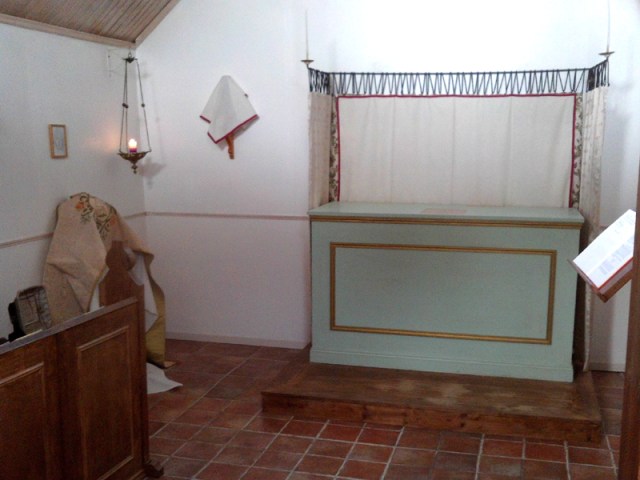
My Sepulchre is something of an improvisation, consisting of a small credence and the wooden urn I used to use for the Altar of Repose when I celebrated the Roman rite. It is covered with a humeral veil. The crucifix is laid on a cushion on the floor under the credence, and covered with a cloth to symbolise the burying.

Sorry to have forgotten to take the ugly gas heater out of the picture!

I wish all my readers an illuminating Transitus Domini and everything this Paschal Mystery can bring each and every one of you.

Posted in Uncategorized | Tagged , , , | 4 Comments

The Brain of God

What a provocative title! Surely God does not have a brain any more than he has hands or the other allegorical images we find in the Scripture! We are so used to the material / spiritual divide that we find it very difficult to comprehend the notion according to which there is no matter, only information or energy, what the ancient Greeks called λόγος or what St John called the Word, what modern science might call information or quanta of probabilities.

When I was a little boy, I read about atoms, long before going to science lessons at school. The science of that time saw them as being like little solar systems: a nucleus being orbited by electrons. I then compared our solar system with an atom, and then I wondered what was over the solar system, and then we can find photos from extremely powerful telescopes of galaxies – thousands of light years across. Then coming back to the atom, who lives on the electrons orbiting round their nuclei? Imagine how small the atoms must be that make up the beings that live on electrons!

Perhaps my childish musings were not so fanciful. I found this photo on Astronomers discover ‘BOSS Great Wall’: Billion-light-year-sized galaxy structure composed of superclusters.

galaxiesDoesn’t this remind you of something? All those things are connected. How about this?

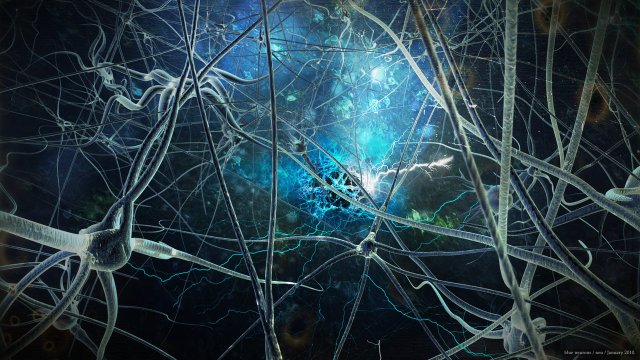
neuronsThat’s right! These are neurons and nerves in a human brain. I was bowled over by this idea of comparing the two. This structure in space is said to be a billion light years across (light speed is about the equivalent of seven times round the world in one second or the distance between the earth and the sun [93 million miles] in a few minutes). Just one light year is beyond our imagination. Perhaps, the BOSS Great Wall, as the astronomers call it, is just a small part of someone’s brain, not made of matter but the λόγος!

Faced with something of this magnitude, we can only be utterly humbled and brought both to our nothingness and our divinity (that image of divinity left within our fallen created beings). Perhaps there are tiny astronomers living on electrons in our bodies looking at the neurons in our brains and marvelling about the brain measuring a billion light years. The mind boggles…

Whatever our lack of scientific knowledge, these few ideas will certainly bring us to the most profound adoration, prayer and sense of wonder.

Posted in Uncategorized | Tagged , , | 3 Comments

Ritual Housework!

monks_sweepingI have seen that a few people have looked at my old site on washing the altars Washing of the Altar on Maundy Thursday.

This morning (yes I celebrated the Mass in Coena Domini this morning), I stripped and washed the high altar with the prescribed responsories and prayers. The altar stone got a good clean and dry with kitchen tissues. I’m not afraid to use modern materials, like the paintbrush I use to apply the wine and water all over the altar.

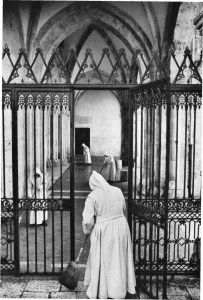
When I got to the Lady Altar, I hadn’t realised the extent to which it was filthy with dust and cobwebs. Before washing with wine and water, I needed to give the altar a real clean with a dustpan and brush. I was not far from taking off my red stole and alb! After the brush work and the washing with wine and water, which was a little more than “ritual”, my Lady Altar is now nice and clean and bare until the preparation for Holy Saturday.

There is an allegorical meaning for this altar washing, the connection with the crucified Christ being prepared for burial as in the old Jewish custom. The allegorical meaning is added to the original functional purpose for everything we do in the liturgy. Originally, it was simply the spring cleaning of the chapel. About a week ago, I had flung open the door and window, and gone through the entire chapel with a vacuum cleaner and cobweb brush – that was not a ceremony! What I didn’t see was the filth under the altar cloths. It just goes to show…

Spring brings vigour and energy, a hearty desire to turn off the heating and fling the windows open. Spring cleaning is something important for us all, and is itself a symbol of our spiritual renewal at Easter, reflecting the passage from Christ’s death to new life in the Resurrection. This afternoon, my wife and I are cleaning the house, and I have a visit to make to the local municipal rubbish dump to get rid of some old junk that doesn’t go with the normal dustbin collection.

I’m sure many other people are getting round to the same old chores. It shows the precious relationship between liturgy and life.

Posted in Uncategorized | Tagged , , , | Leave a comment

Keeping the Flag Flying

As a small diversion as Spy Wednesday is gone and Maundy Thursday dawns, I found a nice little video on Facebook about the strange exhibits at the recent Royal Yacht Association boat show.

The video is presented by Roger Barnes the leading dinghy cruising evangelist in England, seconded by David Sumner who gave me the most useful advice for my rig.

What is really striking is the difference between the racing boats and their associated equipment, marketed by the firms that produce them, for the sole purpose of “sailing round the cans” at regattas. Sailing costs money! Or does it?

The striking thing in this show was in the outer corridor, Avel Dro belonging to Roger Barnes and Curlew, a cruising Mirror belonging to David Sumner. Roger made the point that they were not there to sell anything, but rather to provoke curiosity in this alternative way of sailing small open boats for pleasure.

Sailing used to be called the sport of kings because of the sheer amount of money invested in the boat and all its equipment. Nothing comes free in life, but perhaps we cruisers can rely more on ingenuity than buying a new boat off the shelf. I call my Sarum the “tramp sailor”, because I don’t have an awful lot of money to spend on her. I make do and repair to the maximum and only buy bits of equipment when nothing else is possible. Sarum‘s  workmanlike scruffiness, with her battered fibreglass hull and custom rig, contrasted last year at the Semaine du Golfe with varnished wood and elegant hulls. This year, she has a new launching trolley, an improved road trailer and a better boom tent.

Many people were attracted to those two usual boats impregnated with the humanity of those men who work and sail on them. Curlew has been all the way round the Isle of Wight. The video brings a smile to the lips when we see the spirit of English initiative and grit!

This little Mirror is slightly smaller than mine, which was dwarfed at the Semaine du Golfe last May. Sarum has a white hull and a pale blue deck, just between the clinker-built hull and the two men tending a boat with a red hull.

semaine-golfe02Sailing on the open sea in such a small boat is an intrepid venture, and we have to be extremely prudent with the weather and tidal conditions.

I now look forward to my first time out on the sea this year, perhaps in early April after the spate of bad weather over the Easter weekend.

Posted in Uncategorized | Tagged | Leave a comment

Mit Brennender Sorge

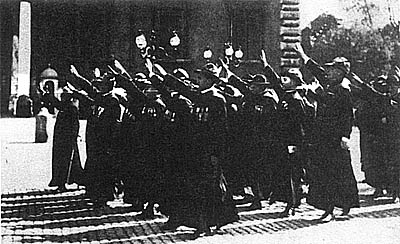
fascistMonday in Holy Week, 1937 … by Fr Hunwicke was brought to my attention by an e-mail from Dr Tighe, with the title Fr. Hunwicke “Gets Political”. I don’t see him getting political so much as rather being a little uncritical about the view put about by Roman Catholic conservatives and traditionalists that we have a choice between the euphemism of “the social kingship of Christ”, in reality the Papacy and its chosen two-bit dictators with Latino moustache, Havana cigar, snazzy uniforms, hundreds of medals and sunglasses – or the Nazi hell as reigned from 1933 until its defeat and the reconstruction of Germany.

Pius XI was the Pope of Christ the King, and one can have certain sympathies for this imagery expressed by the feast of the Epiphany and events like the Transfiguration. I do think that Christ can be seen carrying an allegorical meaning of the King, the anointed one who would lead through love and example rather than worldly power and bullying. We English treasure our Queen, who has reigned for a lot longer than I have been alive. She is a constitutional Monarch – and I think that fact makes her rule over us that much more spiritual and human through her personality.

The encyclical of Pius XI merits being read – Mit Brennender Sorge. Like Fr Hunwicke, I wish my German was better than it is, so I give it in English here. There are two fundamental themes, the evil of an ideology based on race hatred and the so-called Ubermensch – and the question of whether we are to be ruled by Hitler or Christ. A wrongly understood notion of Christ as a king has given rise to the cult-like situation in the Society of St Pius X. By reductio ad absurdam, the real Christian kind of rule would involve a ruthless dictator like Franco or Pinochet, and with rebels and protesters being arrested by the secret police, imprisoned and executed without trial.

How do we recover a more allegorical notion of this kingship? What did Christ himself say?

Pilate therefore said unto him, Art thou a king then? Jesus answered, Thou sayest that I am a king. To this end was I born, and for this cause came I into the world, that I should bear witness unto the truth. Every one that is of the truth heareth my voice.

He did not affirm Pilate’s question, but nor did he deny it. He turned the meaning towards the truth of his word and teaching rather than a temporal authority in competition against that of the Roman occupation and Herod. He who preached the Beatitudes and taught that the lowly of this world would be the first in the kingdom of heaven would not behave like Franco or Pinochet. The Βασιλεία τοῦ Θεοῦ is a concept that is totally different from the modern idea of monarchy or empire. I won’t go into the exegesis here, because others say it better than I, and there are loads of articles on the internet and books that go into the Greek words and the Hebrew from which they were translated.

This will certainly be a part of our meditation on the passion of Christ and the Paschal Mystery. The notion of “Christian totalitarianism” is pernicious and dangerous, and constantly opposed to the notion of secularism or laïcité, whether American style or French style. In theory, American secularism respects all religions when there is no trouble to public order (an atrocity or a riot for example). French laïcisme tends to affirm freedom from religion, encouraging citizens to be atheists. The document on religion freedom of Vatican II was written by an American, in an attempt to colour the post-war situation in Europe with the Pax Americana. Now, in its turn, the Pax Americana is becoming a new expression of aggressive war and crimes against peace.

Times have moved on again. Hitler and Nazism are dead. The American ideology of hegemony in the world is wearing thin, and I admire President Putin for standing up to it in the name of peace and respect of the sovereignty of countries like Syria. I believe in the notion of religious freedom, including the freedom not to believe, but this ideology needs reform and adaptation to the present world. French Jacobinism and its overflows into the five Republics also is dead, and the message of men like Hollande and Sarkozy is hollow and meaningless.

I am afraid for the future in spite of any number of exhortations not to fear, but I cannot see Christianity as having any relevance in a globalist dystopia. If there is anything political to do, it is to dismantle empires and nations, and return to a human level. I don’t know how that can be done, but the mega-society cannot continue. Christianity is made for little communities where people know each other and who are fundamentally guided by good in spite of temptations to sin. We need to drop the slogans and come up with something original and real.

Posted in Uncategorized | Tagged , , , | 5 Comments

Holy Week

Holy Week is upon us once again, and we get ready for long services in my little chapel. This morning for Palm Sunday I was on my own. I set up a lectern in the middle of the chapel for the Passion and some of the antiphons I sung for the procession. But, being on one’s tod is a little limiting.

The rubrics refer to the different parts of Salisbury Cathedral and there are two Gospels before the Mass. I blessed the palms, English style palm crosses, and carried one about with me as I walked to the ante-chapel and the lectern between the choir stalls. It had to be a little do-it-yourself, as I omitted many of the antiphons designed for accompanying the kind of procession one would imagine in the 1520’s at Salisbury. The four palms ended up in two small brass vases on the altar. I took off my red cope and donned my black chasuble with red orphreys (I really need a bull’s blood red chasuble with black orphreys – another year with my sewing machine). I read the Passion of St Matthew at the lectern, and returned to the altar for the “Gospel” part.

Maundy Thursday will be quite simple. I make the concession of using bright red vestments. The spirit of the Sarum Maundy Thursday Mass is totally different from the Roman in which the theme is the priesthood of Christ being transmitted to the Apostles and the institution of the Eucharist. It is a Passiontide Mass with a secondary Eucharistic theme. There is no procession at the end of Mass, nor is there an altar of repose. The second and third hosts simply go into the hanging pyx. The Easter Sepulchre is reserved for after the Mass of the Presanctified on Good Friday. The “deconsecrated” and empty church is not a feature of the Sarum Holy Week. The Easter Sepulchre remains in place throughout the Easter Vigil of Holy Saturday and is only taken down shortly before the Mass of Easter Sunday.

My experience with using Sarum, albeit reduced to being alone with at most a passive lay person in attendance, gives me a different perspective on the modern Roman Holy Week services. I do find it sad that many ceremonies had to be invented rather than being taken from medieval sources. We use red rather than violet and black vestments (my passion chasuble is a stopgap substitute), and there are only four Prophecies on Holy Saturday, like in the Dominican and French diocesan rites. Pius XII adopted the four Prophecies and Paul VI added a fifth. These are all very variable elements. There was good and not so good in all those reforms of the 1050’s and 60’s. One of the most eloquent criticisms of the 1950’s Holy Week services (Palm Sunday, Good Friday and Holy Saturday in particular) was The “Restored” Holy Week by Msgr Léon Gromier, Papal Master of Ceremonies during the Pontificate of Pius XII. He gave this talk in 1960. Since I published my own translation on the internet, others have appeared. I find Dr Geoffrey Hull’ work fascinating. The best known is his book The Banished Heart, which I believe is still available. When he visited my seminary in the early 1990’s, he gave out a few copies of The Proto-History of the Roman Liturgical Reform, which I have reproduced (and no one has objected). There is also the Notes on the reforms of 1964 and 1967 by a French Benedictine monk of the Abbey of Randol. The text was given to me by Fr Frank Quoëx at seminary, and I did a translation which you can read here.

Holy Week often goes too fast, and it is often a stressing time, either because the ceremonies need careful preparation, or because it is the full moon and people become irrational and moody. Of course, everyone knows that a full moon always occurs during Holy Week, since this spring moon determines the date of Easter. I anticipate having a lot of work to do and little time for prayer. The weather in northern France looks like turning bad for Holy Saturday and the entire Easter weekend. High winds and rain may preclude the New Fire outdoors. Plan B is a bunch of candles in my usual cast iron pot on a stand, and that gives a big flame with little smoke when it has to be indoors. The last time that solution was necessary was in 2008. Perhaps the outlook might change over the week.

Liturgical enthusiasts will be happy to know that I will be doing the Vigil on Holy Saturday morning. The reason is partly the annual general meeting of my sailing club at Veules les Roses. I do wish we could do this on a day other than Holy Saturday each year! So, O beata nox will be sung in the daylight. At least the weather will probably be gloomy and overcast!

I wish all my readers a blessed Holy Week, regardless of the rites they use, and may we all live the Transitus Domini that brings us from death to life as on the day of our Baptism.

* * *

One final note, thinking of death to life and the centenary of the worst year of World War I, let us add this piece by Sir Hubert Parry, composed in 1914, to our meditation. It is the Symphonic Poem From Death to Life. Try not to weep too much as you hear this piece in memory of the fallen and our faith in the Resurrection!

Posted in Uncategorized | Tagged , | 2 Comments

Herding cats…

We have been subjected for many years to the notion that uniting Continuing Anglican Churches and their “alphabet soup” is like herding cats, something impossible or futile. This would be the reason why many sought something more “mainstream” in Eastern Orthodoxy or the Roman Catholic Church (or staying with the Lambeth Communion), and scoffed at the remnants and shreds of continuing churches left by brawling bishops, sometimes of great girth, concerned for their bases of power and prestige.

It might have been like that some twenty years ago, but things have changed. Our ecclesial world seems to have sobered up and come to a sense of realism. We are small Churches and being in proportion with that fact – humble and modest – conveys that realism and seriousness to others. This is certainly the case with four Continuing leaders in the USA, our Metropolitan, Archbishop Mark Haverland of the Anglican Catholic Church together with Bishop Brian Marsh of the Anglican Church in America, Bishop Walter Grundorf of the Anglican Province of America and Bishop Paul Hewett of the Diocese of the Holy Cross.

The article in David Virtue’s site Continuing Anglican Leaders set 2017 as Goal for Full Communion is very encouraging. There will be many difficulties to sort out, like ACC clergy having left our Church under a cloud and having joined the TAC, and now expect to be treated as if nothing had happened. I am sure there is a case-by-case solution for most of those priests – just as long as there is some honesty, repentance for sinful attitudes and acts – and better resolutions for the future. There will certainly be many such canonical issues between Churches that like to do things properly and others where things are a little more sloppy. I am sure we can trust our bishops and archbishops to seek and agree solutions and overcome the difficulties.

For the time being, the goal is communicatio in sacris. We already seem to recognise each other’s Orders (nothing messed up by bishops being indirectly involved with women’s ordinations). That is a worthy goal. In England, matters are between Bishop Damien Mead and Bishop Gray of the TAC in England. Only later would there be any question of a full organic union, perhaps something like what the TAC was intended to be in the 1990’s. Our Archbishop and the Presiding Bishops would certainly like such an organic union to come about, but on a sound basis. That would take time to plan and organise.

Many have given up on the Continuum, which is understandable. Commenters on David Virtue’s site are often unkind and cynical, and of Evangelical churchmanship. Threads of comments often go off-topic and become occasions to blame Anglo-Catholicism for all the ills. We little priests and lay folk need to show support for our bishops and those who have been involved with the Continuum right from its beginnings in the 1970’s.

What is apparent from this article is that this will go in stages. Would the final goal be a “union” or “communion” like the TAC in the 1990’s but with lessons learned from errors and illusions?

Although there are different church cultures that exist among the signing bishops, there is no doubt that the commonality which exists far outweighs our differences.

There are the older questions of low church / high church, “old high church” against a culture that resembles Roman Catholicism before Vatican II but in English. There are different ways of organising things and applying laws. There are different rites within defined boundaries using the various local Prayer Books and the English and Anglican missals. There are also differences between cultures between the western world (the former British Empire), Africa, Asia and South America.

Unity and organic union would bring more institutional weight to bear and credibility in the face of our detractors and cynics. More people, presently impeded by “human respect”, would be inclined to join and support us – and then build up everything for which Churches have been responsible in the past.

There is a joy in return, joy in forgiveness and joy in reconciliation. Truly, this is an exciting and historic time to be in the Continuum.

I have felt this before in situations when many of us were led down the garden path. I believe that this time, things are more sober and serious. What is in the jar is what it says on the label. It is paramount to go from a position of truth to oneself and to others. In this, I have full confidence in our Bishops. May God bless this effort and tireless work!

* * *

A clarification: When discussing developments in America, I have sometimes been asked about the Anglican Province of Christ the King, not mentioned in this or an earlier article. This comment was sent by Fr Laurence K. Wells to the article in Virtue Online (there are some nasty and negative comments which are best ignored):

APCK is already in full communion with ACC. In spite of recent troubles, it is perfectly intact and thriving, as the two latest issues of Christus Rex show very well. To say it is in a mess, is almost malicious slander, David. It is mostly a regional body, separated from ACC/ACA/APA more by geography than anything else. If the XnEC [Christian Episcopal Church] is “hanging in the wind,” that is a self-chosen predicament.

Posted in Uncategorized | Tagged , , | 1 Comment

Ponerology

This is a term with which I have been familiar for a few years. The term is based on the Greek word πονηρός, an adjective which is also used substantively, meaning pain-ridden, and by extension evil. Those who use the term ponerology invariably mean the study of evil. Demonology is a discipline within the study of theology, and the mystery of evil has been the most profoundly studied by Russians like Dostoyevsky and Berdyaev to name just a couple.

I haven’t time to go into it completely, but I will attempt a brief summary. This topic has been provoked by the reflection of capital punishment, itself related to crime and human depravity. Jesus said plainly in the Gospels that we were to love our enemies, including people like Hitler, the SS guards at Auschwitz and the ghouls who would rape, murder and eat your children. But, what does that love mean? If evil is not stopped or at least resisted, it will become the kingdom of hell on earth. This has been seen in history from Nero, Vlad the Impaler, the Turkish Sultans, Pol Pot, Stalin, Hitler and so many others. We cannot come to a satisfactory conclusion about the question of killing tyrants and criminals so dangerous and horrible that they cannot be incarcerated in normal prisons. We really need to move on, and ask ourselves where all this evil comes from.

Heinous sin is obvious in genocide, military aggression, colonialism, the destruction of the environment, destroying the economy to make big money, and then on a smaller scale in child abuse, rape, bullying, manipulation, waste, neglect and so many other signs.

How can this be when all the people we know, or nearly all, are decent, hard-working, caring about other people, honest with money, generally virtuous whether or not they believe in God or the principles of a religion? Most of us dream of a better world, care about those we love and those who obviously need our help. Throughout history, good people have been unable to bring about lasting peace, justice and harmony.

Why do we get evil people? What makes them evil? I’m not talking about people who sin by weakness, but those who revel in the misery of others? I have written on Gnostic themes like the Archons, which more or less correspond with the Devil and demons in orthodox Christianity. There are more modern views too, which need to be critically studied.

Some Catholic moralists have ventured onto speculations about “structural sin”, which shows intuition, though such are often incomplete. It would seem that some environments and contexts are more conducive to people turning bad, though not all people from an identical context would turn out to be evil? Is there an intrinsic predisposition, fitting the nation of total depravity as found in Calvin’s interpretation of Saint Augustine’s theology? I personally am more convinced by the more Christian humanist notion that sees more good people than evil people, unlike the pessimism of the Jansenists and Puritans.

There is the old quote from Pastor Martin Niemöller (1892–1984):

First they came for the Socialists, and I did not speak out—
Because I was not a Socialist.

Then they came for the Trade Unionists, and I did not speak out—
Because I was not a Trade Unionist.

Then they came for the Jews, and I did not speak out—
Because I was not a Jew.

Then they came for me—and there was no one left to speak for me.

Our complicity with sin is usually one of omission. We tolerate evil, and then become complicit in it. This is what happened to the German people in the 1920’s and 30’s, and it can happen again. It is happening with the refugee crisis in Europe, the rise of the Right, Islamic jihadism and the continuing war in the Middle East. We do tend to deny what doesn’t immediately concern us. To what extent do we become responsible for this kind of evil?

Certain groups of people and institutions are strongly drawn to causing harm, destruction, cruelty and suffering in others.

The biggest and most soul-scouring question is to what extent can and should we prevent and resist evil, above all in the name of Christian love and “turning the other cheek”. This is surely the criterion by which Christianity is judged as too weak to be of any use in the “real” world. Strict Islam would seem to fit the bill better – but unfortunately that religion has shown itself not to be free from evil!

The struggle against evil seems futile and we make little progress in identifying the real issues. A most interesting theory is that of psychopathy, exactly like the ghouls who have usually ended their lives on the gallows or the electric chair. At an individual level some on the most impressive work has been done by the Canadian psychologist Robert D. Hare in his check-list of characteristics that define the psychopath, the sociopath and the malignant narcissist. Dr Hare is specialised in the study of criminals and the possibility of their rehabilitation.

He proceeded by studying factors containing sets of characteristics, the proportions of which would differ from person to person. Such characteristics would be for example: impulsiveness, aggression, Machiavellianism, persistent criminal behaviour, lack of empathy, shallowness, superficial charm, manipulativeness, etc.

Psychiatrists have found that psychopathic personality disorders cannot be cured and the person himself will not have the self-knowledge needed to recognise that there is a problem. When they commit criminal acts, the only way to deal with them is to keep them locked up or kill them (in countries that have capital punishment). Not all psychopaths are criminals and thus do not end up in the courts and prison. They are gifted leaders and are particularly suited to a highly competitive environment. They run businesses, banks and political parties ruthlessly. They are only called to book when they are overthrown, convicted for crimes against humanity, big-time tax fraud or whatever. The successful psychopath takes over a country, and the unsuccessful one goes to prison or quietly lives off the energy of other people, sucking their spiritual life blood like vampires.

Looking at it like this, we would seem to be faced with intrinsically evil people. We are brought to the Augustinian notion of total depravity. Because of original sin, fallen man cannot follow God, refrain from evil or accept salvation unless endowed with grace. There is no free will. In Augustinian and Calvinist teaching, this is the condition of all of us, and only a very small number (identified by their financial success, naturally) are the predestined Elect. God created man in the same way as a turtle lays a thousand eggs to produce three or four viable turtles. Perhaps a few percent are afflicted with total depravity like an equally small percent are mystics and saints, and the rest of us have our lives to work everything out with God’s help. Could this be so?

In practice, when a psychopath commits criminal acts, he is treated as one with moral and legal responsibility and free will. It would appear that the psychopath is not suffering from a mental illness, but is – evil.

Human society has evolved from families and tribes to nations and groups of nations living hierarchically in dense cities. Technology and science have evolved for the best and the worst. All that incites and encourages the competitive “alpha” man. The scope for destruction becomes greater with “mega-societies”. Fortunately, the same technology has strengthened our ability to unmask the shenanigans of the psychopaths by means of alternative news websites and to blow whistles on Big Brother. We might not be able to do much against corrupt businessmen and bankers, politicians who lie through their teeth and would like to start World War III for money – but we can blow their covers of deceit and secrecy, out them if we dare.

I don’t think that psychopathy accounts for everything. If psychopaths are humans, then they are at a disadvantage in terms of knowledge of God and salvation. I have read theories according to which they are not humans, but the offspring of reptilian beings – demons, archons or beings descended from the nephtalim who were beings from before the Flood recorded in the Book of Genesis and the holy books of most of the religions of the world. I find such an explanation à la David Icke difficult to swallow, but it would leave humans as fundamentally good though capable of sin and evil. Apart from evil deeds and the characteristics of a psychopath, how do we tell the difference? Is our intuitive judgement infallible? Another thing to consider is that it suffices to believe that so-and-so is not human – and therefore we don’t have to respect his life or human rights. Is that not how the Nazis got so many people to hate and kill Jews? That would be too easy.

An interesting study is on by the Polish psychiatrist Andrzej Łobaczewski, who wrote Political Ponerology: A Science on the Nature of Evil Adjusted for Political Purposes, (Grande Prairie: Red Pill Press, 2006). I have a copy of it, but it makes heavy and difficult reading.

His main preoccupation was psychopathy in politics, the so-called pathocracy, rule by the sick. He saw history as oscillating between “bad times” like Nazism from 1933 until its defeat in 1945 and “good times” like the 1950’s and 60’s until the energy crisis of the 1970’s. Similarly, there was the Belle Epoque from about 1890 until 1914, then there was World War I, the growth of totalitarianism (Nazism and Communism) and World War II, a period spanning over thirty years. However, the 1920’s were quite jolly, despite the fact that so many families had lost their young men in the trenches.

Perhaps this is what happened with Atlantis, the Roman Empire when they fell, as seems to be happening today with American hegemony in the world. If enough psychopaths and narcissists get into power in a country, that country becomes a totalitarian state and turns against the people by means of surveillance and violence. A kind of ‘anti-morality’ comes in together with a perversion of language and conceptual thought. The Orwellian dystopia illustrates how far things could go, at least in theory. From this comes the cult of the infallible leader who can never be wrong. Eventually, a pathocracy contains the seeds of its own destruction, and it collapses. This happened in the past and is happening now. However, the process is rarely “clean” and many innocent people suffer when the collapse does occur. One cycle closes and a new one begins.

This might serve as an explanation to all the cloak and dagger lying that goes on surrounding issues that touch on American hegemony in the Middle East and Eastern Europe. I am particularly horrified by the would-be resurgence of the Ottoman Empire in Turkey, the corrupt royal family in Saudi Arabia who are little more than a “successful” Daesh – with just about the same religious ideology and callousness. We are constantly lied to by by our ruling classes and politicians. What are they hiding? Yes, I know that this sounds like conspiracy theory thinking and paranoia. I now hear this way of thinking from my father who has always been a moderate English conservative who eschews all extremes and irrationality. Things are just not the same as years ago!

The fall of a pathocracy is always tragic, violent and destructive. We think of the defeat of the Nazis from June 1944 until the executions of most of the war criminals after the end of the Nuremburg Tribunal in October 1946. Many of the rats escaped to South America and the Communist bloc, but their rule was over. For the drama of their downfall, I recommend Der Untergang, the famous film that shows Hitler raging at the Generals, accusing them of betrayal and how he would drown them in their blood or hang them from meat-hooks with piano wire. People were committing suicide, like a scene from I Claudius and the fall of the Roman Empire. The kingdom divided against itself can but fall.

Pathocracy is like cancer in the human body. The disease goes too far and kills its host. The pathocrats become greedy and turn against each other. This stifles the system they promote and competence becomes subservient to cronyism and corruption. By 1944, it was said that Hitler was fighting for the Allies by making too many strategic errors to the exasperation of professional Army officers and strategists! When we see this, the end is not far away.

Finally the flesh rots away and the bones begin to show. The mask is off and citizens begin to react. The first of the heroes die like martyrs, and the popular movement gains momentum. The downfall and defeat of the Nazis cost countless lives and too many cultural treasures in Europe. Amazingly, the Soviet regime collapsed bloodlessly and without a war in 1989. This may happen with our European Union and the USA, leaving people to reorganise their lives is small communities. We can only pray that we be spared from a nuclear holocaust, now that Saudi Arabia has the Bomb.

We will never be through with evil in this world. It comes and goes, up and down throughout history. The important thing is that we ourselves should recognise the potential for evil within ourselves and “put on the armour of God”, that we may be able to withstand. Evil is a terrifying mystery that none of us will ever fully understand.

Posted in Uncategorized | Tagged | 11 Comments

Sail on the Seine

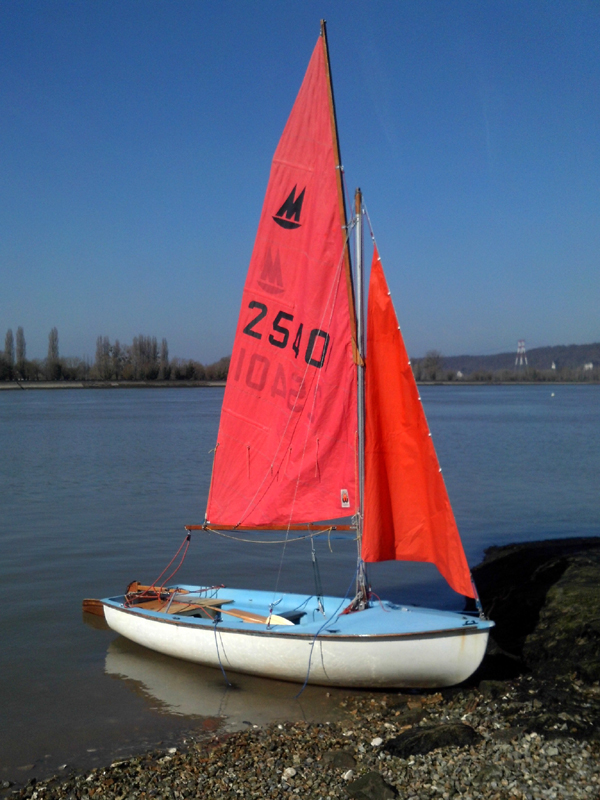
This was my first time out this year, and I have wanted for some time to try the tidal part of the Seine. I launched from the slipway next to the sailing club of Hénouville. The tide was going out, and I had little time for a sail, so it meant going out against the current to make sure I could get back in with the current. The Seine is not to be underestimated, especially the tidal part downstream from the lock of Poses, even though the present engineered banks of the great river have done away with Le Mascaret. Upstream from Poses, the Seine is controlled by locks and is slow flowing, and it meanders its way to Paris and beyond. It is still navigable to river barges. On the tidal stretch, there is the current (fluvial and tidal), so you need a good wind to beat it or an engine. Secondly, big ships sail up the Seine between Le Havre and Rouen. One needs to be careful and be ready to face the bow wave wash from the ship. Here I had just finished rigging Sarum.

seine_tidal01Today is a beautiful sunny day, but the north-east wind is still quite cold. I was OK with my wellies and my sailor’s vareuse over my life jacket.

Here’s my trusty Sarum, launched and ready to go.

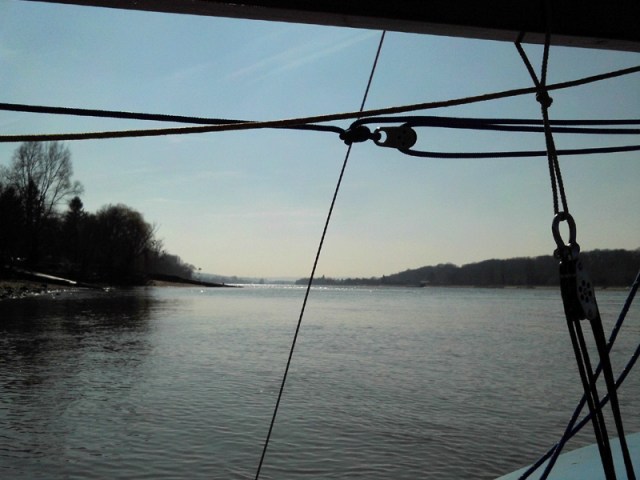
seine_tidal02Looking south in the direction of where I was going.

seine_tidal03One very big cargo ship, going slowly but still not to be underestimated.

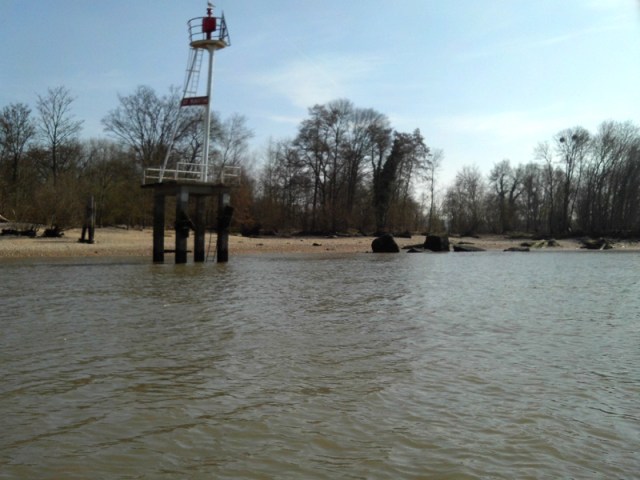
seine_tidal04One of the port channel buoys with a south cardinal marker. I don’t need much depth but the ships do.

seine_tidal05You can just about pick out the ship on its way to Le Havre.

seine_tidal06

Posted in Uncategorized | Tagged | Leave a comment