Facebook

I admit this posting is something of a meme, as it bears the same title as my old friend Patrick’s Facebook… I used to share his sentiments about this strange invention that made a very big fortune for the person who came up with the idea and had the technical expertise for it. For some people, it can be quite addictive. I am assuming that most of my readers have some experience with Facebook as regular or occasional users.

Addiction to Facebook would be of the psychological variety like compulsive gambling. For some people, it can be a means of trying to remake your life, live in the past, rehash things that have to be left in the past. Facebook can lull us into a false sense of security – but we never know who is reading what we say, whether on Facebook or on a blog.

It can be very tiresome when you receive e-mails about being tagged, poked and I don’t know what else. I get hundreds of requests for “friendship”, among which there are a few coming from spammers and scammers. It is all very bewildering. However, I found it useful to seek out people I knew years ago and lost touch with. A friendship (I mean a real one in real life) that has gone cold can take a lot of reviving. OK, that is the social side.

I find the group feature interesting, and I have set up one called Use of Sarum. I also occasionally post to Medieval Catholicism and Culture. For those who share my interest in sailing, there is Dinghy Cruising Association, which is highly active and entertaining. I find these groups more interesting than the old Yahoo Groups e-mail lists – more graphic and colourful, with all comments to postings available for all to read. This is a feature of Facebook that is positive.

When you open Facebook and have an account, you find a page showing the postings of all your “friends”. Some are extremely active and maintain a presence, like a cleric being on his virtual pastoral round. My Bishop likes a light-hearted approach and banter. As he explained to me, it keeps up the contacts with people he does know and minister to in real life. Another cleric whose postings featured in a posting I wrote a few days ago on this blog is concerned for humanitarian causes and the combat against indifference and the uncaring attitude of many people in the materialist west. In such a context, I found the video with the “box of dolls” and the grieving man holding his dead child presumably killed in Syria by Daesh. There are some who like to entertain us with extreme sports or feats of modern technology. It can go on for ever and we can end up spending too much time before switching to another site or doing something other than being in front of the computer.

Another option is to look at the top of the page and restrict ourselves to notifications of who has “liked” or commented on something we have posted or written. This also covers our activities on the groups feature, like my Sarum group and someone’s else’s Medieval Catholicism and Culture group. The latter has implemented a rule to prevent the group from being bogged down by contemporary Catholicism issues such as traditionalist vs. liberal or “true church” apologetics from the addicts to such issues.

Use of the internet, whether Facebook, blogs or fixed sites, takes critical out-of-the-box thinking and being oneself, not trying to be clever or setting out to impress. If we have something to contribute to discussion, then we have our opportunity. Other people might be critical or violently disagree. There are always our spooky troll friends out there somewhere with false names, invalid e-mail addresses and URL addresses that can’t be traced because they have special technology for that. If you fly in enemy territory, expect flak!

I have mixed feelings about Facebook, but I think I would lose out if I stopped using it completely within its limits as a “virtual pub” or place where special interests can be discussed. It can be quite stimulating, as it can, be frustrating and show the worst of sinful human nature. It has its place like the more serious blog and our quiet websites – equivalent to books on library shelves.

In the end, who is in charge, man or the machine? There are many negative aspects and we have to come to terms with them. The first thing to remember is that on the opening page, 99% of it is complete drivel. Trivia can be addictive, but it gets us nowhere in life. It is best to go on Facebook for a reason, the precise things that interest us, and never mind the rest. I was caught out the other day looking at trivia, where I found the “box of dolls” video.

Another thing to remember is that our “friends” are not friends, except the few we might know in real life. The internet is incapable of conveying emotions or body language. It makes us all “aspies” but socially and emotionally blinder than those with varying degrees on the autism spectrum. That is why people are so literalist on the internet – <sarcasm> great for discussing religion! </sarcasm>.

We do need to ask ourselves about what we like doing away from our computers. My main three are my priestly life, music and sailing. With a bit of effort, I do maintenance work on the house and what’s necessary in the garden. Then we have two young dogs to walk and work on their obedience training. That’s not too bad. Then of course, my work as a translator keeps me hooked to the computer.

Some people do well to give up Facebook completely. An alternative is to use it very selectively and as a tool. Are we self-critical enough? Good question. I don’t change my image very much, and stability is something as important as the mast-head on a blog. Facebook is a place to be more light-hearted and shallow than on a blog, but we do need to watch what we are saying for our own good. Don’t expose your intimate self!

I don’t send invitations, and I very rarely request a “friendship”. Many people have to wait a long time before being accepted by me, and many don’t make it because I cannot ascertain why they would want to “be my friend”. There are often no interests in common, and some profiles look suspicious, especially when they don’t use their real name. Too many friends make for a horribly long opening page with horrible videos and trivia.

Above all, know how the system is designed to work, and don’t let it manipulate you. Above all, have a real social life and enjoy doing things away from the computer.

Posted in Uncategorized | Tagged , , | 5 Comments

Synod 2016

I have just returned from England where I was this weekend for our Diocesan Synod.

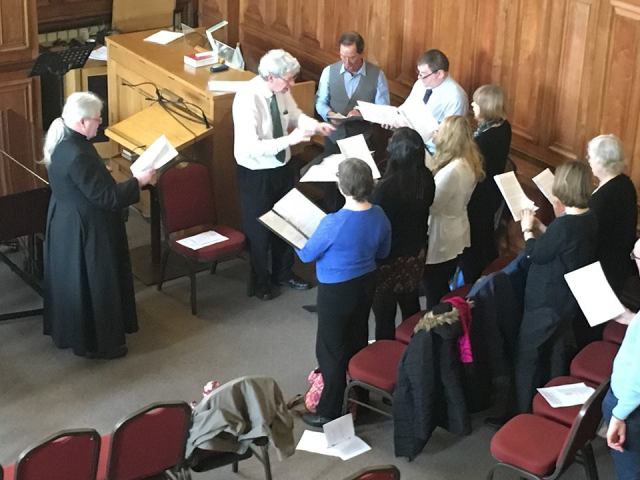
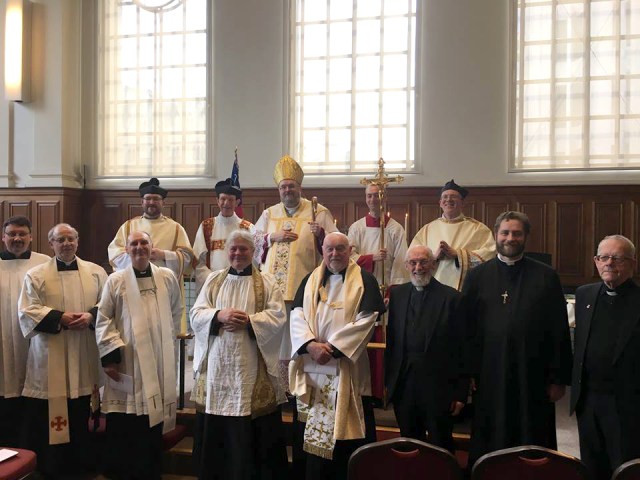
We began with Mass celebrated at Central Hall in Westminster by our Bishop. During this ceremony, he ordained Revd Roger Bell to the diaconate to serve in Bolton. At the Mass and the Synod meeting all the currently licensed clergy were present. The following photos are copied from various postings of our clergy and Bishop on Facebook.

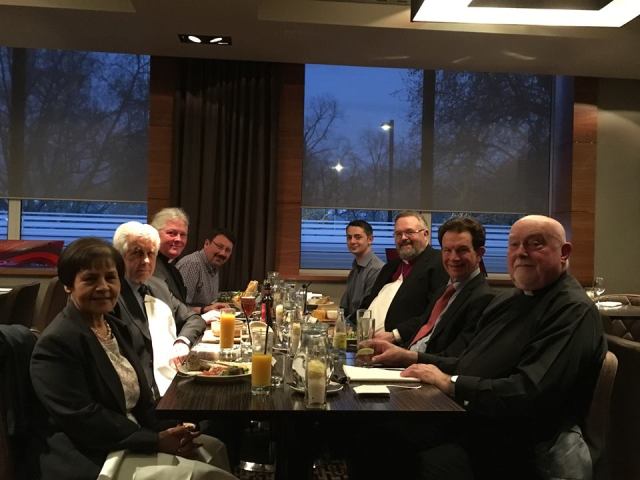
mealHere are a few of us at table on the evening before the Synod. This dinner has become a custom for those of us who stay Friday night in London.

choir-rehearsalI had no liturgical role at the Mass, so I lent my voice to the choir which sang the proper of the Mass of Our Lady in polyphony and a nice Latin Tantum Ergo (unknown composer). This photo is of the rehearsal before Mass.

This is a recording of the Tantum Ergo sung during the rehearsal.

clergy

Clergy of the Diocese of the UK in the Anglican Catholic Church, with our new deacon to the Bishop’s right.

Posted in Uncategorized | Tagged , | 3 Comments

The Slaughter of the Innocents

The scourge of abortion is bad enough, but I went onto Facebook a few minutes ago. All of a sudden, I saw a large and shallow wooden box with what appeared to be dolls. They were not dolls but real human children killed by Daesh in Syria. I still have the tears in my eyes as I write this and a feeling of anguish. After seeing the dead children in the box, we were shown a man, presumably a father of a family with a dead child and a living one with him. I just saw the images. I’m glad I didn’t turn on the sound.

I left the following comment:

I don’t know about the origin of this video, but it is so heart-rending and crucifying to watch. Out of respect for those children, the video is just too much, at least for me. It popped out of Facebook as I popped in for a look. It’s too hard. I hope and pray the last man of Deash gets taken out and shot, that we can be rid of this abscess of humanity. That video has torn me to the depths and I can do nothing about the situation in Syria. I think it is better not to show such videos. Just inform us that the rats are killing children and that the war against them has to be won. Pray for us all who grieve – the parents and families, and yet the rest of decent humanity.

Now we know what happens when people put explicit videos on Facebook. It is not a mere antidote to apathy and indifference, but an exploitation of human beings with an ounce of empathy.

Perhaps I will make a suggestion, since I am too old and not fit enough to join the Syrian Army. It is altogether possible to put up a site on the subject of children, persecution of Christians, the fact that the jihadists are as bad as the SS and the Gestapo who went into French villages, killing every last man, woman and child in the name of reprisals against Résistance activity. Links to videos, even gruesome ones, could be given but with appropriate warnings, so that we can be ready for them. Having such videos pop up on the Facebook main page is too hard, and may be counterproductive.

I’m not being dramatic, and I have seen my fair share of Rambo and James Bond films. My curiosity was drawn to what appeared to be a box of dolls. Why show a box of dolls? Then I found out why. I was completely unprepared!

Then what can we do? Fine, dispel ignorance and educate people about what is going on over there. The war isn’t yet won, because the head-choppers are heading towards Jordan and the Golan Heights. Let them take on Israel, which has a good army – and nukes! When we see too much of what we are not prepared for, then we react in a way that is historically dangerous – vote for extreme right-wing politics. Mainstream politics don’t convince me either, and just at this moment, I am ashamed to be English. We live in a world where politics are a heap of lies and deception. Perhaps the jackboot would be better than the Caliphate and endless terrorism, but better still would be the love of Christ.

My grief turns to anger, and then to understanding how different people think and react. Only Russia was prepared to help the legitimate government voted in by the Syrian people. Other “democratic” countries want to split Syria up into warring sects of fanatical Muslims – for oil, for petrodollars, for grimy money. Those involved in this filthy intrigue also deserve to be taken out and shot once their crimes against humanity are known to the world.

I am tempted to pray for the Parousia, for the end of the world. Perhaps we can wish for such if we are willing to be the first to die. No prepping, no “bug-out” bags, just the reality of what we seem to deserve. Is that really what we want? Do we want to see the deaths of more innocents, humans and animals and the beauty of nature? If we are here at all, is it not for a purpose, to put good in the place of evil.

The person who put up the video wrote a comment in response to mine. Wilberforce also used graphic methods in his combat against slavery. Is it acceptable to put up videos that will wrench our hearts out or make us harder and more indifferent and uncaring than ever? We are seeing more and more videos of young men having their heads cut off with a knife, stamped on, shot repeatedly with high-speed bullets. On Youtube, you can find films of real executions, and salve your conscience by saying that they are guilty men getting the recompense for their crimes. Before we know it, these images of real death will affect us no more than James Bond killing the Hitler-like monster about to destroy the world. We should be extremely reserved with this kind of thing.

Like the old cat o’ nine tails in the British Navy, this kind of treatment breaks a good man’s heart and makes a bad man even worse.

By all means, set up a site. Find out what is going on in countries like Syria and Irak. Write out a credible description of the war with Deash and the involvement of the western world. Give links to documents, photos and videos. Deal with the real problems and give us ideas of what we can do: add to the killing, look after the victims of war, raise money to help the Syrian nation rebuild itself and take back its exiled children. Then something positive might come out of it all.

We can at least pray for those people, still trapped in the hell-holes or in places like Turkey or the Greek Islands, or already discovering that there is no gold in El Dorado

Posted in Uncategorized | Tagged , , , | 12 Comments

Bootleg Liturgy under Prohibition

I couldn’t resist the temptation, since I have been offering reflections on drugs, addiction and prohibition. I can almost imaging the cops in some American village descending on a church and demanding to see what books are on the altar during Holy Week, tasing the priest or clobbering him over the head or even shooting him dead – and beating up the servants before carrying them off to jail!

A little closer to reality, Rorate Caeli put up an article about the use of the pre-Pius XII Holy Week rites in the Roman rite, and very quickly took it down. This article Maybe the Liturgical Extremists Have a Point? has given a link to a cached version: Holy Week notes – On the tiny (but growing) number of TLM locations celebrating the pre-1956 Holy Week.

This is embarrassing evidence that the older rites are favoured by some of those who are not ideologically motivated like the sedevacantists. Even for those who are theologically and politically “moderate”, objections to the modifications to the Roman liturgy under Pius XII and John XXIII are comparable with those criticising the Novus Ordo of 1969. This was a tendency I found at Gricigliano in the early 1990’s, and Fr Quoëx (our MC) managed to tweak things as best as possible within the limits of tolerance from the superiors and Rome.

Somebody got very cold feet over this article, probably after some nasty e-mail from a bully. Just imagine trying to revive Sarum in the Roman Catholic Church! The last one who tried it in the 1990’s got reported to Rome by some little prig with a gripe, and had to stop. It is not my intention to provoke polemics or attack personalities.

Perhaps the issue of the liturgy is of no importance and we could all be like the Quakers or American mega-church evangelists.

There are and always have been differences between rites and uses, and getting steamed up about the details of one of them can seem un-Christian. On the other hand, liturgical rites have their history and sometimes an obscure rationale, which is destroyed by rationally-based modifications and reforms. The Holy Week rites are witnesses of the oldest liturgical forms in the history of the church, predating much of the knowledge we have from books and other archaeological sources. Destroying them is like building a car park over an archaeological site. Car parks are useful for those who need to park cars, but man also needs his collective memory of the distant past and a sense of continuity in a tradition.

This seems to be a valid reason for conservatism in liturgy even if it celebrated in the language of the people as we Anglicans do.

Posted in Uncategorized | Tagged , | 6 Comments

Annunciation

We are at sixes and sevens this year, because the feast of the Annunciation was trumped by Good Friday. When that happens, by Holy Week or the Easter Octave, the Annunciation is transferred to the first available day after the Easter Octave.

In the Roman rite and our ACC calendar, it was two days ago, Tuesday 5th April. In the Use of Sarum, we had St Richard, Bishop and Confessor on Sunday 3rd, but who was trumped by the first Sunday after Easter. His first available day was Tuesday 5th April. My Sarum Kalendar 2016, compiled by Dr William Renwick, gives today as the day for the Annunciation.

Everything comes to he who waits…. Be it done to me according to thy Word.

Posted in Uncategorized | Tagged , , , | 6 Comments

Shape-shifting Jesus?

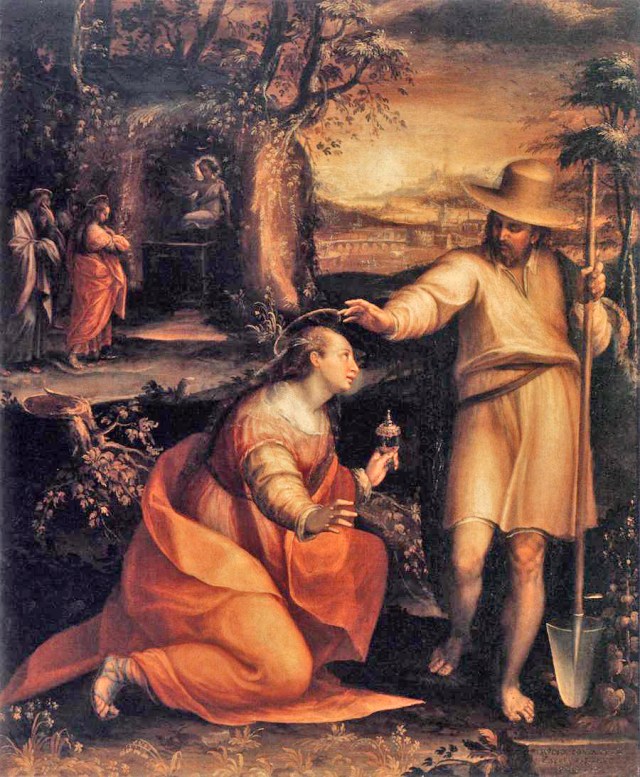
noli-me-tangereThis title may seem provocative or even blasphemous, but reading the Gospel this morning (Quasimodo Wednesday in the Use of Sarum) troubled me profoundly. The passage in question (Mark 16) contains:

Now when Jesus was risen early the first day of the week, he appeared first to Mary Magdalene, out of whom he had cast seven devils. And she went and told them that had been with him, as they mourned and wept. And they, when they had heard that he was alive, and had been seen of her, believed not. After that he appeared in another form unto two of them, as they walked, and went into the country. And they went and told it unto the residue: neither believed they them.

People like David Icke often go on about humans who are in reality reptiles and “shape-shift” between their “natural” state and the human appearance. That association came into my mind as I was about to begin the Offertory. I paused, remained at the altar with “Lord, I believe, help thou my unbelief” like St Thomas whose being faced with the evidence was related last Sunday. I dismissed the “reptile” idea and concentrated on the idea of mystery, and what a resurrected body might be. I can’t dismiss what I don’t understand, but I have to keep an open mind. Many others must have faced the same problem of common sense logic and exegesis.

My studies in theology never prepared me for this. The Gnostics had their ideas, as had the Docetists so contested and refuted by St John. There were so many differences in the early Church about the incarnation and resurrection of Christ. The Ecumenical Councils would bring clarity about the consensus of the Fathers and a right interpretation of Scripture. Our New Testament classes went into general principles and what was known of the history of the texts, but we did not often go into great detail. That is the job of a student researching his own work. That is what university is all about. They give the keys – you go to the library and do the work!

There are any number of apologetics sites attempting to answer the question of why people like St Mary Magdalene failed to recognise Jesus after the Resurrection. On the road to Emmaus, Cleopas and the other disciple didn’t recognise him either. He could be recognised when he did the “right” things like breaking bread or in the case of St Thomas by showing the crucifixion wounds.

We find the notion of eyes being bound and opened. This happened to St Paul as he fell off his horse and the scales fell away when he was brought to the place of his baptism. People had such poor eyesight that they could not recognise Jesus whom they had seen preach and do miracles. Perhaps… Alternatively, Jesus could change appearance or “shape-shift”. Why would he do that?

In Luke 24 he simply disappeared. How did Jesus vanish from the sight of his disciples?, On the Gospel for the 3rd Sunday of Easter is very interesting and from a Catholic point of view rather than that of the slick American evangelicals. The article refers to the difficulties I faced today and on others days since Easter.

On reading this article, another thing comes into mind which I have already discussed on this blog: quantum mechanics and the non-existence of matter. What is at stake in the Resurrection narrative was not whether Jesus’ resurrected body was material, any more than anything in the holographic universe. We begin to approach the Gnostic notion of resurrection, not being simply the undoing of physical death, a dead person returning to his former state as what we know as a living person. The resurrected body passes through closed doors, changes appearance, appears and disappears, but yet relates to objects that we consider as material like fish, bread, wine and everything related by the New Testament. In theology, we talk of a glorified or spiritualised body which is no longer subject to the laws governing the bodies that we know in our experience.

This brings about a revolution in our thinking. What is spirit and what is matter? They are both the same thing. The basic unit, according to quantum physicists is not the atom, but the quantum particle of probability. I will leave the reader to try to understand a subject about which I myself know very little and find confusing. We live in a universe that looks “real” enough to us but which is like a hologram. Normally, we only experience our own “frequency”, but exceptionally we see other existence “through a glass darkly”. Perhaps Jesus was in another universe and could appear in our life sporadically and in different “forms”. It sounds fantastic, but I find the idea plausible.

* * * Materialism sucks! * * *

The article to which I linked above brings up some quotes, which I would interpret as saying that Christ could not be perceived through the ordinary senses. One had to be spiritually disposed: able to experience something other than the ordinary existence we experience from day to day. Christ would have appeared in different forms according to the spiritual dispositions of the observer. We might today define these differences in terms of altered states of consciousness like the example of St Bernadette of Lourdes seeing a figure that identified itself as the Blessed Virgin Mary and hearing messages in comprehensible language – among many other examples of mystic experiences.

St Thomas Aquinas obviously had no idea of quantum physics, but we have to admit that he was talking of no ordinary human body! If we deny matter in the way it has been understood by Greek philosophy, medieval theology and Newtonian physics, then everything is spirit or consciousness, particles of probability given form by the Word or λόγος. The problem is no longer one of knowing whether Christ’s resurrected body is physical and material or not.

The question of moving from one universe to another is a subject of speculation, science fiction and real science. I have mentioned the case of a schizophrenic. A psychiatrist would make a diagnosis and prescribe a drug to close down the symptoms, thus restoring “normality”. The voices or “psychotic” visions could be real but from another “frequency” if we use the analogy of radio waves or visible light. The idea of the afterlife is not being bound by our bodies to our present world, but our consciousness or spirit being released to experience the other multiverses or whatever would be appropriate to call them. One big question would be whether we become disincarnate at death, or whether we carry the “higher” (astral) body with us as we left the “lower” one to corrupt in the earth, fire or whatever. However, in the case of Christ, no body of any kind was left in the tomb or anywhere else. That body was resurrected with any other kind of body and changed.

What about Lazarus? He was resurrected but died a second time later and left his remains somewhere on earth.

There is something else to be considered: the apparitions of Mary and the other saints to which I have alluded, but not only. There is the phenomenon of the materialised ectoplasm. In certain conditions, the consciousness of a deceased person, through the offices of a medium, can appear in visible form and be heard by the sitters in the room via a “trumpet”. Sometimes, the apparition can influence objects, for example by moving them. Some of these séances can be faked by fraudulent means, but others have been strictly controlled so as to avoid such “natural” explanations. I am as grateful to read about such research as I am about the progress of science beyond materialism.

Is the notion of “glorified body” an échappatoire? With these notions, I don’t think so once we escape from Newtonian physics and materialism. With a search on Google for “quantum glorified body”, we find any number of speculations and ideas we can all find of great interest.

This morning, it was my materialist instinct that made me doubt and have a sad time saying Mass, but I was provoked into asking the question and seeking some answers. We all need some kind of support and help from time to time.

Posted in Uncategorized | Tagged , , , , | 9 Comments

Use of Sarum on Facebook

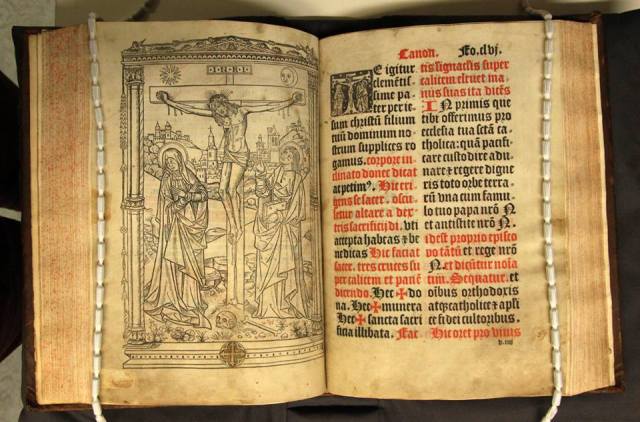
sarum-missal_bIt was a while ago since I set up the Use of Sarum group on Facebook. It gathered momentum fairly quickly and now it has 346 members including Dr William Renwick who is a university professor in Canada (music) and Fr Allan Barton, an Anglican university chaplain in Wales. I expected the group to become inactive fairly rapidly, and I have not had much time to tend it. We get amazing photos of old liturgical books and loads of leads to books and sources of the Sarum liturgy.

This thrilled me as I discovered it only today: the Sarum Customary Online. This project is under the direction of John Harper, research professor in music and liturgy at Bangor University. He was once Director of The Royal School of Church Music. It is really heartening to find people of this calibre showing interest in the Use of Sarum. For the amount of work he has obviously put into it, I hardly imagine that it is of academic interest only!

I have no pretension of being of any importance in the movement for the Use of Sarum and its revival, but I seem to have provided a viable meeting place for ongoing discussions and sharing of material. I am just happy to be a little priest who celebrates according to this Use without having done the research and editing work of these three intellectual heavyweights.

Deo gratias!

Posted in Uncategorized | Tagged , | 2 Comments

More on Addiction

Updating my article of a few days ago on drugs, I have just discovered this amazing article Dr. Gabor Maté on the Stress-Disease Connection, Addiction and the Destruction of American Childhood. We read some extraordinary insights into the psychology of addiction to drugs and compulsive behaviours. This examination of the problem perfectly complements the article to which I linked in my earlier article. Most thought provoking.

Posted in Uncategorized | Tagged , , | Leave a comment

A little more about Archbishop Lefebvre

I was recently given the link to this video by a correspondent who was once a seminarian at Ecône and knew Archbishop Lefebvre rather well. This video is intended as a reply to a polemical book against sedevacantism, theory represented by Fr Cekada and others. The book in question had been recommended by the present leaders of the Society of St Pius X. The video contends that Archbishop Lefebvre was in himself open to the possibility of the sedevacantist theory, something at variance with the official line or alternative positions the Archbishop adopted for diplomatic or pragmatic reasons.

The reason why I add a post on this subject is to try to find a balanced view over a situation of deep conflict in an ecclesiastical organisation, and how it can serve as an analogy for understanding difficulties closer to home for Anglicans in an analogous situation. Perhaps the Archbishop should have adopted a firm position as a soft-liner (negotiate with Rome to get canonical status as a religious order of priests) or a hard-liner (denounce the “errors” of modern Rome and remain separate for as long as Rome does not return to “orthodoxy”). Had he done that, he would have lost half of his men, and would have to justify that policy of narrowing down rather than a “comprehensive” approach. In the end, there were three “tendencies”: the two mentioned above plus what I might call the “clones” or uncritical supporters of the person of Archbishop Lefebvre who would go along with anything, even if it changed into its opposite.

I saw the same kind of malaise, expressed differently, at the seminary of Gricigliano. I was there during the more easy-going foundation phase, and was gone before the real silliness (canons, blue tat, etc.) set in. In the SSPX, the differences were deeper, ideological and very much connected with powerful persons.

There is one thing I have sought to understand over the years: human nature itself and how malignant narcissists can take something over for their own ends and poison the well from top to bottom. The reign of terror sets in and the purges begin of any independently-minded person involved in the corporation. It happens in politics, business, banking – and the Church, in any hierarchical human institution with a chain of command. It is not necessarily the leader (in this case Archbishop Lefebvre) who is the malignant narcissist but the men seconding him, advising him and exercising power over the lower ranks of the hierarchy. This is the story also of the Roman Curia, where a pope is not necessarily badly intentioned but gives way to pressure from below. This is the true reason behind the abdication of Benedict XVI, a man who had decades of experience of the Roman Curia and who thought that it could be guided by kindness and a pastoral hand. Now the leader is a devious Jesuit (no one really can understand his true agenda), and we now observe the lines of division.

What emerges is an Archbishop Lefebvre who reacted like any Roman Catholic churchman in episcopal orders in history: reconcile conflict and seek to promote peace and unity. He had to be seen to be decisive and carry authority, but against his own desire to tolerate divergences such as existed between the hard-line and the soft-line. His advisers and heads of districts of the Society did not share this generous tolerance and institutional considerations came second to doctrines and principles. Perhaps there is rectitude in this kind of intolerance of weakness and perceived falsehood. The problem is that intolerance breeds intolerance, the “mark of Cain” and man’s murderous instinct.

Over the years, I have seen the interaction of the “alpha male“, the man who leads, is assertive and competitive, and the “beta male” who is either a cog in the machine or has no place in the competitive power struggle. There seem to be alpha males who are true leaders and are guided by conscience and sound moral values, and then there are the bullies and criminals, men without conscience or remorse for wrong deeds, but yet use the priesthood (or rather the clerical status) as a tool for their personal agendas. It is a human problem, the corruption of human nature and sin, the genesis of the “pathocracy“. Ecclesiastical entities (societies, institutes, dioceses, etc.) can quickly become pathocracies in the wrong hands.

I don’t think Archbishop Lefebvre was evil, but he was the “constitutional monarch” of a number of ruthless men who struggled for their agendas. He was weak and easily manipulated.

We have had troubles of this kind in the Continuing Anglican movement, as attested by Douglas Bess in his book Divided we Stand. The experience I lived through in the TAC was almost identical to that of the SSPX. The question was our Anglican identity (albeit Anglo-Catholic) against the conviction according to which Continuing Anglicanism was a failed experiment, and that the only way was to seek uniate status with Rome, or simply convert as individuals to the traditionalists or the parish and diocesan system. We Continuing Anglicans are also “sedevacantists” in a way, though our intellectual way of explaining things is different. We do not recognise the authority of the Lambeth Conference or the Archbishop of Canterbury. We have set up independent Churches and we have our own hierarchy. The SSPX did not dare to establish itself as a sui juris Church! We even went further with the consequences! The dividing lines are exactly analogous.

Archbishop Hepworth had hopes of being “let off the hook” for being a former Roman Catholic priest and then divorced and remarried. Some of the mandarins of Ecône might have dreamt of promotions and honours from the Pope – a bit of purple trim on the cassock, a mitre or even a Cardinal’s hat. Archbishop Lefebvre had his men. I followed Archbishop Hepworth too uncritically, but yet formulated the intention within my own mind not to make any personal application to Rome. I would be a part of the TAC or there was no deal for me. The TAC had a “hard-line” minority that is now getting on very well with the ACC (which I joined in April 2013) and the other Continuing Churches that had nothing to do with the events leading up to the establishment of the Ordinariates. I too was not very constant, because I was influenced by others and could not see the “big picture” clearly. We cannot judge others from the point of view of retrospect! Archbishop Hepworth always denied that he was doing the same thing as Archbishop Lefebvre in seeking uniate status, but Archbishop Lefebvre was “cleaner” as a person, and went ahead with the means of guaranteeing the future of his Society beyond his own lifetime – by consecrating bishops. The TAC never (in anything other than appearance) had the hierarchical structure of the SSPX, financial resources or seminaries. A lot more was at stake in the SSPX, because its numbers of clergy and laity could be verified.

There are many parallels also with the foundering ACC in the late 1990’s due to bishops seeking their own agendas in competition against other bishops. Fortunately, though a considerable amount of damage was caused to the ACC and the credibility of the entire bowl of “alphabet soup”, the bad elements left and a new core of conscientious men has been able to build something small, but worthwhile, wholesome and stable. I keep an eye on John Bruce’s blog, in spite of his calling me a “crank”. It describes problems that still simmer under the surface (even if the description may be exaggerated or distorted), and of the problem of “churches” (I will not name any) established for the sake of individuals who wanted to be bishops for some reason known to themselves.

This kind of conflict is endemic to human nature, even among persons who have received Christian sacraments and profess the way of Christ. It is human sin. Unchecked, a religious entity can become a pathocracy and oppose its very purpose. This is the consequence of over-institutionalisation. Some might dream of being “mainstream” clergy, but the pathocracy manifests itself again, albeit in a different way. The demon is weakened when thought comes from persons thinking for themselves and not “groupthink” as Orwell might have put it. Anything worthwhile in the way of art, literature and philosophy comes from individual persons – or the Saints in the history of the Church. Hierarchies, especially those run by bullies and sociopaths, bring out the worst of human nature.

The reaction from pathocracy, when it isn’t violent revolution and bloodshed, is anarchy – which also can be corrupted and turned into terrorism. I believe that the real solution is small communities in which we know each other and have forged friendships. Anything bigger becomes a bureaucracy, in which individual responsibility and moral rectitude and covered up by anonymity – and then becomes pathocracy until it cannibalises itself. Then the cycle begins again.

I do believe that our Bishops should be very careful in the unity movement and their noble initiatives to reconcile past conflicts that have no further meaning now. I believe that Christianity survived not through forced unity with political and coercive power, but through tolerance of diversity, the unity being at a spiritual and sacramental level. I want to be able to trust my Metropolitan, Archbishop Haverland, and my Diocesan Ordinary, Bishop Damien Mead. It is because of them that I am a priest in a Church, and not a severed branch rotting away. I am optimistic that my Church has learned from her own suffering and that of other ecclesial entities with and outside Anglicanism. I try to be an obedient son of my Church, but yet one who thinks for myself. I am prepared to lay aside my priesthood if my Church becomes corrupt and I find myself again orphaned. I don’t believe it will happen, and I pray that God will continue to fill us all with his grace, light and love.

We should not dwell too much on these negative stains and betrayal of the spirit of Christ, but we must learn in order to move on to more radiant and beautiful things in our present and future. I would like no longer to read about the alleged wickedness of individuals, even of Archbishop Hepworth, but to challenge bad ideologies and everything that impedes our progress towards forgiveness, light and grace.

Posted in Uncategorized | Tagged , , , , , | 4 Comments

Classical Catholicism

In the wake of recent reflections about the Roman Catholic traditionalist world, I am brought to offer a few reflections from my point of view as it developed over the years since I left the Institute of Christ the King and the RC Church.

As I pointed out in my recent posting Fraud or Illusion? and the comments following it, the problem with which the traditionalist groups (including the Society of St Pius X) are fraught is one of ecclesiology. It is a problem that goes back to the time of the Avignon schism and the Council of Constance that proclaimed that the Episcopal authority of the Church was vested in the Episcopate, the Ecumenical Council, and that the Pope was subject to this authority. A recurring contention of the traditionalists, especially in regard to Paul VI in the 1970’s, was that Tradition was a higher principle than arbitrary Papal authority to change the liturgical rites or replace them with new creations or express ideas or teachings close to heresy. This was the greatest intuition of men like Archbishop Lefebvre, Cardinal Siri and a larger number of isolated parish priests who soldiered on with great resilience and courage. This is the positive side of that movement. The SSPX disappointed many as its idealism gave way to institutionalism and pragmatism, around 1983 when the “hard line” was sacrificed in favour of dialogue with Rome, John Paul II and a seemingly more conciliant atmosphere than the intransigent Paul VI. The big problem is that most of these groups remained mired in papalist ecclesiology, to which they clung in the name of orthodoxy.

In my own experience in the 1980’s, I had remained deeply rooted in my native Anglicanism, which I would have had trouble defining if one asked me at the time. Even today, there are many definitions of Anglicanism from a “traditionalist” point of view. One such is Two heads are better than one by Fr Robert Hart, written in 2010. The posting is followed by scores of comments, and I find this conversation very rich. The dividing lines of Continuing Anglicanism are not the same as Roman Catholic traditionalism in the 1970’s and 80’s and up to the present day.

Fr Hart tries to define Anglicanism as being “both Catholic and Protestant”, at the same time an incarnate and sacramental reality coupled with an Evangelical message, a greater emphasis on preaching than in the pre-Reformation Church. We do indeed come unstuck when we try to define and worry about what other people think or even try to sell our way to them. Very often, Anglicanism is defined by the kind of liturgy we celebrate, what books we use, our doctrinal references or “adhesion” to the sixteenth-century Reformation.

I have always been struck by the parallels and analogies between the two movements, since I have personal experience of both. Roman Catholicism lives its dichotomy between Papal authority (infallibility) and Tradition, and we Anglicans between an attempt at revival of the pre-Reformation Tradition and the Reformation. Human minds are often guided by the same lines of continuity and self-identification.

In favour of the Reformation, we would see the end of Gnadenkapitalismus, the notion of considering God like one’s banker. The account book would show the balance of sins and merits, the latter being obtained by precise religious practices. Perhaps this notion existed in places in the early sixteenth century, as can be found now with some people in their inherited beliefs. The Reformers attacked popular religion and sought to replace what they saw as Pelagianism by their interpretation of St Augustine’s teaching on faith and grace, salvation and predestination.

One problem I find with the Reformers is that they were formed in the same mould as the Catholic theologians of the time. They were all based on interpretations of St Augustine, from Thomas Aquinas to Luther and Calvin. To shock the reader with the notion of the absurd, I think of Pope Paul VI trying to be “with it” yet mired in the same old mentality of late nineteenth-century papal anti-liberalism, and traditionalists trying to find the essence of what they believed to be true, but yet also victims of the same ideology. I have not been satisfied with restorations of Reformation “pristine purity” (which never existed in church history) any more than their modern counterparts or traditionalism founded on Counter-Reformation religious orders of missionary priests.

At the same time, a sense of self-identity is both relative and necessary for us as human beings. Personally, I am less concerned about Classical Anglicanism than with Classical Catholicism, for want of a better term. The word classical has a less polemical overtone than traditional. One big problem with human language is the use of euphemism – implying things we are not saying and not respecting the etymological meaning of words. Definitions can be made all the more confusing and polemical, so this is something we have to watch for all the time.

I have been fascinated by the Use of Sarum for many years. As a liturgical rite, it did not fall from heaven any more than any other way of celebrating the Eucharist and the Hours of Prayer. It is imperfect and defies the rational in many respects. There always seem to be “accretions”. One example is the repeated Easter Sunday Mass that overshadows the “Sunday masses during the week”. The Prayer Book, the English Missal and the Anglican Missal (the latter two missals based on the Roman Missal of 1570) have “corrected” this anomaly in the Sarum Use. That is just an example. Corrections can and should be made when the reason is obvious, but that is a long way from scrapping the entire rite and replacing it with something new as happened in the 1960’s in the RC Church. In the Anglican Communion, there was also great enthusiasm for liturgical reform, but from an opposite perspective. The Prayer Book was too arid and needed to be fleshed out, expanded and supplemented with other material from eastern and western sources.

In my liturgical studies, I discovered the notion of “archaeologism”, wanting to return to “pristine” sources, a romantic view of the early Church of the persecution era or shortly after the Peace of Constantine. Return to sources would often prove to be a euphemism for creating new material to suit modern political and theological trends. This was made made possible by the reversal of Prosper of Aquitaine’s Lex orandi principle in an encyclical of Pius XII in the 1940’s. The question is whether the liturgy is a place of theology, a source of teaching, or whether the liturgy follows changing or “developing” theological trends. This is the centre of the argument about the liturgy. It is often contended that the latter principle originated with Pius XII’s Mediator Dei and before him with the Reformers. That could prove to be too convenient an explanation, but constant modification and tampering of the liturgy can only lead to its destruction and the cultural uprooting of Christians.

This is a problem we can find in common between certain forms of Catholicism (Jansenism, rationalism as in the eighteenth century and the modern liturgical movement) and Protestantism.

Something else was tried in the nineteenth and twentieth centuries, the grafting of Benedictine monasticism on parish life to give new value to the liturgy and a spiritual outlook to contribute to a renewal from the dry rationalism of the “classical” pre-French Revolution era. There we see the role of Dom Guéranger in France up to Dom Odo Casel in Germany, the introduction of a “soft gnosticism” into the Church. This can be compared to the use of the monastic Typicon by Orthodox parishes and lay faithful. This had tended to be my sympathy over the years. If there is any point to the Church, its business is our spiritual life under the Gospel of Christ.

Monastic liturgy and church aesthetics tend to be “cleaner” and more sober than nineteenth-century parish Catholicism with all the “dripping” devotions and paraphernalia. This movement coincides with cultural developments in the nineteenth and early twentieth centuries like the Pre-Raphaelites and Arts & Crafts, something to which I have been very sensitive in my own time slot. Let everything be more based on liturgy, contemplative prayer and beauty rather than chatter and repeated practices designed for the “simple”. There may be limits in this “Romantic” approach, but the glove seems to fit me.

In my studies of church history and “heretical” movements, I really come to the conclusion that there was no “pristine pure” expression of Christianity. It was all a gaggle of conflicting and sometimes mutually tolerant sects and little groups. Any objective examination of the history of scriptural texts reveals the late composition of the Gospels and other books of the New Testament. For one book forming the canon of the New Testament, there are ten more from Nag Hammadi or other nearby ancient burial places in Egypt. The “pristine” church sought by the Protestants and bleary-eyed folk in the 1960’s never existed. That is my one objection both to “modern” Roman Catholicism and the Protestant Reformation. There is no one Christianity for all. Christianity becomes incarnate in local cultures like Judaism and Paganism of various kinds, whether in Europe or other parts of the world. This is why Christianity does better in Africa than here, because we have lost our pagan roots.

So, talk of getting rid of “medieval accretions” and “restoring pristine purity” is no more than idle claptrap. Neither Anglicanism nor Classical Catholicism can be based on that idea.

Our problem is getting the genie (or even the gin or jinn!) back into the bottle, which is impossible. Logically, Christianity should be discarded as something not viable. That would be a shame, since it is a religious tradition that has done more to promote the highest of humanity and principles of virtue more than either Judaism or Islam among the monotheistic religions. As things are now, with capitalism and atheism both teetering on the edge, the only substitute for Christianity is the kind of hard-line Islam that now threatens the world. We would not only say good bye to Christianity but a whole humanist culture that has enlightened us since the late fifteenth century. Just think of Saudi Arabia, Syria and Irak under Daesh, Afghanistan and Pakistan under the Taliban and some countries of Africa and how cheap life is! Perhaps here there is an emerging basis on which the Christian way could become grafted. I fail to identify it, but it must be there. Perhaps some of my readers might have an idea or two.

If we go from there and hang onto our monastic and “Romantic” archetypes, maybe those could provide a basis of Classical Catholicism for small groups of lay people and priests. The internet is a great help, since it assembles like-minded people who live too far apart to be able to attend liturgies and engage in face to face discussion and sharing. As an Anglican, I feel more called to the cause of Classical Catholicism than trying to reconstruct seventeenth-century Anglicanism of the Restoration era.

Whatever we aim at, it will be an artificial construct, since the cultural underpinning of Catholicism in the west is gone. We no longer have vital “critical mass” or consensus. I can only make suggestions as other people make other suggestions. Loads of different brands can be chosen at the supermarket, and each customer is happy (is there is no quality problem with a product). This is the risk we take – that Christianity becomes a consumer product and loses its meaning totally. Islam is laughing and guffawing in our face!

One thing about the RC traditionalists like we Continuing Anglicans: we had to learn to live in the catacombs and become recusants. No one is (yet) threatening us with death, but we have no money and precious few buildings or trained clergy. Some of us fell off the back of the “mainstream church” lorry, and are valued members of our communities. I am reserved about our future, because we don’t have resources or critical mass. That is something for which Archbishop Lefebvre’s pragmatic mind was concerned for all his rhetoric and ruthless decisions. I have a feeling that we in the ACC are over the worst and have potential for surviving our own deaths. It would be nice to be able to leave my “stuff” to my Church in my will!

We have to be realistic as well as give priority to the spiritual side. We are far beyond Reformation polemics even if we are native Anglicans or Roman Catholics with our gut reactions and ways of reacting. We need to study church history and a more realistic view of patristics and fundamental theology (theodicy, tradition/authority and faith/reason) and seek the best of what will give us perennity.

I have no one formula for all. Several things come from the Anglicanism some of us have known. Typically comprehensiveness and tolerance of diversity. Another is the quality of discussion, using words properly and ascertaining that analogies and allegories are understood – that two or more people are discussing the same thing and not talking past each other. This can be the gift of a good upbringing and a university education. These are things learned in the Debating Societies of our schools.

After having read things that made my heart sink to my feet, I can only try to build and look to a brighter future – even if we get our throats slit for it…

Posted in Uncategorized | Tagged , , , , , , , , , | 7 Comments