Dripping…

I linked to Fr Hunwicke’s article When did the “Vatican II” liturgical ‘reforms’ really begin? yesterday whilst discussing the Ordo done by Rubricarius in Worcestershire. There are some comments thereto appended. This one by Anselm in particular draw my attention:

Very interesting indeed for private study and for a possible reform of the Usus Antiquior in fifty or so years time. Thank you Father for suggesting this. However the Usus Antiquior (1962) is also in continuity with what ‘B John Henry Newman, Bishop Challoner, the English Martyrs, all the Saints (and sinners and common ordinary Christians) of the Western Church in the seventeenth, eighteenth, nineteenth, centuries’ prayed. If you don’t believe me, then re-read ‘Summorum Pontificum’. There is also this important question : ‘Why not go back to the time before Pope St. Pius X, or even further back to the first edition of the Breviarium Romanum and the Missale Romanum ? Or even further back ? Despite unfortunate changes in the history of the Roman liturgy, we can still speak of continuity. Change can also be beneficial too. For example, the introduction of new feast days, more prominence given to the seasons of Advent and Lent, and ordinary Sundays, and ‘some’ simplification of rubrics. It is also worth re-reading Pope Pius XII’s groundbreaking encyclical, ‘Mediator Dei’, specially in relation to ‘archaeologism’. We should not be too hard on this great and venerable pope. Thank you.

It’s just the same kind of stuff you get about the Sarum Use. If you follow the logic, then this gentleman should go to the Novus Ordo and nothing else. A “possible reform of the Usus Antiquior in fifty or so years time. I can only assume Anselm is a little child or at least a young boy, since he assumes he will still be alive in that time frame to enjoy the promised future reform. In reality it’s just a smug grin to say “never”. Talk about patronising…

It is not my wish to be nasty with a person I have never met and will probably never meet. My concern is with the reductio ad absurdam that is applied by many Roman Catholic conservatives – if we don’t accept the contemporary liturgy we have to be “archaeologist” and revive much earlier liturgical forms than the ones to which we are attached like Sarum or the pre-Pius XII Roman liturgy. I have discovered in life that many things cannot be judged by the reductio ad absurdam principle, that there exists a via media or as St Thomas Aquinas put it, translating from Aristotle – in medio stat virtus. The Roman Catholic conservatives want to uniformise everything around the two uses (as Benedict XVI put it in Summorum Pontificium). You don’t talk too much about the Ambrosian or Lugdonensis rite, and the Dominican rite is too well contained to care about. Things would be a lot better with more liturgical diversity. There aren’t many Roman Catholics or Anglicans who would go any earlier than the period immediately preceding the Reformation and Counter-Reformation. The argument of “If you want something older than what is in contemporary papal legislation, you have to want some third-century fragments dug out of the incunables department of the Vatican Library” just doesn’t wash.

Though I don’t know Anselm, and I won’t go out of my way to meet him, I felt an “atmosphere” as I read his condescending words, and it was an unpleasant one. I spent fifteen years as a Roman Catholic. I was able to find another Church in which the Catholic Church subsists, and for that I am eternally grateful. To be out of the stifling hothouse – I am truly thankful to have my life back!

As for such attitudes as that of Anselm, it is best to spit it out and move on.

* * *

This little bit is worth adding – Patricius‘ write-up, More snides…, which is a lot more intemperate than mine. I am not interested in saying bad things about the unknown person behind the Anselm pseudonym. This seems to be like a case of condemning the sin and not the sinner. It is definitely a tendency rather than a person.

I think what got up my nose was the unoriginality of the comment, its being representative of a totalitarian vision of Catholicism which, fortunately, does not have the sanction of the very authorities to which these conservatives appeal. The joke has worn off. We are no more inspired by this kind of thing than with the maxims of Chairman Mao Tse-Tung’s Little Red Book. The condescending moralism is at about the same level of ideology.

Patrick and I seem, both of us, to pick up on the same points to criticise. As a priest using the Sarum Use with the knowledge and tolerance of my Bishop, I am familiar with the “museum” argument. We live in an age when everything is in a museum except what is most “modern”. We are cut off from our cultural roots in a “hermeneutic of rupture”. Anselm perfectly represents the modern managerial style that cannot tolerate any cultural reference other than his own. Any object in a museum, if it is in functional condition, can be used and made to live. It suffices to use a liturgical book and everything comes alive.

I have also grown tired with the development theory, since it has been hacked to death and can be used to justify anything. At the same time, it is impossible to justify Bossuet’s semper idem. We are putting ourselves above history and judging it like an item in a museum. What is tradition? Perhaps we need to be less self-conscious and stop trying to justify everything – just get on with life.

Back to the ideological dimension, projecting one’s ideology on a Church one would like to be Ultramontanist and totalitarian. The square peg no longer fits the round hole. Anselm is the exhibit in the museum, the one suffering from cognitive dissonance – and perhaps licking window panes as Patrick so deliciously puts it. Being a priest of another Church, I can take something of an aloof attitude – but I hope with compassion.

The Enlightenment was designed to be all about dispelling irrational ideology to replace it with reason and balanced argumentation. The Romantics went further and sought to free the imagination, the heart and feeling. We live in a time that reflects the eighteenth century in many ways: science and technology, the widening gulf between rich and poor and the imminent breakdown of the entire system. Our collective memory remains influenced by what the twentieth-century dictators left behind – and the extent to which churchmen saw opportunities in spite of the flagrant violation of human rights to life, liberty and the pursuit of happiness. We need to begin to learn from history and develop our critical faculties.

This question goes far beyond a single person writing comments on a blog or even questions of liturgical minutiae. The real issue is the mentality behind it, which isn’t pretty. The totalitarian party is over, at least in churches. If we continue in this trajectory, we pass into history and our artefacts whose purpose will be forgotten will be placed in museums. If the heart is gone, the savour of the salt, then it is over. I think Patrick senses this as much as I do, even if his expression is different.

The work begins within ourselves, nowhere else.

* * *

Some postings I have written on the question of liturgical tradition and archaeologism.

Posted in Uncategorized | Tagged | 13 Comments

Lighten our Darkness…

Following on from the more depressing aspects of Christmas (or at least its materialistic / commercial version), I see articles like this one on the phenomenon of Black Friday. I am astounded how some people can be so bestial as to be fighting over television sets and other consumer goods being sold at special prices on this day.

Indeed we see the worst of human nature, which we might be tempted to associate with race or social background. Perhaps that is so to an extent, but white people were also involved in the scuffles.

What makes this happen? There are various theories of psychology that are used by traders and advertisers. Many of us have a system of priorities in life and adjust them according to our financial means. We think about what we need, what we would like as “icing on the cake” and above all what we can afford. The question of money or lack of it often brings us to say “no”, deny ourselves and decide to desist definitively or wait. For some very expensive things like houses and cars, we have to contract debts, which is fine if we are sure of being able to pay them back. For other things, we just have to save up and decide on our priorities.

The commercial and advertising world want it their way, for us to forget our needs and means, and to buy their product without thinking about it. We exist for their business. We live in a world where they peddle their wares by every means possible, using psychology to overcome our normal big-picture instincts of managing our money and needs. Modern advertising by bill boards, television, telephone, spam, etc. is profoundly immoral and a violation of every human right.

Some of us see through it all and resist. Others are ensnared into behaving as they want them to do – spending more money and no matter whether it can be afforded or not. We exist for their business, and they will hound us until we buy. The retail trade seems to have used the ritual and religious instincts we humans used to have, and they have us worship at their “altars”. Christmas starts in October in the supermarkets, and that is followed by the January Sales (I buy my January sails on E-Bay! 🙂 ) and St Valentine. To this is added Black Friday.

I translate marketing stuff all the time, and this has given me a tremendous insight into their cynicism (modern meaning) and callous disregard for the “consumer”. A pseudo ritual makes people lower their prudence (knowing how much they have in the bank and what has to be kept back for paying the utility bills, etc.) and feel permitted to having a spending spree. Lowered prices would give this justification for buying more stuff.

Another one of our base instincts is our sense of competition and being hunter-gatherers. We do this in supermarkets, comparing prices and the quality we are looking for in products. We are made to think we are beating the retailer by getting an expensive product for a lower price. We have only to ask the question – What’s in it for them? Briefly, they are destocking and getting rid of what will shortly become obsolete. They make a big buck in a very short time, so they can afford narrowed profit margins. I don’t know too much about it, so I won’t go into it.

What I have found so astounding as a result of the marketing manipulation is the scene of people fighting over television sets and other pieces of electronic equipment. We are brought to think of dogs fighting over a scrap of meat. We are made to feel like winners as we snap up the “bargains”. This instinct is combined with our emotions around Christmas and “making it up” with the family.

Advent is certainly a time to resist the marketers and advertisers, thinking about what we really need in life, what we can afford, and perhaps even the satisfaction of buying something because it came from our own initiative and not from outside pressure. We can take on the challenge of resisting the advertising and marketing propaganda, and have pride in buying only what we need and can afford.

Especially at this time of year, it is a good idea to make a shopping list as we go through the fridge and kitchen cupboards. We then get the stuff and keep up our guard against the manipulation, spending as little time as possible in the shop. Perhaps, such a mentality is less difficult for someone already prejudiced against social conformity and the prevailing order. The so-called “growth” can’t go on forever. We need to reflect on our own mortality and yearn for a higher world than this one.

As I mentioned in my last article on Christmas, there are lights in the darkness. In history there are the saints, and in our own experience there are good people with whom we can emphasise. The world is dark, but there are lights that are worth more than silver and gold, or the glitter and noise of the “reign of quantity” as René Guénon expressed it. Let us turn our minds and hearts to the great prophecies of Advent, so that we can seek the essential, and truly celebrate Christmas in the fulness of time.

Perhaps a few ideas. For buying Christmas presents, decide on a reasonable budget and think of the kind of things that are most useful and meaningful. Then go and look for them and resist the manipulation. Go to those shops and internet sites knowing what you want and don’t give in to any pressure. Don’t be afraid to leave a shop empty-handed if you haven’t found what you are looking for or if the price is too high.

We can stop being “consumers” and can begin to be human beings with dignity and rights. We can buy and sell, but on equal terms, and we must insist on this. We will be helped by God and the Angels in our spiritual warfare against the powers of darkness in high places – and the glitzy sales men and women. Not all that glitters is gold.

Posted in Uncategorized | Tagged , , | 5 Comments

Ordo and Calendar

Advent is the time when we need the new calendar and ordo for our respective rites. Most begin with the first Sunday of Advent, though some begin on 1st January and Advent is in the current year.

Anglican Catholic Church – based on the 1928 American Prayer Book and the Anglican Missal. It is ordered online. It contains the essential information needed for the Mass and Office, including special celebrations of our Province and Dioceses. It is also graced with fine and high-quality illustrations.

Sarum – download 2014 for the Advent time (December) and 2015 from 1st January. This calendar is free but in pdf format. You need to print it out. It follows the Gregorian Calendar, even though it was not introduced in England until 1752. Sarum is thus a living Use.

Roman – in accordance with the Pius X – Benedict XV rubrics. You pay for a beautifully printed booklet which is highly detailed and in Latin. This is the best ordo I know for the Roman rite. See Fr Hunwicke’s glowing write-up in When did the “Vatican II” liturgical ‘reforms’ really begin? in which he also discusses the early liturgical reforms under Pius XII and John XXIII. Very daring for an Ordinariate priest… Wouldn’t you think? This good priest seems to look down his nose at me. He is doubtlessly right! There is a fine article on him at Hunwickean in Parkdale.

1962 Roman – for the sake of completeness. Latin Mass Society. Go to the sidebar of this page to find the year you want. Each month is given as a pdf file, and they can be downloaded free and printed up. 2015 will begin on 1st January and Advent is available in December 2014.

Posted in Uncategorized | Tagged | 4 Comments

The Christmas Build-up

lighthouseMost years, Christmas seems to have become something gruesome and obscene, going by the sights we see in our supermarkets and shopping centres. For them, Christmas has already begun. Lights and signs are already in place in our towns, and the pressure is on to spend and consume. As time goes past, we will find piles of dead poultry in the meat departments, many of which will run past their sell-by date and will be wasted. As we draw near the date, there will be the pressure to maintain certain conventions with our families.

It is often a time of hypocrisy and family loyalties that are less than sincere, covered by the exchange of presents and over-consumption of food and alcohol. As Christmas Day draws to an end, the guests leave, piles of washing up remain and the left-over food adds to the disorder. What is left when the bills are paid and life seems to slide back into “normal”?

Though I love my father and my family, some of my best Christmases have been spent at seminary or in a parish with a priest. My saddest was when I was with Bishop Hamlett in 1995 and found myself on my own, simply because everyone else were with their families. I would have had a long drive to be with mine. After the Mass of the Day, I went to where I was living, cooked a nice meal and watched some films, and went to bed.

We priests often preach to people about this gulf between secular Christmas and the Incarnation and Nativity of Christ. Much of what we say is hollow and lacks much meaning for others. To continue “normal” life on this feast would be like Scrooge being miserable and counting his money!

Like with Lent and Easter, the secret to this whole thing is Advent. In the old tradition of the Church, Advent is a kind of “light” Lent. We fast and pray, and prepare ourselves by meditating on the great Messianic Prophecies of such as Isaiah and the things we yearn for in this dark world. November (at least for us in the Northern Hemisphere) is a time when the days are dark and gloomy, wrapped in fog and dampness. We become prone to seasonal depression and thoughts of mortality and death. The Church gets us to pray for the dead and remember those who fell in the various wars of recent history. We find there isn’t much going on in the churchy blog world, and fewer comments are written now that the news is that there is no news. It is a time of emptiness and listlessness. Conversations with friends show the strident of three years ago in the “heady” days of Benedict XVI as keeping their heads down and waiting for days when thought and expression can become clear.

With this almost silence, which is not a bad thing, I attended my Bishop’s council meeting last Saturday in London. Much of the business was just ordinary mundane stuff, like questions of money and who does what. Some things came up, which I am not at liberty to discuss, but it was plain to me that we are a Church of friends, one of people who love each other and care for each other. We could speak our minds. As in the New Testament, we support each other’s sufferings and fully empathise. This is what being a Church is all about! This was a moment of light in these gloomy November days, as was a pleasant couple of hours I spent with a friend in a pub after the meeting. The world is dark and its evil is overwhelming, but there are also sparks of light like the stars in the night sky. These are little lights of divinity and holiness that restore in us a faith in humanity and God. I experienced that with my Bishop and brethren.

Advent is full of these images of seeking, waiting and looking for the signs. The culmination of the consolation is the coming of Christ. This is the “mere” message of Christmas without the blaring advertising of the businessmen and merchants. This is the light on the horizon of the dark sea giving the ship its bearing. There are so many things to meditate, like the lessons in our Office and short texts in the Mass. Advent is tightly associated with the Mother of God, much more so than Lent. Very often, when my prayer life is desolate and dry, as it so often is, the best is to go to Mary, in all simplicity and innocence. This is especially true with my earthly mother gone and passed away… Our Lady is precious for us who mourn.

How will we spend Christmas. My in-laws will go and spend Christmas in a guest-house in Brittany. Why so far away? I can’t imagine. I like to be at home, and going in and out of my chapel, not sitting round a fire being “Christmassy” but with nothing to say. This is also how my wife feels, so we will just be the two of us at home. Maybe there will be a friend on his own, and he will be welcome. We will certainly have a nice meal with seafood and stuffed guinea fowl, and we’ll order a couple of presents for each other on the internet. There will be Midnight Mass and the Mass of the Day, and I’ll try to get the second Mass (dawn) in somewhere. It is a day when we need to comfort each other and meditate on the goodness that discreetly penetrates through the evil of the unredeemed world.

I am thankful for Advent, and living in the country enables us to block our the blare of commercial “christmas”, so that we can move towards the very beginning of Advent. There it is, a new chapter opening in our lives as a new liturgical year begins.

Posted in Uncategorized | Tagged , , | 7 Comments

Nowhere near his holiness…

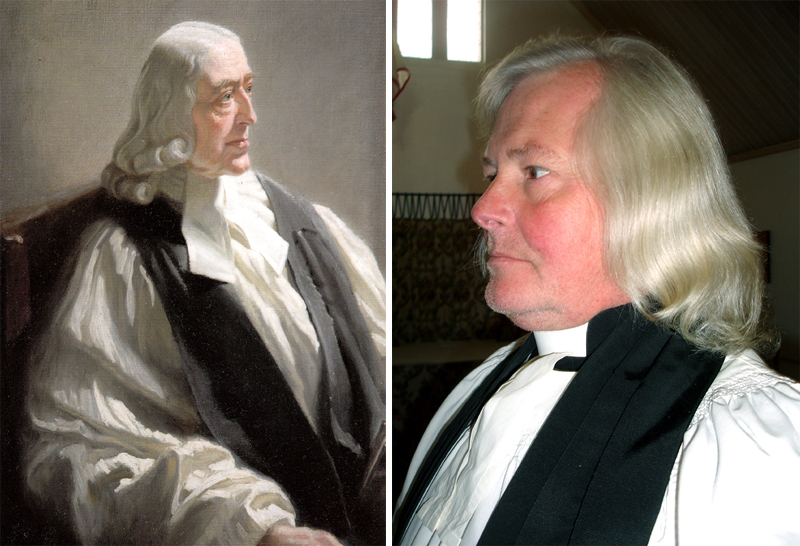
I recently saw a picture of a splendid pontifical Mass in Poland and almost fainted on seeing the military hairstyle of the MC!

I have no pretension to the holiness or evangelical zeal of John Wesley, but I seem to have almost reached his length! I am glad of the choice I made.

longhair-priests

Posted in Uncategorized | Tagged | 7 Comments

Liturgical Minutiae

If my memory serves me well, Fr Adrian Fortescue said:

You have to incense an altar somehow. It doesn’t hurt to be told how.

It is the theory according to which the rule of the arbitrary is worse than the rule of law. This is one thing I often heard from my old canon law professor at Fribourg. Poor old Patricius got his head bitten off trying to comment on The New Liturgical Movement, which I admit seems to have lost some of its spice since its former moderator retired from it. He writes about this subject on Amateurs…

I remember old Fr Montgomery Wright telling me that he was fed up with the Roman Catholic Church in England in the 1940’s and came over to France just after the war to complete his training for the priesthood and be ordained for the Diocese of Bayeaux. Whether it was liturgical rubricism or moral casuistry, it must have been stifling!

In my book, it is important to learn to do things properly – get someone to teach you, read it in books, hold rehearsals until you get it right. Then one just gets on in life. When I say Mass, everything is done properly, because I took the trouble to learn the Sarum ceremonies as best as possible. Of course, I am always ready to accept criticism, just like when I perform a tack or a gybe when sailing or playing a fugue by Bach on the organ. It is the same with any acquired skill.

I sympathise with those who are burned out by constant criticism, but we do need to be on the watch to keep up high standards. As with many things, there needs to be a via media between the arbitrary and constant nit-picking.

It is rather like men who fuss over their hair all the time and worry about this or that shampoo or conditioner. I just look after mine reasonably and live with it. Just the same with my boat. I could restore it and bring it to a new-looking shine. I would be afraid to launch it. So, my boat is a bit untidy, but sails just fine. What more do you need? The liturgy is at a different level, the worship of the Church and Sacrament of Christ, but it needs to be a part of our spiritual life and like a rudder is to a boat.

I occasionally look at The New Liturgical Movement, but since I came across some quite nasty folk there, I stopped commenting long ago. I was never well accepted, because of being a vagante priest pariah. Shawn Tribe wrote to me a few times, and was always kind to me. I certainly don’t get angry if a blogger doesn’t want me commenting. It’s their blog and life is too short…

Keep calm and carry on!

Posted in Uncategorized | Tagged | 15 Comments

How masculine should a priest be?

It is sometimes claimed that giving roles to women in the Church causes priestly vocations to dry up. In  recent years, we find church institutions ordaining women or allowing them roles in the liturgy. Conservatives find this “feminisation” disturbing, since they claim that women draw attention to themselves in a way that “masculine” men don’t. In the history of the Church, women have had no liturgical role except singing in a place where they are not seen by the congregation.

One of the major tenets of the Anglican Catholic Church, to which I belong as a priest, is opposition to the ordination of women in common with the Roman Catholic Church and the Orthodox Churches. This question is not negotiable, since, in the words of Pope John Paul II in Ordinatio Sacerdotalis (1994):

Wherefore, in order that all doubt may be removed regarding a matter of great importance…I declare that the Church has no authority whatsoever to confer priestly ordination on women and that this judgement is to be definitively held by all the Church’s faithful.

This is our position for the theological and sacramental reasons given by all the apostolic Churches. I too will not debate this judgement. I don’t approve of women serving in the sanctuary, but I do allow women to read the Epistle at Mass from their place. I see nothing wrong with that.

I think the real issue is how priests relate to women and how the traditional opposition of men and women can be overcome, that very opposition that usually creates difficulties in marriage. Conservatives affirm that men have to become more manly, masculine and muscular – hypermasculine. That seems to me as bad as a man taking up knitting and taking orders from his wife or the dominant dykes in the parish!

The effusive, emotion-drenched atmosphere of contemporary Christianity is like a gauntlet thrown down before him, a challenge to his elemental, irrefutable identity as a man.

Eek! Something I picked up from a Facebook entry somewhere. Then emotion, and empathy itself, are to be considered as weaknesses. This is where I part company with the conservatives. Our world is increasingly governed, not by femininity, but by lack of empathy and moral conscience, in the extreme by psychopathy. To be a real man, you have to be strong, callous, pitiless and dominant. Hypermasculinity is a phenomenon that involves a stereotype of male behaviour, an emphasis on aggression, sexuality and physical strength. It has been scientifically studied since the 1980’s.

The “macho” image has assimilated some of the characteristics of psychopathy, namely a lack of empathy or treating women as sexual objects, being excited by danger and the belief that violence is manly. The stereotypes are often seen in excessive muscle building and the use of artificial hormone and steroids, tattoos and neo-fascist ideologies. Is this the style we want for priests? Obviously, there is a via media somewhere.

Is hypermasculinity a physical or hormonal problem? I can only suggest consulting hypermasculinity and scientific research to which the article refers. I suspect it is more cultural and psychological, a question of self-image in response to a person’s childhood and early experiences. The hormone most responsible for degrees of masculinity is testosterone. It makes your voice break, enables you to perform sexually, gives you muscle and body hair, and often makes you go bald. Many men are perfectly normal physically, yet have all their head hair, a light beard, little body hair and have tenor rather than bass voices. All that being said, I am more concerned with attitudes.

The most disturbing characteristic of hypermasculinity is lack of empathy or moral conscience, the things that make a good soldier or policeman. There is also a degree of stoicism and endurance under hardship and stress. That can be valuable, but contempt for women or wanting to treat them as sexual objects is inexcusable. English public school has been the seedbed of hardening boys up through sport and lack of comfort. It used to be said that the British Empire was built by flogging boys with the rattan cane. I was lucky to find in 1972 that my school has been radically reformed, especially in questions of fagging and the authority of monitors (upper sixth form pupils). When I went to St Peter’s, fagging took the form of performing certain set tasks for the sixth-formers in their absence. Thus, we washed pots, polished shoes and swept out studies, and that is as far as it went – nothing like Tom Brown’s Schooldays!  In England, things have rather gone to the other extreme and the conservatives are complaining.

Another character is competition rather than connection between persons. That is the prime characteristic of sports and modern business. Winner take all without any compassion or consideration for the loser. Empathy and compassion are for women, as some say. The cause of many failed marriages is this inability to synthesise rather than confront. Hypermasculinity is seen in films, on TV, in the media and advertising. The degree of it in video games is frightening. The imbalance in modern popular culture between hypermasculine men and feminism is frightening. It is said that there is now pressure on women to wear their hair short, but it is difficult to say whether it is simply a fashion trend or symbolic of submission to corporate systems that seek to denigrate personality or character.

Many seminarians and priests I met in the traditionalist places where I went had been in the army, the Scouts and, in my case, boarding school. They were not all “hyper-butch” but had refined their training into a more rounded personality. I don’t see aggressive or competitively-minded men in the priesthood, not if we take the Gospel message to heart – the Beatitudes, empathy, compassion and pity, self-sacrifice. We have to have character to get through the system and have resilience to deal with adversity, deal with hypocrisy and double standards without confronting authorities with these tendencies. We do need to “man up” in many ways, but we also need to develop our feminine side of empathy and care. That is something that only comes with suffering.

I sometimes see references to lace albs and “dandyism” in relation to priests and their masculinity. My alma mater was the Institute of Christ the King in Italy with Msgr Gilles Wach, who is well known in the traditionalist world. “Camp as a row of tents”, some would unkindly call him. The article to which I have linked here affirms that Fr Wach has never received the title of a prelate from Rome, nor does Rome refer to his priests as canons. Since leaving the Institute as a deacon in 1995, I have learned many things from that experience. I like simple things like plain albs and the kind of churches we have in England, the ones that were restored in the early twentieth century in the spirit of the Arts & Crafts movement. I find “over the top” baroque aesthetics tiresome. Are Fr Wach and my old confrères effeminate? Woman-like? My wife certainly is not impressed with such men! There were many seminarians and priests who were much more themselves and “normal” men. They and I ate together in refectory, worked together around the seminary and normal routine community services, going to classes and especially having a good conversation during free time. Lace can be worn by unaffected men, and my belief that it does not cause men to become “camp”. Perhaps Fr Wach’s problem is that he was ordained too young (22 years with special dispensations).

What kind of priests do we need? We above all need mature and human persons with an altruistic and spiritual view in life. I don’t think there are many men with such a degree of personal development under about thirty years old. There is a problem with the method of formation, emphasising corporate conformity rather than the formation of talent and personality. Turning products out of moulds and production lines makes it much easier to hide defects and perversions of personality. The Roman Catholic Church, and the Anglican Communion for that matter, needed to reform their methods of training clergy. What is needed is genuine personality and empathy, and then a spiritual view of life, and then the “technical” stuff of theology, practical liturgy and pastoralia. It is only that maturity that prevents a man from burning out.

The real question is the way bishops deploy priests in a system that was designed in the nineteenth century and which is for all intents and purposes dead. In France, you take the number of parishes and divide it by the number of priests, then give each priest that number of parishes. Perhaps there is some intelligent adjustment in places. The personal relationship between the bishop and his priests and the priest and his people has been destroyed and replaced by bureaucracy. With the dearth of priests and death of the parishes, palliative care consists of recruiting lay people to do some of the work of priests, and few men are interested. The result is the use of middle-class retired women, often from the teaching profession. The usual result is bad relations and the priest burning out. I see no long term hope in Europe.

In the end, it isn’t about being masculine, but finding a way to be a balanced person with Christian qualities, “beating the system” or working independently from it as we Continuing Anglicans do, like many traditionalist priests. The average laity find it difficult to relate to such an idea. Between priests and laity, the “offer” and the “demand” do not correspond. Laity are priestless and many priests, myself for example, have no pastoral ministry. There is still some good “matching up” in America and south of the Equator.

We seem always to return to the same subject. The dinosaur is dying or dead and needs to be cleared away for new life to flourish. Catholicism needs a reboot and the psychopathic elements need to be purged out, just as with society at large. There seems to be no human solution other than establishing communities (monastic, intentional, you name it) such as I have discussed before and taking one’s distance. If masculinity means being a mature and developed person, I’m all for it, but if it is the caricature of the psychopath – forget it!

Posted in Uncategorized | Tagged , , | 11 Comments

An Epic Voyage

I have just been sent a link to this amazing voyage in a sixteen-foot cruising dinghy.

I have never sailed on the Mediterranean Sea, but I am told the weather and winds are extremely fickle. The Romantic poet Percy Shelley perished at sea off Italy. The advantage of what was called in ancient times the Great Sea is that there is very little tide. Americans who sail the Great Lakes would probably experience similar conditions.

This is a fine introduction to the extreme form of dinghy cruising, from Greece to Egypt and much further, sleeping in the boat with a tent arrangement, all the practical aspects of food and hygiene and everything we could imagine. This guy used a Wayfarer dinghy which is reputed for its seaworthiness and reliability.

I don’t have anything like this man’s experience and I will stick to coastal waters (reliable navigation and safety). A few days at a time is generally enough and such a cruise still needs a lot of preparation.

I plan to go sailing tomorrow, probably for the last time this season before winter closes in. We are promised good weather and a weather shore – which means a calm sea but gusty winds. At present I am debating between Veules les Roses to Veulettes sur Mer, or Fécamp to Etretat. We’ll see – just a daysail with a packed lunch…

Posted in Uncategorized | Tagged , | 1 Comment

Encouraging Continuing Anglican News

I have just found Not so breakway after all on Fr Jonathan Munn’s blog.

From the Provincial Website

The College of Bishops of the Original Province met October 16th and 17th in Shelton, Connecticut, where they took important steps toward the reunification of Continuing Anglican jurisdictions. In addition to voting to receive former ACC Bishop Thomas Kleppinger back into the Church, a report on Validation of Orders was approved, paving the way towards closer relations with the Anglican Church in America (ACA) and Anglican Province in America (APA). Reception of a new diocese in the Republic of South Africa was conditionally approved and representatives were appointed to respond to a request for dialog from a large group of Anglicans in Burundi. For more information on this and related matters, see the upcoming issue of The Trinitarian.

You should go to Fr Jonathan’s blog (link above) to read his own reflections. Here are a few of mine.

I am far away from it all, but I have the Internet which is a valuable source of information and a way to keep in contact. I believe that we can make progress as we have been doing for several years. We are getting together, even if there are some differences that we just have to tolerate, namely a view of Anglicanism emphasising the Reformation and another that seeks a more Conciliar Catholic basis (the Church defined by the college of bishops rather than communion with the Pope). There are also points of convergence and understanding.

Indeed, the “establishment” folk would like to dismiss us as all the names they call us. We have developed a thick skin. I for one couldn’t care less what they say. I have had a lot of experience with smug clergy. One example is when I took down an organ to transport it to Triors Abbey in France. I had a friend to help me, and we needed to do an efficient job. We camped in the vestry, and even in May 1997, it was cold. I was concerned to limit costs and waste of time. We ate simply, basically Chinese and Indian take-aways. Then the vicar wanted to hold council meetings in the church and require silence. Finally, he reproached us for our “unspeakable behaviour” and “You even had a meal“. I merely responded that it didn’t bother me in the slightest if I left the organ in pieces strewn all over the church, forgot to pay the agreed price and looked for another organ somewhere else. His face went ashen. I explained that I was also a Christian and an ordained deacon and serving the interests of a Benedictine monastery by providing them with a pipe organ – and that we had a job to do. Meetings could be held in the vicarage or some other place. This is the kind of thing we find with Anglican clergy who fail to understand reality or even their own best interests. This is the kind of smug hypocrite who judges and condemns everything outside his small and self-contained world.

No, we are not an “angry” Church. At least I’m not angry. I am deeply alienated from most institutional Christianity and find it very hard to relate. My wounds are deep, but I pray for the grace to forgive and re-find my innocence. In the end, the important thing is not institutional horse trading and “unity” schemes, but whether we are trying despite our sinfulness to be disciples of Christ.

As I packed the last pipes and bits of organ mechanism into the Pickfords lorry bound for France and did a final clean-up, I left the vicar on good terms. I think there was something of a conversion in him and I had to understand where he was coming from. They respect someone who shows a bit more character than what they are generally used to.

Indeed, this and other blogs are avenues through which people can get to know us and overcome prejudice. We have had to break away to be free from the bullies, so that we could be free in our consciences – perhaps a little like those who fled inquisitions in the past for the freedom of the New World. The same thing happened with the Methodists and Non-Jurors in the past. A little tolerance goes a long way, and it can avoid any kind of schism or break-up. Louis Veuillot, the hyper-ultramontanist French journalist in the nineteenth century, once said: “Il n’y a pas plus sectaire qu’un libéral” –  There is nothing more sectarian than a liberal. Liberalism and tolerance are often very thin veneers that hide intolerance, bigotry, hatred and anger.

We have an inestimable gift to share, but we don’t force those who don’t want it. We do well to cultivate tolerance and love, and maybe people will see some tiny pieces of Christianity as a gift and not as a load of nonsense or a sickness to be cured by rationalism. We need to stand up to wrong and injustice, having character and courage to confront, but we need also to have kindness and empathy.

We’re getting there…

Posted in Uncategorized | Tagged , | Leave a comment

The Episcopal Charge

Being a bishop of a diocese or particular church is a hefty responsibility, and the one who occupies the Apostle’s shoes takes a lot of stick. It is certainly a thankless job, like being the captain of a ship. It is easier to be a member of the crew or an officer, having only a limited degree of responsibility. As a priest, I can always answer that I belong to the clergy of an institutional church body and am in communion with my Bishop. As for my Bishop, he is in communion with the Archbishop Metropolitan and college of bishops of the Anglican Catholic Church – Original Province. All that is perfectly legitimate as far as I am concerned. The Church as a human institution is divided and fragmented in history, but is indivisible in sacramental terms. The same thing happens in institutional churches as in politics and business: dominant men without moral conscience or empathy lord it over others and create a situation in which groups of clergy and laity can take the bullying no more and move to another church body or give up church Christianity altogether. The bullies don’t care. They just turn round and tell the world that their victims are the culprits. Communion repairs itself, because it is divine. The Sacrament of the celestial Jerusalem, reflected in its earthly icon, transcends human sin, jealousy and hypocrisy.

My Bishop has written a piece on Facebook. No doubt, the bullies in the Church of England establishment and others will say that he is winging. Now if he had joined the wait-wait-never-never queue for the Ordinariate before Benedict XVI abdicated (the conservative apologetics are now made more difficult with the baroque finery having been put away again). Benedict XVI’s legislation has even been unkindly nicknamed by one blogger Anglicanorum Coitusinterruptus! Alternatively, on the other hand, if he had remained a tithing layman in the Church of England… Either way, the bullies have no concern for our happiness or spiritual life. We are here to be exploited, or to cease existing if we are not useful.

Here is what Bishop Damien wrote:

Sometimes I think I should move to the other side of a Mulberry Bush because I seem to be forever going around one!

Recently it has been alleged, and not, sadly, for the first time, that certain local Churches have an unofficial ‘boycott’ of our Church Shop in Canterbury because of it’s links with my Anglican Catholic Church – Diocese of the United Kingdom. I also have reports of the clergy of other churches telling my clergy, with ‘authority’, of what they think the ACC is supposed to think about everything from homosexuality to the ordination of women. Of how we aren’t real Catholics, or we aren’t real Anglicans, or we aren’t really a Church, and even (presumably because of something in this list) we aren’t therefore really Christians.

Some years ago I contacted an organisation called ‘Churches Together in Kent’ to inform them of my presence and the work of our Parishes and Missions in Canterbury, Dartford, Lydd and Rochester. This was partly to avoid misinformation. The polite response I received was that we were not recognised as a Church because we were not ‘gazetted’ at Lambeth Palace – and therefore we were not an organisation that CTK could work with nor recognise!!! After an exchange of communication it seemed I was getting nowhere. A year or two after moving into our new Church building in Canterbury I received a nice letter from the Local Churches together in Canterbury inviting me to some ecumenical event to consider a shared vision for the Christian Churches in the City. I responded positively but, copying in the previous correspondence, said that before I committed myself and my congregation I wanted to know that we would be accorded the same level of respect as the clergy and members of other Churches. I received no response. I didn’t attend the event. Twice more this has happened over the years since then and twice I have responded with the same information and request. I have still had no response. It has been suggested that I go anyway and show everyone that I am not an ogre and that the ACC are not leprous! But to be honest I am both too busy and no longer interested in such ecumenical efforts.

I have heard snide and nasty comments made about my clergy and people and have from time to time had some interesting things said about me, over the years. Most of this has come from within the clergy and membership of other Churches. The only comments, if indeed we are moved to comment, we make about the clergy, laity or policy of other Churches is when we genuinely believe that they are in error and/or have departed from Apostolic Faith and Practice. We do not refer, for a closer-to-home-than-I-like-to-think example, to how, ahem, “obese their bishop” may be!

Now I am not sharing this because I want sympathy for me or my Church – for I also know that there are many Christians out there of all shapes and sizes who I count as friends to me and the ACC, without necessarily believing all that the ACC does, or indeed agree with that we hold fast to. Among my Facebook friends this is also so and it includes non Christian’s as well as Christian’s from all manner of Churches and folk with whom I don’t necessarily see eye to eye on everything outside the Church either.

No, I am not looking for sympathy, because I also know that all those in my small diocese are very lucky and very blessed, because although we seem to attract undue attention from some uncharitable folk, we are not paying for the Faith that we hold with our homes, jobs, education, or lives in the way that so many of our brothers and sisters in Christ are around the world. Our sympathy, all of it and magnified an hundredfold, should be reserved for them.

The Facebook message attracted many comments of support, from myself included. With my north-country origins, my reaction was to see the “establishment” churches in business and cartel terms. We are to them as a small grocery shop would be next to a large supermarket. The latter can afford to sell its products at lower prices and undercut the small retail business. It is usually very difficult to park cars in town centres, and so the business goes to the titans. We are a Church, but an ecclesial body of recent foundation, as a schism from the Anglican Communion on account of innovations we find unacceptable. If the Church is a mere human institution, a branch of the State, having law and order on its side, then we are wrong, wrongdoers and delinquents. Conscience and spiritual freedom have no place. The Church is a mere moral police force to enforce politically correct agendas as they change over the years and decades. If the Church is something more, then it is not a business cartel or a political organisation, but a spiritual community governed by other principles including conscience, freedom and empathy.

It is interesting to note that there are some Church of England clergy who deeply sympathise with us, because they are not of the spirit of the cartel, but are true to their vocation of pastoral care, empathy and spiritual concern.

In a further message, our Bishop thanks us for our support:

I am very grateful to all the lovely and supportive comments in response to my previous post. I posted primarily because I wanted those members of my Diocese who visit me on Facebook to know that the silliness and nastiness that from time to time they encounter was recognised and is an experience others have had. My fb friends you have exceeded my hopes for the post’s value through your comments and I thank you. If it brings encourage and comfort to anyone experiencing similar problems then I thank God. 🙂 — feeling humble.

Even if we are in good conscience, with the freedom of God’s children, the hammer-blows of criticism and reproach weigh heavily – and they can have a deeply demoralising effect. I live outside England. The Roman Catholics don’t care about my existence (I am not making people believe I am them) and the Anglican churches in Paris seem to be even less concerned. I live amongst people who mostly believe that the Church is a load of rubbish and are just getting on with life, being honest, decent and often spiritually-motivated folk. Institutional churchianity has done enough harm. All we can do now is find new ways of fostering the spirit of Christ, through our own kindness and empathy – so that people ask the question of why we are different from the bullies and winners-take-all of this world.

My Bishop can be assured of my prayers, living in a country where Christianity is all but dead and forgotten, amidst the mouldering churches. Surely, there are churches that attract people, especially charismatic-evangelicals, traditionalists, fundamentalists and political conservatives. That doesn’t mean that we should all join them. Our way is often lonely, but Christ did not promise us anything else. We know the way is rough and that we will be done down for being signs of contradiction.

Bishop Damien Mead has proven himself as a pastor with a particular degree of empathy and care for his flock and the many unfortunates of our society. As a priest, I am proud to have him as spiritual father and my Bishop. I ask my readers to pray for him, and for us in his Diocese, that the Lord may continue to give us all strength and resilience in difficulties and discouragements.

Posted in Uncategorized | Tagged , | 1 Comment