My attention was drawn to an article in Fr Robert Hart’s blog – Convert Orthodoxy as Media Echo Chamber and the use made of it by You-Know-Who to portray Anglican / Anglo – Catholics as faux Catholics. I had brushes with Fr Hart in the old Hepworth days of the “Coeti-bus” and various other analogies of public transport from various players in the game. Since then, the Continuum shows little more than Fr Hart’s sermons, which of course are very good and edifying. Occasionally an article like this one emerges when we are reminded about the “two one-true churches”.
It is more an American problem than anything else. Our friend in California portrays his “faux” Catholics as hipsters, or people who follow certain fashions, who perhaps lack originality of thought, or who do not conform to his middle-class standards.
We Europeans are wont to quip about Americans lacking culture, but the same problem is here too. Europeans started being faux Americans a long time ago, and Americans remained on the whole quite religious. The USA is about the unique exception of the proportion between consumer capitalism and the extinction of religion, faith or spirituality. I suppose you get the same level of proselytism by Roman Catholic and Orthodox converts in cities like London. It happened to me and my fifteen years as a Roman Catholic were a curse (though there were some blessings). Europe still has that Cujus Rex ejus religio. You practice the religion you were born into, or none at all. Even New Age and the cults are out of fashion these days. Materialism and über-rationalism are still “in”.
Some people get so worked up about what other people are up to. People do many things that make me squirm like taking drugs and getting tattoos, or listening to infernal machine noises that some call “music” – but who am I to stop them. They and I belong to different worlds. They and I have different values and priorities.
One thing I suggest is more independence of spirit. Perhaps you have to be autistic to understand it. We don’t have to live and march in lockstep with other people. We can live our own lives whilst respecting the freedom and good of others. If religion is fashion or something to define our outward appearance, then it won’t do us much good.
My Baptist sister wrote to me a short while ago to contrast a “relationship with Jesus” and “religion” in its meaning as a code of observances and “works”. I don’t relate to that somewhat simplistic dualist distinction, but there is a point – the relationship with God and the Incarnate Word and our knowledge of God and ourselves. That certainly is the priority over outward observances and traditions. Christ laboured the point as he fustigated the Scribes and Pharisees. C.S. Lewis made a wonderful point as he came up with the idea of Mere Christianity – the core of beliefs and practices we all have in common.
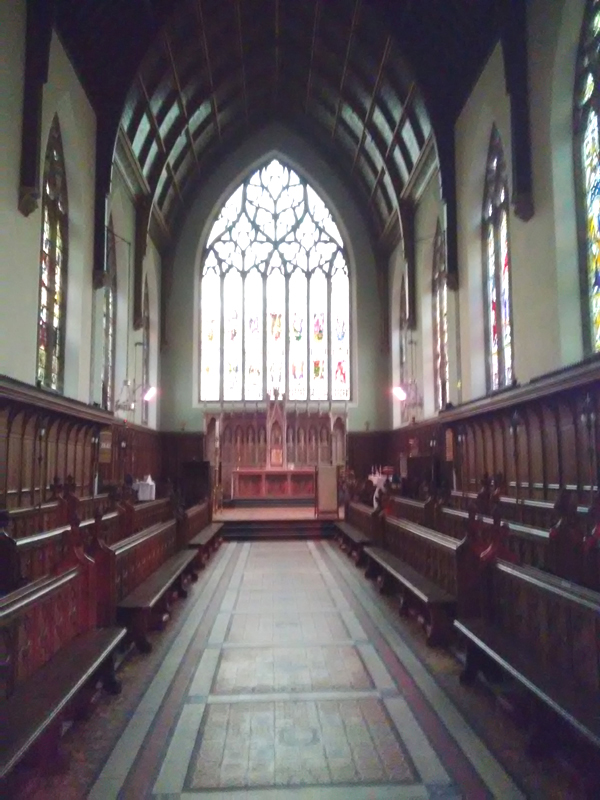
It is insulting to call the Church I belong to faux because it is not in communion with the Pope and within the norms of their canon law. The word faux is the French word for false or fake or bogus. Used in English, it seems to mean the other French word pastiche or imitation, like a modern house built in an old style. It can be used in a very derogatory way, or it can be a good thing. The nineteenth century saw the building of some very fine neo-gothic churches in the wake of the Romantic movement. I see nothing wrong with appealing to the past for good ideas and a reference when we are lost and confused with modernity.
Whichever Church we belong to, I think is unkind and even cruel to disturb members of others communities to get them into our pews instead of theirs on the pretext of our boutique church being better than theirs. Again, institutional Christianity comes up against the same pierre d’achoppement as in the eighteenth century. It has had its day, unless we find what it was really about – which is not power / money structures. Proselytism and self-righteousness eventually lead to the Déesse Raison in the place of the statue of Our Lady and the guillotine in the town square, because when the salt loses its savour, it is fit only to be rejected and thrown away.
It is about the intrinsic value of each and every being of creation and its reconciliation with the Creator through inner knowing and love. Let us, each one of us, reconcile ourselves with ourselves, and thereby with God. Then perhaps there is some hope.