
These are the words that came into my mind as I read A Brief (Very Brief) History of Practical Liturgics by JV. He published an unfinished, or rather in-concluded, posting. I would probably have felt the same had I written it, not because of anything “unworthy”, but because there seems to be no finality in sight.
I was not in communion with Rome at any part of the Benedictine pontificate (2005 to 2013), but I kept my eyes open. It became relevant to me as Archbishop Hepworth followed through with his plan, and as the Ordinariate scheme unravelled and twisted and turned as it was pulled out of its bag. I discovered some of the more inspiring Ratzinger texts in the early 1980’s and saw the man as he is, a German theology professor and supremely intellectual bishop. Many of my own professors and fellow students at Fribourg were Germans or German-speaking Swiss, and I learned a smattering of that extraordinarily difficult language. I feel as a Germanophile and at one with that country’s tradition of music and philosophy, the sturdy spirit of Romanticism that would produce both the highest sublimity up to 1914 and the basest evil in the Nazi era. My ancestors were Germanophiles, and my great-grandfather and grandfather were named after Kaiser Friedrich Wilhelm. I thank God that I was not around in 1914 when my country had to go to war against Germany. My point? Josef Ratzinger was (is) not a conservative Catholic but a German Romantic, and beauty is a part of his life as it is for me. That is why he did all he could for the liturgy in the Roman Catholic Church.
I think JV refers to The New Liturgical Movement which I hardly ever read nowadays, ever since the end of the Benedictine papacy and the resignation of Shawn Tribe who was running that blog. I don’t say that it is no good, but it attracts me less.
And then things kind of stopped. A hard, sudden stop. And there doesn’t seem to be much sense of direction.
My answer is cuius rex eius religio. Benedict XVI the German Romantic was replaced by the Peronist Jesuit who was nearly elected in 2005. I have always found Jesuits incredibly boring in conversation. Perhaps they are Classicists, or perhaps have an agenda that non-Jesuits cannot understand. Every time I have been tempted to say something horrible about Francis, he comes up with something that we cannot ignore. One thing is sure with this event of just after my mother’s death. It shut down the euphoria of the ordinariates and liturgical conservatives. When Pope Francis goes the way of all of us, who knows? Cardinal Burke for Pope! I don’t think so. What the Church needs is not conservatism but vision. Benedict XVI had it, but he was unable to translate it into terms that would be understood by ordinary folk and priests brought up on slops since the 1970’s and earlier in some places. He was too much of an introvert. I understand that because I am one myself.
As the seeds of something luminous were rooted out and poisoned, we can only wait for the present situation to wear itself down, go the way of the Church of England and the general slush of western institutional Christianity. Like JV, I fail to see how things can go other than decomposition and decline. Then it’s goodnight to the light of the Gospel, the Renaissance, the Enlightenment and all we have known. And then it will be darkness, brutality, torture and slavery as has happened in Irak, Syria and other middle-eastern countries. This isn’t about maniples or cuts of chasubles, but about a dying civilisation.
I am in no illusion. My own love of pre-Tridentine liturgics has not been very contagious. I hardly expected it. My own chapel will not survive the time I am in my house or my lifetime, whichever occurs first. The Church I belong to is real and legitimate, but it is fragile. I have been tired and burned-out for many years, but I seem to receive the grace of resilience and the ability to keep myself reasonably healthy emotionally. I am attached to my duty as a priest. It mostly takes willpower and determination, since that is the nature of work and duty. It is something we have to do whether or not we get pleasure out of it. That is the way I was brought up, like many of my generation and that of my parents. Sometimes we see glimmers of light that help us along and make it all worthwhile.
I have been aware that were I to change the way I celebrate Mass, for example put in an altar facing the people and use the Novus Ordo or some modern Anglican rite, it would make no difference in terms of attracting “clients” to the chapel. Such is not my objective. That brings me to think of the Church in general – trying to be relevant is burned out and finished. We can only be true to ourselves.
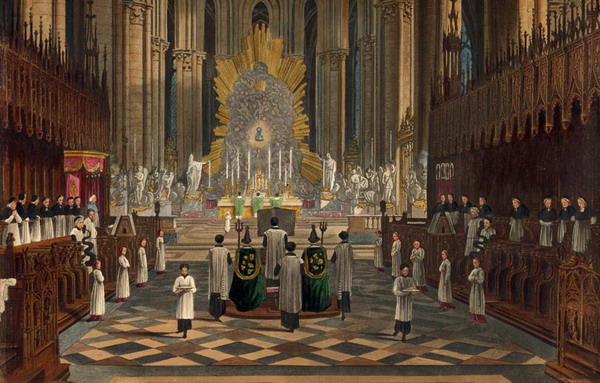
New liturgical movement? We are all too divided between our various ecclesial and ideological affiliations. I see nothing to compare with the work of French, German and Flemish monastics from the Romantic era to World War II – and a little later in places. My good friend Dom Alcuin Reid is a monastic in France, and his Prior seems to approve his work to which I have had the honour to contribute in a small way. In the end of the day, it all depends on our own work and our publishing it for others to read.
What of the future? The future of the French Church in the wake of the Revolution and Napoleon’s regime was bleak. It was re-born of bright little lights like Dom Guéranger and St Jean-Marie Vianney in his parish. It was a part of the Romantic movement in a strange kind of way since the silliness of the late eighteenth century was over. Minds were turned to something new and luminous. Perhaps that is our hope today.
* * *
Please see Salt of the Earth in response to my article. It resonates within me as does the comment below of Stephen K.














 The Blue Flower