
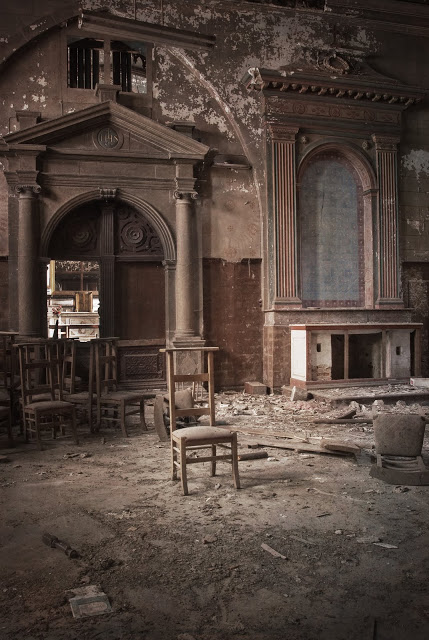
 I have been on this subject before, and I may have some insight not being a sociologist or a “new atheist”. It is very difficult to get any kind of objective understanding of a situation that seems to elude anything but subjective opinions and simplistic propositions. However, there are ideas floating around that might help our own circles avoid some of the very things that cause people to be alienated from Christianity. It is frustrating to live on a continent with so many monuments to its Christian past, but which will have to be put to other uses or demolished.
The general assumption over the past few centuries is that Christianity was a force of darkness and fear, and that only by denying God or any kind of transcendence could man find fulfilment and happiness in his new found rights to life and freedom. So in came emphasis on education, reason and scepticism in metaphysical matters. One idea strikes at the heart of Christianity – that belief in God is motivated by fear and anxiety rather than love of truth. Atheism largely consists of recycled arguments from the eighteenth century, but has evolved in its subtlety.
There is something else that can be blamed for the decline of Christianity, the easy availability of other religious traditions and spiritual philosophies. This has come from immigrating peoples from other parts of the world, particularly those parts of the world colonised by the various historical European empires. Thus, we have a massive influx of Islam and Hinduism. In an attempt to react against our racist past, we try to integrate foreign cultures into our own and the result is syncretism. Whether we think this is a good or bad thing, inspired by our desire of respecting and accepting people of ethnic minorities, it is eroding Christianity – or Christianity cannot adapt to such syncretism without cost to its own substance or claim to truth.
Christianity no longer runs in families, and this has eroded the meaning of tradition. People are merely free to choose a spiritual identity in which they think they would feel at home. There is no limit to the variety of products on the supermarket shelves. The decline of Christianity goes hand in hand with the erosion of the family and the notion of cultural tradition. There is a phenomenon of “cultural Christianity”, for example northern Irish republicans and loyalists calling themselves respectively Catholics and Protestants, but who are mostly alienated from their religious practice.
I don’t know to what extent the “new” atheists like Richard Dawkins, Sam Harris, the late Christopher Hitchens and others are having that much influence. Those with knowledge of recent scientific work know about a movement away from materialism in the world of quantum physics. Old laws of physics are no longer absolute, and many things even in the realm of the “natural” escape our understanding. Reason finds itself humbled. Perhaps the “new” atheists spread their ideas by irrational means like cult gurus, appealing to desires for cultural identity and moral freedom rather than a search for truth and intellectual fulfilment.
Another thing to consider is the question of why Christianity seems to be dying in Europe, yet surviving in America where there are just as many challenges like consumerism, moral laxity, education and modernity. What is the fundamental difference between Anglicanism (for example) in England and the USA. The former is an established state religion, and the latter is no more established than the Methodists or the Roman Catholics. Does that make any difference? That contrast might be better seen between the theologically and morally liberal churches of the west, always eager to comply with political correctness, and on the other hand, the conservative churches of Africa, Asia and South America. Is it still the question of whether churches can still take advantage of cultural “primitiveness”, fear and ignorance?
Some are discovering that the old rationalist / secularisation thesis is incredibly patronising in regard to people in other parts of the world, a leftover from imperialism, and it is being challenged – just like Newtonian physics. Evidence of this is the USA, with perhaps an even more advanced state of modernity and consumerism. There is just as much in the way of social problems, poverty, warfare and propaganda from the “new” atheists. Perhaps swathes of American society are going the same way as Europe, just a little late on the uptake. Time will tell.
Is the question of separation of church and state the one underlying cause? Many of us have read something about Constantine and the support given by the Roman Empire to the Church, and then the same kind of support being sought from other monarchs and princes after the fall of the Roman Empire. It’s a long and drawn-out story. Saint Jerome is quoted as saying Ecclesia persecutionibus crevit; post quam ad christianos principes venit, potentia quidem et divitiis maior, sed virtutibus minor facta est (The Church firstly languished under persecution. After this, she turned to Christian rulers who gave her wealth and power, but she thereby grew weaker in virtue). People began to become Christians to get temporal favours, and no longer for reasons of spiritual conversion. Those who wanted to continue to be the older “kind” of Christian retreated to monasteries and hermitages in deserts. All being said and done, the Roman Empire spread Christianity to every corner of its colonised lands – and that influence became Christendom. In becoming so influential, the Church had to become a society of both saints and sinners, people in it for their discipleship with Christ, and others in it for power and money. As the latter influence became unbearable at various times in the history of Christianity, the splits appeared as the former sought the freedom to be Christians. Denominationalism has always been part of American life and introduced an element of competition and the ability to self-reform. In Europe, the Reformation and the Counter-Reformation were a bloodbath! To this day, denominationalism outside England on this side of the Atlantic just doesn’t seem the “thing”. It’s OK for ethnic minorities but native (French for example) have a choice between Roman Catholicism, “mainstream” Protestantism or nothing.
Was it not Christ who warned that those who live by the sword would die by the sword?
The French Revolution showed what happens when the Church is tied to an unpopular kingdom, and why the nineteenth century in France produced two Liberal desires: the separation of Church and State and Ultramontanism. In Europe, the Church lost the working class as crisis followed crisis, caused by industrialisation and the hecatomb of World War I. They turned towards the various political demagogues of the twentieth century who seemed to have more to say than the increasingly irrelevant state churches.
Disestablishment of churches would not be the only thing to highlight, blaming Erastianism for everything, but to a significant extent. Free and independent churches, of sacramental and “reformed” traditions, also seem to be in decline. As in the twentieth century, some people are eager to listen to demagogues and Pentecostalist preachers of talent. Some are attracted to themes and ideologies similar to those of the 1920’s and 30’s in Europe. Many challenges to Christianity like New Age and the ideologies seem to have lost vital energy and are of appeal only to the margins. Doubtless, Churches that remain independent of the “mainstream” would seem to have more of a basis of credibility.
We finally come to a notion of some independent churches wanting to imitate and perpetuate trappings of their parent bodies as they were when they were connected with secular power. This idea will certainly question many of the cultural trappings we have: bishops’ violet cassocks, church buildings and ornate liturgies. I do notice that few people are turning to western sacramental Christianity or liturgical traditionalism. There are two possible answers: adapt the offer to the market or make Christianity such that it doesn’t need to attract those who are motivated by something other than Christ himself and their spiritual life. The latter is the way of the monasteries and the little Christian communities in the catacombs – the “creative minority”.
That seemingly “Jansenist” idea has been popularised by the quote from Pope Benedict XVI in his old Salt of the Earth interviews.
Perhaps the time has come to say farewell to the idea of traditionally Catholic cultures. Maybe we are facing a new and different kind of epoch in the Church’s history, where Christianity will again be characterised more by the mustard seed, where it will exist in small, insignificant groups that nonetheless live an intensive struggle against evil and bring the good into the world – that let God in.
The election of Pope Francis seems to have come to refute this essentially monastic notion of Christianity. Surely we are called to “market” what we believe to be good and true, by whatever means will draw in large numbers of people. This will remain one of our most debilitating dilemmas, bringing us to agonise over the kind of liturgy and culture we love, wondering whether it would not be better to give it all up and seek relevance in the changing values of the “market”. I think Benedict XVI’s idea was not one of turfing out all the “dross” and just keeping saints in the church, but not going out and appealing to the lukewarm at any cost – a question of priorities.
Are we to be cultural or counter-cultural? The question remains and will not go away. We in the ACC are certainly marginal, and we don’t keep people out. We give priority to traditional worship and what we believe to be right, and never mind if no one comes! It sounds a bit simplistic, but what else is there?


