Let there be light!

My Bishop’s loyal companion Roy Hipkiss took quite a few photos with his smart phone, and this is quite a mysterious one. I appear to be holding a luminous orb!

fiat-luxI seem to be quite intent on something. The direction I am looking is towards the Rood, and I am probably pointing out the statue of Our Lady of Walsingham who looks towards the altar like on some German rood screens. My right hand coincides with the electric light mounted on the wall above the cantoris stalls and makes me look as if I am carrying a very bright light in my hand. The effect is quite amusing.

Bishop Damian wrote in his Facebook entry: Father Chadwick attempts to enlighten me or perhaps is trying to set fire to me. Unfortunately for him – I am clearly either resisting his best effort to enlighten or am just far too wet to catch light!

He then photographed my hanging pyx and choir stalls.

choir-stallsI made most of the things in this chapel. Bishop Damien seemed to be quite impressed with the atmosphere of this chapel. I intentionally designed it with the Arts & Crafts ideal in mind, to which Dearmer adhered fervently. This aesthetic movement at the end of the nineteenth century and up to the outbreak of World War I reacted away from the complex gigantism of the nineteenth century and aimed at something that would be characterised by noble simplicity, sobriety, honesty, homeliness whilst aiming for transcendent elevation.

I am not an architect. I just worked with what I had and with very little in the way of financial resources. I would like to encourage this spirit in our churches and chapels in our Diocese. It just takes good will, hard work and the desire to build up holy places of worship in different places. My Bishop has done something very similar in an outbuilding in his garden, which is now his private chapel of St Nicholas.

It takes vision and a sense of tradition in our little churches. I’m sure that if I can do it, many others can also build up their missions and parishes. I have tried to set the example.

Posted in Uncategorized | Tagged , , , | 1 Comment

Canonical Visit

Update on 27th April: Visit to France has appeared on our diocesan website.

* * *

I have just had the pleasure of receiving a canonical visitation from my Ordinary, Bishop Damien Mead. He with Roy Hipkiss who is driving the car are presently touring France and will go on to Spain and Portugal before sailing back to England.

can-visit02Roy Hipkiss took this one in our sitting room at a relaxed moment.

can-visit03There were no pontifical ceremonies, but I had him sit on the throne which represents the fact that my chapel and ministry are a part of his ministry and that of our Diocese in the wider Anglican Catholic Church.

can-visit04Again, taken by Roy in front of the main altar of the chapel.

can-visit06This must be one of the smallest vestries in the world, which, as I remember, had to be planned very carefully to make the most use of the available space.

can-visit07

I made this surround for this crucifix many years ago after a visit to Bavaria. It is fixed to the wall of our house near the front door. It is sheltered by the protruding queue de gaie roof which is typical in Normandy.

Doubtlessly, more will be said on Facebook and our diocesan website.

Posted in Uncategorized | Tagged | Leave a comment

The Banner of Saint George

We all know that St George was a Cappadocian soldier in the Roman army and, as a convert to Christianity, was martyred for the usual reasons. Obviously the fair damsel and the awful dragon are an allegorical symbol of his victory through the palm of martyrdom.

Elgar’s The Banner of Saint George is a favourite of mine, giving full indulgence to our national pride and perhaps even some nostalgia for the old Empire.

We Brits do need a little pepping up from time to time. We celebrated our Sovereign’s ninetieth birthday two days ago, and today it is our national Feast. Our grandparents and parents lived through the darkest hours of the war with only Winston Churchill to spur them on and give them courage.

England had to fight against the dragon of Nazism and come out victorious in 1945 (with help from the Americans who lost many more men than we did). The myth of St George has always been our encouragement to fight evil and always be on the side of justice, truth and right. That hasn’t always been the case in our history, as the Sepoy rebels of 1857 would testify had they been alive today. Many things make me ashamed of our erstwhile Empire and the blatant cruelty committed against native populations. The countries in which we were born may give us feelings of pride and patriotism, but they also sinned. Like Germany, we all share in the guilt in some way. Elgar and Coldstream Guards do us a lot of good, but always remembering the reality of history and the sobriety that becomes us.

The enemy, the dragon, is also within each one of us. St George offered his life in exchange for victory. We have to remember that the red cross on the white background is first and foremost a Christian symbol, but also the emblem of that country we English love and cherish, even when we live beyond our national borders.

Posted in Uncategorized | Tagged , , | Leave a comment

Latest Diocesan News

My Bishop regularly publishes a diocesan magazine, which is available in pdf format.

ACC UK Magazine of the Diocese of the United Kingdom (Anglican Catholic Church).

Bonne lecture….

Posted in Uncategorized | Tagged | Leave a comment

That’ll cost you a tanner…

lsdLSD nowadays means a drug that does funny things with your mind – though I have never tried it. I heard that there was a man on the stuff who thought he could fly and jumped off a roof. He never returned from his trip, at least not in this life.

At one time, £sd meant something else, our old British currency of before decimalisation, in 1971. I remember it well: 12 pence in a shilling, twenty shillings in a pound, 240 pence in the pound. The coins I knew were a ha’penny, one penny, 3d (known as a Joey in the south of England), 6d (a tanner in most parts of England), one shilling (or a bob), two shillings (a florin or two bob), two shillings and sixpence (half a crown or a half crown). We then had the ten bob note which was quite a lot of money. I considered myself very lucky if my birthday or Christmas money from aunts and uncles would add up to one pound. Then we had the fiver, tenner and higher value notes. Between the wars, before my time, there were two other coins, the crown (5 shillings) and the farthing (a quarter of a penny).

See A pence for your thoughts – decimalisation, history, monarchy and a rare BBC correction by Peter Hitchens.

I was in the last generation of boys to be taught “money sums” and not to carry over tens but twelves and twenties – and to get whacked for getting too many wrong each day. When I was very little, we had a tanner (6d) per week, which rapidly rose to a shilling and then half a crown (2/6). I was 12 in 1971 when it all went over to decimal, just when I was starting to get my money sums right. My reaction was therefore one of intense annoyance after all those whackings from Mr Hales (my prep school master), and he lowered his arms and told us that money sums would be like all other (decimal base) sums!

That being said, the old English money system was becoming increasingly a nightmare for international exchange and markets, and the Common Market had been on the agenda for a while. I understand just about zilch about economics, but can appreciate the problem when all other currencies are decimal. In those days we were beginning to exchange our slide rules for electronic calculators (but we weren’t allowed to use them for maths exams at school). Converting one decimal system to another simply needs a multiplication or division factor. <Face palm> – My head hurts! It is strange to think that I lived in a world of transition from everything being English to seeing more and more imported goods, household appliances, toys, games and all sorts of things.

I have to agree with the article mentioned above. A penny is a penny in the singular, not one pence. We lost the habit of tuppence, thruppence and sixpence, but I at least kept the distinction between the singular and the plural. The denarius, going back to Roman times was soon forgotten. We English were, and still are for many things, very insular (apart from the literal fact of living on an island). Our legal system is still incredibly archaic, based as it is on custom and jurisprudence. Is it fairer than the ultra-rational Napoleonic Code? In the Church, we like to appeal to custom and tradition against the will of the legislator and positive law. The old things can still be found in dusty places in the City of London, in the most surprising places, in the livery companies and guilds. In London clubs, the old joke goes that you can tell that a member has died because of the god-awful stench coming from behind the newspaper! We are a strange country, even stranger when one has years of experience of living in another country.

Sometimes, the appearances remain but the meaning has gone. I have thought of this a lot today as we celebrate the Queen’s birthday. It is easy to take something for granted until it is gone. I am very fond of our Queen as most of my compatriots are. Many French people look to our Monarchy and regret that they chopped off the head of theirs! We had our Restoration after our countrymen did the same thing to Charles I. In our own time, I have known only Elizabeth II, who was still a beautiful young woman when I was a baby. The incredible thing is that she grew up in harder times, and she lived through the war, learning the stiff upper lip the hard way. I am old enough to have been taught the virtues of dignity, stoicism and devotion to duty. At the same time, the old stuffiness could easily become a place of hypocrisy and coldness towards others.

This is probably something we once had in common with the Germans. My own grandfather and great grandfather were named Frederick William after Kaiser Friedrich Wilhelm. Why did we have to go to war against the country of Göthe, Bach and Beethoven in 1914? It was the greatest tragedy, and one of the bitterest trials our Royal Family had to live through.

I hope and pray that at least some of these Christian qualities and virtues will survive in our Queen’s succession, in Charles, William and George, to be passed on to future generations of British people.

God save the Queen! May God help our nation and forgive us our sins!

Posted in Uncategorized | Tagged , | 10 Comments

A Couple of New Posts

A blogger with whom I have a considerable amount of sympathy has produced two new articles after a time of hiatus.

Marcel Lefebvre – Totemism in Traditionalist Catholicism and The post-Vatican II routine on Amoris Laetitia. I think I have said all there is to be said on the Roman Catholic traditionalists. Perhaps my article on priests prolonged the theme to some extent, since Ecône has always been about prolonging the Counter-Reformation seminary system and its highly standardised product.

On the second subject, like many others, I won’t bother. I haven’t had the heart to read the piece by Pope Francis, and I can’t criticise what I haven’t read. One thing I hate about big institutions, like modern Socialist politics, is that so little is said in so many words. St Benedict had many pearls of wisdom on this subject when discussing silence!

Turning to an unrelated subject, I turn my prayers and greetings to Her Majesty Queen Elizabeth II who has led my country for the last 64 years and who seems likely to continue for a good while yet. She celebrates her ninetieth birthday this very day. Long may she reign over us and see honesty and integrity restored to our political institutions!

Posted in Uncategorized | Tagged , , , | 3 Comments

The Right Stuff

Over the past three years, I have taken very little interest in the Roman Catholic Church and its Jesuit Pope. I have on occasion heard that Pope Francis is a bully with priests who work in the Vatican (well, at least half of them work as John XXIII would have said). On a number of occasions, he has complained about priests who seem to be rigid and neurotic. Here is a recent article Bergoglio: Be careful of who you admit to the seminary. I have the impression that the photo is of Legionaries of Christ with their slicked 1950’s hairstyles and Latino complexions, but I might be wrong.

The problem is that the words unstable, neurotic and rigid are often euphemisms for some other issue, perhaps being too staunch or unwilling to go along with some agenda that seems wrong to them. The Soviet regime considered those who disagreed with totalitarianism as mentally deranged and in need of psychiatric treatment. The Russian mental hospital in the Stalin era and later was little more than a torture chamber!

This is the problem we are facing when we read news articles of this nature. On the other hand, I have personally known priests who behaved and reacted quite irrationally to situations or who showed signs of fanaticism. How do you weed that out? I have seen seminarians and priests who fit into the “overly pious” category and whose behaviour is affected and visibly artificial. I have been through that system myself (though Gricigliano is quite untypical) and was quite surprised by some of the men I met. My contact back in 1982 with the Society of St Pius X was quite revealing.

I throw the question open to my readers. What is instability? What is an unstable person? Does this word refer to changes in a person’s emotional life, perception of reality or his religious or political convictions. Is stability related to change or evolution? It is one of the most idiotic terms I have ever come across in questions of judging a man’s suitability for the priesthood, religious life or a job opening.

Pope Francis proceeds from the viewpoint of an irreproachable institution, and that the onus is on candidates to prove themselves to be suitable for it. Perhaps that is so, but many of us are not interested in that institution, nor do we believe in any “true church” claim it might still make. Human beings can very well be seen in a different way matched with another reference of health and goodness. Could it be that the institution itself is sick, as Jung once observed when considering twentieth-century society and culture? Another problem is the doubt being cast on the credibility of psychiatry as a science or a legitimate discipline of medicine.

We in the small and marginal churches find the problem of finding the “right stuff” presenting itself differently. In the ACC in England, we once had a priest in the north of England who had a drink problem, and then flipped quite dramatically. He joined one of those “potemkin” churches consisting entirely of bishops and has now become one of them. Some men turn out to be living a fantasy with so much conviction that they begin to believe in their illusions.

In the Roman Catholic Church, I have seen the genesis of some serious problems with some priests. There was one I knew in Rome, an American, at the Nepomucene College and the Angelicum. Oh yes, he was so pious with his rosary and his office book, and later came to join us at Gricigliano. He was ordained a priest, no problem, and was sent to America to set up an apostolate. Some years later, he was abusing children with sado-masochistic practices, and was found guilty in a court of law and imprisoned. L’homme n’est ni ange ni bête, et le malheur veut que qui veut faire l’ange fait la bête. “Man is neither an angel nor a beast, and the problem is that whoever wants to act like an angel, acts like a beast”, as Blaise Pascal said in his wit and wisdom.

Whether the Church in question is a tiny diocesan structure like mine in England or the mighty Roman Catholic institution, there are always problems with human beings. We all seem to teeter between the light and the darkness, and the surprise is complete when the worst happens. How do you weed it out? More psychiatry and paperwork?

I have no infallible plan, but I would imagine that we are generally safer with people we know and trust rather than those who satisfy abstract criteria on an application form. In the ACC, the “bad eggs” are usually the one’s who want instant clerical status without allowing us to get to know them, take them through our procedures and answer the question of what use they would be to us. There are those who have plenty to hide, and others who talk too much.

What attracts the “bad eggs” to the Roman Catholic Church? Pope Francis compares the secure institution of the Church to the army or any other body that offers bed and board in exchange for work. In the Roman Catholic Church, in countries where there is a concordat with the state, priests are lodged rent free and get a decent salary, something like in the Church of England. In the ACC, we get none of that, at least in England or Europe. We either have to be retired and on a good pension, house paid for, etc. – or we have to have a job or a small business. Our financial independence allows us all the eccentricities we want, but we do have to ask ourselves why we are attached to this or that institutional Church. The bottom line is the degree to which we are committed to its life. I am not a parish priest, but a chaplain to all comers and participate in Synod and our Council of Advice meetings. That keeps me in touch and attached to the base. We all need to belong to something, to have roots somewhere in this age when people are increasingly alienated emotionally and spiritually.

What I have seen and experienced in the Roman Catholic Church is unhealthy. The assumption that everything is well with the institution, the seminary system and finally the parishes where priests are appointed but who are impeded at every turn by bureaucracy and the corporate spirit. Some of church life is teamwork, but some is individual and creative. The latter category seems to be unknown to Jesuits!

It is still my opinion that the Tridentine and Counter-Reformation seminary system is a part of the problem and not the solution. In general terms, a candidate for the priesthood should be a mature person who has studied or worked in a job. He then studies theology at university as a lay student, and then is sent to a parish where the priest has the responsibility of taking on a few junior clerics and introducing them to parish life. They would be taught all the necessary “priestcraft” and observed in their interactions with ordinary people. Such a system would be a lot cheaper financially, but above all would enable men to be seen for what they really are. We in the ACC don’t have resources for seminaries, and fortunately. We expect men to acquire a given standard of theological knowledge and be seen to be committed to the life of the Church.

As for psychiatric problems, people are often sick in one circumstance of life and healthy in another. There is a story about the bombing of Dresden during World War II. A bomb landed on a part of the lunatic asylum and some of the inmates got out. They suddenly became completely sane as they started to help people in bombed buildings. As they were rounded up, they reverted to their various ailments of psychosis, schizophrenia, etc. I don’t know whether the story is true, but it is not impossible.

I have mentioned before that I suspect that many things in my own life could be explained by what psychiatrists call Asperger’s syndrome or high-functioning autism. I intend to take tests and get a diagnosis for the sake of my wife and others I deal with. Normally, such a condition would exclude anyone from the priesthood. If I lived my life again, I would perhaps take another direction like being a boat builder or a composer. But, I did become a priest and am appreciated by my Bishop and fellow clergy – because I found a community to which I could relate. If one is profoundly alienated from something, there is no point in insisting – best to turn the page and move on.

I have read quite a lot about narcissism and related personality disorders. A personality disorder is not an illness but who you are. This idea rejoins the possibility that some people are totally depraved. That might seem unfair, but the world is full of evil, deformity, illness and ugliness as well as the contrary. The narcissist is more likely to be a problem in the priesthood with his sense of self-importance and delusions of grandeur like the Bishop of X who prances around without being in reality Bishop of Anything.

There are often young men who are psychologically unstable without knowing it, and who look for strong structures to support them. For some it is the police or the army but for others it is the clergy.

What does Pope Francis mean by this? Perhaps I could make a suggestion: take away the structure and security and see what you get. That could be a challenge, and probably will as the structures crumble away for lack of money or popular interest like in France.

I understand what he means by fundamentalist or rigid. He could be more specific and mention the narcissistic personality and its lack of empathy. That might be more helpful than implying that the problem is one of doctrinal or moral orthodoxy. This Pope seems very pastoral in some ways, but is a big bully in others. He remains a boring Jesuit! At the same time, like Benedict XVI, he has demystified the Papacy and things are beginning to be what they look like. We can be grateful for that.

We have to be sober. In many places where the Church has declined to nothing, there is no need for priests as there is no need for Christianity among the indifferent and the materialists. The churches crumble amidst the indifference, and there is nothing for the most altruistic and devoted priests. In most of France, apart from the big cities, it’s all over.

This is another reality to which we have to adapt. If there was more creativity and originality, rather than dreary corporate bureaucracy, that might encourage priests to show better human qualities and be of interest to people considering Christianity as their spiritual philosophy of life. Christianity can no longer force people. The onus is on Christianity to convince through beauty and truth.

Finally, to get the right stuff, the proof of the pudding is in the eating – not only the candidate but also the institution considering him.

* * *

Update: my brother in the priesthood Fr Jonathan Munn has published Validly invalid. His emphasis seems to be on the question of sacramental validity of ordinations: is the ordination for real in metaphysical terms – is the resulting priest a real one or a dressed-up fake? This has been the question between the Church of England and the Roman Catholic Church in England since the fierce polemics culminating in 1896 with the Bull of Leo XIII Apostolicae Curae. This partly led to the phenomenon of episcopi vagantes with their carefully documented lines of succession from the Dutch Old Catholic Church or various oriental Churches. They became a caricature of the Augustinian thesis: a sacrament is valid if there is matter, form and the lack of a “positive contrary intention” (I intend to go through the motions but withhold what the Church does when conferring a Sacrament). Most of us know that the Orthodox Churches refuse such a reductio ad absurdam and emphasise the communion of the Church. It is valid within the Church and invalid outside. I would call this an ecclesial context, but where are the lines drawn? People argue and counter-argue, and the “true church” polemics and apologetic cuts and thrusts go nowhere.

Fr Jonathan does well to look at this aspect, but I’m sure that he is as aware as I am of the limits. Our Church, the ACC, is beyond the limits of some, and we are looked down upon as fakes and charlatans. I have in-laws coming to my Mass on certain occasions, and they are Roman Catholics (not traditionalists but “ordinary” ones) and they receive Communion in full knowledge of what I am. I don’t think they are interested in knowing whether the priest came from the Ngo-Dinh-Thuc succession before joining the ACC! [The Vatican once issued a statement that Palmar de Troya and other men with orders from the maverick consecrations of Archbishop Ngo-Dinh-Thuc were highly illicit and that no pronouncement was made on the validity.] My in-laws just see me as belonging to a Church as a priest and doing Catholic things. Therefore to them, I am a priest.

He and I are concerned about our smallness. Indeed, perhaps we will fizzle out to the joy of the RC and Eastern Orthodox internet bullies. One thing that reassures me after my experience with the TAC as it was under Archbishop Hepworth is that the ACC is what it says on the label of the jar. We are small but don’t pretend to be big. That fact may enable us to survive in time. Then again, we may fizzle out and I would be like a fish on the beach again. That hasn’t happened, and speculation is useless and harmful.

Frankly, I am just not bothered about whether conservative Roman Catholics or others see me as a priest or as a fake. They have their lives and their clergy have their ministries and carry their crosses. I am not envious of them, constantly in diocesan and deanery meetings, long and boring meetings that give someone a sense of their own importance. I hardly ever relate to those people. I may be doing one of my organ removal jobs in the Burgundy are in the next few weeks. I’ll just go down there with my bermuda shorts and long hair – and take the wind right out of their sails. I don’t mind being clandestine and quietly reading my Office out of their sight!

Nearly all arguments between Christians are problems of language and the meanings of words. Most of our theological analogies are woefully inadequate to describe mysteries of faith, like in my discussion of the Resurrection a short while ago. Validity is a legal term, not philosophical. I have often come up against confusions between canon law and metaphysics. An analogy about validity and liceity is something like a child born out of wedlock. In the old days, a bastard could not inherit and was considered as inferior. But, no one could deny that the baby existed and had been born like any other child. Marriage does not determine the existence of the child but his rights in his family and in society. Could this analogy be applied to Sacraments and Holy Orders? I’m not sure, because we are dealing with things of realities other than our material world.

My article was about the suitability of persons in terms of human qualities to be admitted to Orders in a Church. That is another question which is situated as a pastoral and psychological level. Pope Francis is a Jesuit like Jesuits have always been since St Ignatius. They are mostly involved in education when they don’t have the clout to interfere in politics. They were part of the reforming Counter-Reformation movement to “purify” the clergy and set up systems of checks and controls to keep out the unhealthy and unscrupulous elements. That’s what seminaries were for… But the Church managed for fifteen hundred years without seminaries! In every aspect of life, the emphasis is on standardisation and theoretical criteria enforced by bureaucracy and non-human methods. Take the human judgement out of everything – and then expect priests to be human! I prefer my Church not to be Orwellian…

Perhaps, further questions could be asked. Why bother with priests in an institutional church that is crumbling away, at least in the west? Just let it all go congregational. The problem with “congregationalism” is that the leaders it appoints are even more clerical and authoritarian than the old parish priests. I would not go to such a church or advocate that it should receive any financial support.

Returning to Fr Jonathan’s article, and reading it in its own terms, we are concerned about “wannabes” from the point of view of a small Church. They are stealing our credibility, we so often complain. On the other hand, I have tried to be fair in my articles with a few independent clergy in their sincere efforts to lead a genuinely priestly life. I have been one myself and had first-hand experience of the ambiguity of someone in such a situation. I might be valid but I am no one’s priest or bishop. There are some “independent sacramental” clergy whose vocations are noble, but they have gone into complete clandestinity to bring an end to the contradictions brought about by “aping” mainstream institutional churches. Their priestly lives become those of contemplatives looking like ordinary lay people and often involved in humanitarian concerns.

Sacramental validity (ontological and metaphysical) is generally considered as something permanent and stable, at least for as long as a given person is alive. No matter what that person does, even committing such vile acts as the Church deposes him from ministry, once a priest always a priest. At the same time, what sense does it make? We can’t go through our lives with the “minimum” of Christian life to justify the theoretical construct of a priestly character (which the “Cyprianic” Orthodox deny). Some theologians like Dr Eric Vogel of the University of Strasbourg did come up with a priesthood that could be annihilated in some circumstances. That would indeed be convenient, too convenient, for an institutional Church (we can take away what we give, so watch it) at the same time as putting a stop to the shenanigans of episcopi vagantes.

We have discussed minima and the underworld, which cannot be representative of the kind of priesthood we want to live in our Churches. It is important not to have the wrong persons in the priesthood – but there is no infallible way to do that with 100% accuracy. That is the awful responsibility of bishops and their directors of ordinands.

The subject can and should continue to be discussed from a “non-corporate” point of view. How do we do a good job of selecting the right characters without stifling originality and creativity? How do we go towards a more human Church, therefore one that is more open to divine grace and sanctification? Good question…

Posted in Uncategorized | Tagged | 3 Comments

Gregorian Chant

I have just left a comment on Patrick Sheridan’s In answer… on a number of questions of church music. I was brought up in the Anglican tradition at St Peter’s School and a number of parishes in York gravitating around the prestige of York Minster and the inimitable Dr Francis Jackson. Naturally, when I became a Roman Catholic in 1982, I sought to take as much as possible into the world of choirs singing on west galleries, not surpliced and in choir stalls. I took the trouble to learn as much as possible about Gregorian chant and a much different approach than in Anglican cathedral and parish worship.

Roman Catholicism suffered in general from the Reformation and the Counter-Reformation, the uniformity movement in liturgy, music, doctrine, pastoral methods, spirituality and everything. What followed Vatican II was an effort to put persons and humanity back into the machine, but it was an equal, opposite and excessive reaction.

People can get awfully pedantic about Gregorian chant and it can all become such a bore! Indeed, I took a long time off Gregorian chant, apart from singing some offices and parts of the Mass on certain days. To a purist, singing in English with Gregorian chant must seem quite unauthentic, but I appreciate it. Some very fine editions were produced in England at the back end of the nineteenth century and the beginning of the twentieth. Many Anglican religious communities trying to revive Sarum liturgical standards at least to some extent produced fine graduals and antiphoners with English texts. Some of us use them to this day.

In reality, Gregorian chant is an important part of western musical tradition, based as it is on eight modes, and not only two (minor and major) as in “modern” music. Bach often played with modes and wrote the famous Dorian fugue.

Many composers were deeply inspired by Gregorian chant, especially in twentieth-century France. I cite Marcel Dupré and Maurice Duruflé as examples among many French organists and composers.

What I wanted to instil in my fellow seminarians at Gricigliano was not to get bogged down in a “method”, but rather to sing the text and the notes accurately, but with humanity and heart. Gregorian chant often became dry and boring like scholastic theology because it was made “mechanical”, dreary, deprived of harmony or any accompaniment. This is only a part of the drama of western Catholicism since the late sixteenth century.

This is my comment that Patrick has published:

You have some good reflections on church music, something in which I have some experience. It all started at the Council of Trent when there was a movement to abolish all music other than Gregorian chant. Palestrina saved the day with the Missa Papa Marcelli.

I was in charge of music at seminary and I made it a matter of pride not to follow the Ward Method for teaching Gregorian chant. My resistance was answered by Fathers Wach and Mora bringing in the “Vamps”, two elderly ladies from France who used the strict Solesmes-Ward method. Instead of hearty chant, it was all “mi-mi-mi”, or “bouilli de chats”, a mish-mash of simpered and insipid singing. I was soon farmed out to a “parish” in Marseille and my organ loft with the old 18th century Tronci organ went to another seminarian who was more compliant with the new directives.

The only positive thing with the Solesmes movement was the restoration of mediaeval notation and its system of neumes as opposed to the nasty style of notation that was introduced in the 18th and 19th centuries. That was something positive which Dr Renwick has used for his editions of the Sarum gradual and antiphonary. The notions of binary and ternary rhythm introduced by Solesmes (Dom Gajard) were quite artificial as are signs like the episema for slowing down in places. I think more priority should be given to the natural rhythm of the text.

I have had a lot of sympathy for Perosi and I have recordings of most of his oratorios. Puccini held Perosi in high esteem, despite Perosi  being accused of plagiarising Puccini. When I come to his church music, much of it is quite nice, but I am an Anglican, and see that he didn’t have a patch on Stanford or Parry among the many other English cathedral organists of the Victorian era. When I installed an organ at the Abbey of Triors in France, I played for high Mass and played Howells Saraband for the Morning of Easter. It was much too flamboyant and Anglican. Those men are used to Nicolas de Grigny and Couperin! I learned many things from that experience.

Many gregorianists disapprove of organ accompaniment of Gregorian chant. I disagree. Harmony gives warmth to the melody as a good sauce prevents meat from being too dry to eat. I always use a soft 8 ft stop and keep the harmony very simple: tonic, dominant, subdominant and relative minor. That also helps to prevent the whole piece sliding down as happens with people singing without good breath and support.

All that seems moot in most places as music is once again based on secular standards and bad taste. You have done well to bring up the subject.

Posted in Uncategorized | Tagged | 15 Comments

Facebook

I admit this posting is something of a meme, as it bears the same title as my old friend Patrick’s Facebook… I used to share his sentiments about this strange invention that made a very big fortune for the person who came up with the idea and had the technical expertise for it. For some people, it can be quite addictive. I am assuming that most of my readers have some experience with Facebook as regular or occasional users.

Addiction to Facebook would be of the psychological variety like compulsive gambling. For some people, it can be a means of trying to remake your life, live in the past, rehash things that have to be left in the past. Facebook can lull us into a false sense of security – but we never know who is reading what we say, whether on Facebook or on a blog.

It can be very tiresome when you receive e-mails about being tagged, poked and I don’t know what else. I get hundreds of requests for “friendship”, among which there are a few coming from spammers and scammers. It is all very bewildering. However, I found it useful to seek out people I knew years ago and lost touch with. A friendship (I mean a real one in real life) that has gone cold can take a lot of reviving. OK, that is the social side.

I find the group feature interesting, and I have set up one called Use of Sarum. I also occasionally post to Medieval Catholicism and Culture. For those who share my interest in sailing, there is Dinghy Cruising Association, which is highly active and entertaining. I find these groups more interesting than the old Yahoo Groups e-mail lists – more graphic and colourful, with all comments to postings available for all to read. This is a feature of Facebook that is positive.

When you open Facebook and have an account, you find a page showing the postings of all your “friends”. Some are extremely active and maintain a presence, like a cleric being on his virtual pastoral round. My Bishop likes a light-hearted approach and banter. As he explained to me, it keeps up the contacts with people he does know and minister to in real life. Another cleric whose postings featured in a posting I wrote a few days ago on this blog is concerned for humanitarian causes and the combat against indifference and the uncaring attitude of many people in the materialist west. In such a context, I found the video with the “box of dolls” and the grieving man holding his dead child presumably killed in Syria by Daesh. There are some who like to entertain us with extreme sports or feats of modern technology. It can go on for ever and we can end up spending too much time before switching to another site or doing something other than being in front of the computer.

Another option is to look at the top of the page and restrict ourselves to notifications of who has “liked” or commented on something we have posted or written. This also covers our activities on the groups feature, like my Sarum group and someone’s else’s Medieval Catholicism and Culture group. The latter has implemented a rule to prevent the group from being bogged down by contemporary Catholicism issues such as traditionalist vs. liberal or “true church” apologetics from the addicts to such issues.

Use of the internet, whether Facebook, blogs or fixed sites, takes critical out-of-the-box thinking and being oneself, not trying to be clever or setting out to impress. If we have something to contribute to discussion, then we have our opportunity. Other people might be critical or violently disagree. There are always our spooky troll friends out there somewhere with false names, invalid e-mail addresses and URL addresses that can’t be traced because they have special technology for that. If you fly in enemy territory, expect flak!

I have mixed feelings about Facebook, but I think I would lose out if I stopped using it completely within its limits as a “virtual pub” or place where special interests can be discussed. It can be quite stimulating, as it can, be frustrating and show the worst of sinful human nature. It has its place like the more serious blog and our quiet websites – equivalent to books on library shelves.

In the end, who is in charge, man or the machine? There are many negative aspects and we have to come to terms with them. The first thing to remember is that on the opening page, 99% of it is complete drivel. Trivia can be addictive, but it gets us nowhere in life. It is best to go on Facebook for a reason, the precise things that interest us, and never mind the rest. I was caught out the other day looking at trivia, where I found the “box of dolls” video.

Another thing to remember is that our “friends” are not friends, except the few we might know in real life. The internet is incapable of conveying emotions or body language. It makes us all “aspies” but socially and emotionally blinder than those with varying degrees on the autism spectrum. That is why people are so literalist on the internet – <sarcasm> great for discussing religion! </sarcasm>.

We do need to ask ourselves about what we like doing away from our computers. My main three are my priestly life, music and sailing. With a bit of effort, I do maintenance work on the house and what’s necessary in the garden. Then we have two young dogs to walk and work on their obedience training. That’s not too bad. Then of course, my work as a translator keeps me hooked to the computer.

Some people do well to give up Facebook completely. An alternative is to use it very selectively and as a tool. Are we self-critical enough? Good question. I don’t change my image very much, and stability is something as important as the mast-head on a blog. Facebook is a place to be more light-hearted and shallow than on a blog, but we do need to watch what we are saying for our own good. Don’t expose your intimate self!

I don’t send invitations, and I very rarely request a “friendship”. Many people have to wait a long time before being accepted by me, and many don’t make it because I cannot ascertain why they would want to “be my friend”. There are often no interests in common, and some profiles look suspicious, especially when they don’t use their real name. Too many friends make for a horribly long opening page with horrible videos and trivia.

Above all, know how the system is designed to work, and don’t let it manipulate you. Above all, have a real social life and enjoy doing things away from the computer.

Posted in Uncategorized | Tagged , , | 5 Comments

Synod 2016

I have just returned from England where I was this weekend for our Diocesan Synod.

We began with Mass celebrated at Central Hall in Westminster by our Bishop. During this ceremony, he ordained Revd Roger Bell to the diaconate to serve in Bolton. At the Mass and the Synod meeting all the currently licensed clergy were present. The following photos are copied from various postings of our clergy and Bishop on Facebook.

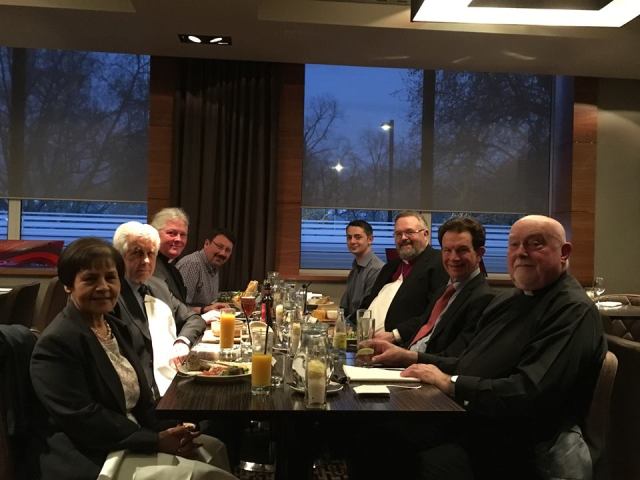
mealHere are a few of us at table on the evening before the Synod. This dinner has become a custom for those of us who stay Friday night in London.

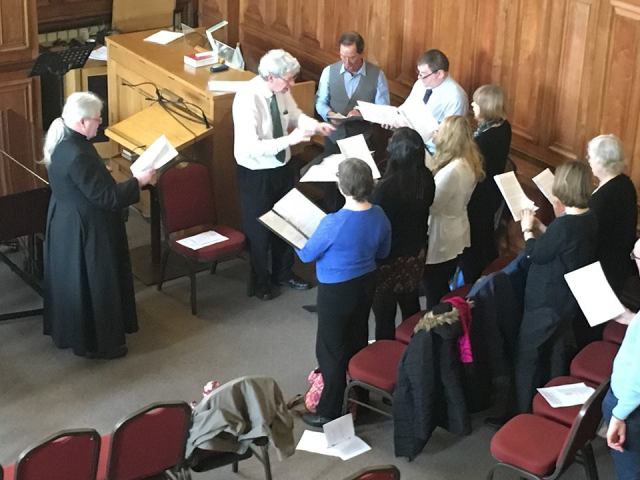
choir-rehearsalI had no liturgical role at the Mass, so I lent my voice to the choir which sang the proper of the Mass of Our Lady in polyphony and a nice Latin Tantum Ergo (unknown composer). This photo is of the rehearsal before Mass.

This is a recording of the Tantum Ergo sung during the rehearsal.

clergy

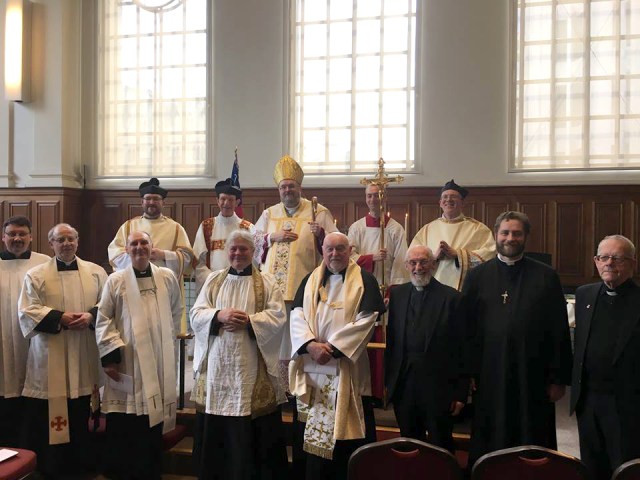
Clergy of the Diocese of the UK in the Anglican Catholic Church, with our new deacon to the Bishop’s right.

Posted in Uncategorized | Tagged , | 3 Comments